Once again, an amazing commentary. She points out the obvious – that an animal-focused diet is the leading cause of chronic sickness and disease. But, even more, it’s illogical that those who expound on a fully animal-focused diet that makes humans sick actually are for animal testing in an attempt to cure these actual diseases! Yet, animal testing does not work, so it’s a vicious circle. The only true way to prevent them is jus that – look to living prevent ably vs. reactionary. Here is a quick quote from the commentary below:
“We never hear researchers or animal-testing advocates address this ethical question. Why not? Well, one answer is that there is not a lot of money in seriously promoting prevention, so doctors and pharmaceutical companies are happy to oblige their patients. An entire mega-industry is supported by this kind of irresponsibility and greed, and it rides on the backs of animals.”
Commentary:
Eat, Drink and Be Merry: Let the Animals Pick Up the Tab
http://www.americanchronicle.com/articles/
viewArticle.asp?articleID=9230
Gayle Dean
Gayle Dean is a freelance writer, outdoorswoman, and cruciverbalist. Her work has appeared in The New York Times, Washington Post Magazine, L.A. Times, Simon & Schuster books, Dell puzzle magazines, River Runner and Men's News Daily. Gayle's puzzle book series (Wordplay Crosswords) was published by Merriam-Webster.
May 8, 2006
When animal-rights activists criticize animal-testing, and forums are provided for public response, someone always insists that animal-testing is vital for finding treatments for the millions with chronic diseases like cancer, diabetes, and heart disease. They believe animal sacrifice is morally required to save these sick people. Setting aside whether animal-testing yields good results for treating human disease (and there is a lot of doubt about it), many people accept this moral justification without question. Inevitably, they will say: "Well, people with cancer and heart-disease wouldn't agree with you." Or they'll say, "I'll bet you sing a different tune when you get cancer!"
But there is a big problem:
The diseases that cause most of the illnesses and death in the United States are chronic diseases like cancer, diabetes, and heart disease. And these diseases are most often due to lifestyle choices, which means they are largely preventable.
According to the American Cancer Society:
Tobacco use, physical inactivity, obesity, and poor nutrition are major preventable causes of cancer and other diseases in the US. The American Cancer Society estimates that in 2006, more than 170,000 cancer deaths will be caused by tobacco use alone. In addition, scientists estimate that approximately one-third (188, 277) of the 564, 830 cancer deaths expected to occur in 2006 will be related to poor nutrition, physical inactivity, overweight, and obesity.
This means that roughly two-thirds of all cancer deaths are due to lifestyle choices and are preventable. Two-thirds! And those estimates don't even include the less deadly afflictions like arthritis, inflammatory bowel disease, ulcers, cataracts, or common ailments like flus, colds, constipation, etc. -- many of which are also caused or exacerbated by diet and lifestyle.
The American Heart Association agrees that heart disease is "mostly preventable." The American Diabetic Association publishes similar estimates and analysis. In other words, the major killer diseases are largely self-inflicted.
People know all this, but they still refuse to stop smoking, change their diets, lose weight, exercise or make other beneficial lifestyle changes. Doctors suggest all these "cures" in a casual way, but they know that most people will not make the recommended changes. As members of the instant gratification generation, people would rather abuse themselves now, and call on doctors later, to prescribe the newest little purple pill or perform the latest heart-bypass procedure to treat problems that could have been prevented in the first place.
The serious ethical question is this: why should millions of innocent animals be tortured and sacrificed to find treatments for largely self-inflicted diseases in people who refuse to take responsibility for their own choices?
Granted, some people do make responsible lifestyle choices and still get disease. But if we accept scientists' estimates that two-thirds of the major diseases are caused by diet, nutrition, and other lifestyle choices, we could at least significantly reduce animal testing. The majority with self-inflicted chronic diseases must face the moral dilemma. It should not just be accepted as a given that when people are irresponsible, animals can be tormented and sacrificed to save them.
We never hear researchers or animal-testing advocates address this ethical question. Why not? Well, one answer is that there is not a lot of money in seriously promoting prevention, so doctors and pharmaceutical companies are happy to oblige their patients. An entire mega-industry is supported by this kind of irresponsibility and greed, and it rides on the backs of animals.
Gayle Dean is a freelance writer, outdoorswoman, and cruciverbalist. Her work has appeared in The New York Times, Washington Post Magazine, L.A. Times, Simon & Schuster books, Dell puzzle magazines, River Runner and Men's News Daily. Gayle's puzzle book series (Wordplay Crosswords) was published by Merriam-Webster.
Friday, May 19, 2006


Pop Artist Pink Joins In Call for Queen to Withdraw the Bearskin Hats Worn By Her Palace Guards
I’ll be honest, I’ve never even heard Pink. Yet, this is an excellent way for her to use her coverage. The use of bearskin hats is an outdated, archaic and cruel practice.
Article:
Pink in animal rights plea to Queen
http://uk.news.launch.yahoo.com/dyna/article.html?a=/
18052006/344/
pink-animal-rights-plea-queen.html&e=l_news_dm
(Thursday May 18, 2006 04:49 PM)
Pop star Pink has asked the Queen to withdraw the bearskin hats worn by her Palace guards.
The singer wrote a letter to the monarch at Buckingham Palace saying: "Sorry to be a royal pain, but my feelings reflect the sentiment of a new generation that respects animals."
She is supporting a campaign by the animal rights group PETA to replace the hats with ones made of fake far.
Pink is due to perform in front of the Prince of Wales, the Duchess of Cornwall and William and Harry at the Prince's Trust 30th anniversary concert at the Tower of London on Saturday.
She wrote: "From what I hear, you're a modern monarch - I've even checked out your website. So if you haven't already, please visit PETA.org.uk, where you can see for yourself the distressing footage of what happens to these bears in Canada.
"Britain's reputation as a nation of animal lovers is being tarnished by these money-grabbing hunters. I know that your Army Drummers' cool leopard-skin aprons are synthetic and that the Royal Horse Artillery has fabulous faux-beaver caps.
"Isn't it about time that your five Regiments of Foot Guards joined your other ranks by replacing real fur?"
PETA argues that it can take the entire hide of a Canadian black bear to make just one guard's headpiece.
The towering black hats date back almost 200 years and are a familiar sight outside Buckingham Palace and in ceremonies such as Trooping the Colour.
The bearskin was thought to have been adopted after the defeat of Napoleon's Imperial Guard at Waterloo in 1815.
Article:
Pink in animal rights plea to Queen
http://uk.news.launch.yahoo.com/dyna/article.html?a=/
18052006/344/
pink-animal-rights-plea-queen.html&e=l_news_dm
(Thursday May 18, 2006 04:49 PM)
Pop star Pink has asked the Queen to withdraw the bearskin hats worn by her Palace guards.
The singer wrote a letter to the monarch at Buckingham Palace saying: "Sorry to be a royal pain, but my feelings reflect the sentiment of a new generation that respects animals."
She is supporting a campaign by the animal rights group PETA to replace the hats with ones made of fake far.
Pink is due to perform in front of the Prince of Wales, the Duchess of Cornwall and William and Harry at the Prince's Trust 30th anniversary concert at the Tower of London on Saturday.
She wrote: "From what I hear, you're a modern monarch - I've even checked out your website. So if you haven't already, please visit PETA.org.uk, where you can see for yourself the distressing footage of what happens to these bears in Canada.
"Britain's reputation as a nation of animal lovers is being tarnished by these money-grabbing hunters. I know that your Army Drummers' cool leopard-skin aprons are synthetic and that the Royal Horse Artillery has fabulous faux-beaver caps.
"Isn't it about time that your five Regiments of Foot Guards joined your other ranks by replacing real fur?"
PETA argues that it can take the entire hide of a Canadian black bear to make just one guard's headpiece.
The towering black hats date back almost 200 years and are a familiar sight outside Buckingham Palace and in ceremonies such as Trooping the Colour.
The bearskin was thought to have been adopted after the defeat of Napoleon's Imperial Guard at Waterloo in 1815.
Thursday, May 18, 2006
Death-Row Animals At Roicy Duhon Animal Control Center in Lafayette, Louisiana: Victims Of Katrina: Can You Or Those You Know Help Via Adoption
From another group. Please read and view pictures below. If you can help, please do so. Even cross posting can help as you will read. In short, if you have the time and money, go down there and save a few lives! It’s that simple!
Posting:
This quick-kill gas chamber facility is certainly in overflow due to hurricanes.
One person cross-posted to a Basset Hound rescue list, and a Roicy dog was saved. Every effort makes a difference. I personally thank all of you for months and months of
commitment and caring.
Out-Of-Town Adoptions
Out of town rescues and adoptions are welcomed, but you must come in person
or work through a contact here. The shelter will not ship, arrange your
transport, or hold these animals until you can arrange transport.
Out of town adoptions are welcomed:
- You must come in person or have the help of a local friend or relative.
- Rescues must furnish proof of 501(c)(3) status, spay/neuther policy,
adoption policies.
- Fax above forms in advance to Virginia Lee: fax - 337-291-7051.
As expected at this time of year, there are lots of puppies and kittens
coming in. Although the shelter gives them more time, they do not stay
healthy for long. My pick is the most wonderful black Lab you have ever met
in your life. If you are looking for a gentle family dog, pick him. How
anyone could owner surrender him is beyond me. There is also a stunning, 1.5
year old chocolate Lab named Isis who has been owner surrendered.
If you can commit to 60-day minimum as a foster home, contact ASAP:
Jennifer Rohrbach, whippetdogs@yahoo.com or Debbie, rescuerealtor@cox.net
Animals facing gas chamber (Petfinder list - http://www.petfinder.com/):
Cut and paste each into your browser or contact people above:
http://search.petfinder.com/shelterSearch/shelterSearch.cgi?animal=
&bree
d=&age=&size=&specialNeeds=&declawedPets=&children=&
status=&id=&internal=&contact=&name=&shelterid=LA40&
sort=&preview=1
http://search.petfinder.com/shelterSearch/shelterSearch.cgi?animal=
&bree
d=&age=&size=&specialNeeds=&declawedPets=&children=&
status=&id=&internal=&contact=&name=&shelterid=LA40&
sort=&preview=1
http://search.petfinder.com/shelterSearch/shelterSearch.cgi?animal=
&bre
ed=&age=&size=&specialNeeds=&declawedPets=&children=&
;status=&id=&internal=&contact=&name=&shelterid=LA40&
;sort=&preview=1#
http://search.petfinder.com/shelterSearch/shelterSearch.cgi?animal=
&bree
d=&age=&size=&specialNeeds=&declawedPets=&children=&
status=&id=&internal=&contact=&name=&shelterid=LA40&
sort=&preview=1#
http://www.petfinder.com/fotos/LA40/LA40.6299913-1-x.jpg
http://search.petfinder.com/shelterSearch/shelterSearch.cgi?animal=
&bree
d=&age=&size=&specialNeeds=&declawedPets=&children=&
status=&id=&internal=&contact=&name=&shelterid=LA40&
sort=&preview=1#
http://search.petfinder.com/shelterSearch/shelterSearch.cgi?animal=
&bree
d=&age=&size=&specialNeeds=&declawedPets=&children=&
status=&id=&internal=&contact=&name=&shelterid=LA40&
sort=&preview=1#
http://search.petfinder.com/shelterSearch/shelterSearch.cgi?animal=
&bree
d=&age=&size=&specialNeeds=&declawedPets=&children=&
status=&id=&internal=&contact=&name=&shelterid=LA40&
sort=&preview=1#
http://search.petfinder.com/shelterSearch/shelterSearch.cgi?animal=
&bre
ed=&age=&size=&specialNeeds=&declawedPets=&children=&
;status=&id=&internal=&contact=&name=&shelterid=LA40&
;sort=&preview=1#
">">http://search.petfinder.com/shelterSearch/shelterSearch.cgi?animal=
&
breed=&age=&size=&specialNeeds=&declawedPets=&children=&
amp;status=&id=&internal=&contact=&name=&shelterid=LA40&
amp;sort=&preview=1#>
http://search.petfinder.com/shelterSearch/shelterSearch.cgi?animal=
&bre
ed=&age=&size=&specialNeeds=&declawedPets=&children=&
;status=&id=&internal=&contact=&name=&shelterid=LA40&
;sort=&preview=1#
http://search.petfinder.com/shelterSearch/shelterSearch.cgi?animal=
&bree
d=&age=&size=&specialNeeds=&declawedPets=&children=&
status=&id=&internal=&contact=&name=&shelterid=LA40&
sort=&preview=1#
http://search.petfinder.com/shelterSearch/shelterSearch.cgi?animal=
&bree
d=&age=&size=&specialNeeds=&declawedPets=&children=&
status=&id=&internal=&contact=&name=&shelterid=LA40&
sort=&preview=1#
http://search.petfinder.com/shelterSearch/shelterSearch.cgi?animal=
&bree
d=&age=&size=&specialNeeds=&declawedPets=&children=&
status=&id=&internal=&contact=&name=&shelterid=LA40&
sort=&preview=1#
">http://search.petfinder.com/shelterSearch/shelterSearch.cgi?animal=
&
breed=&age=&size=&specialNeeds=&declawedPets=&children=&
amp;status=&id=&internal=&contact=&name=&shelterid=LA40&
amp;sort=&preview=1#>
eed=&age=&size=&specialNeeds=&declawedPets=&children=&am
p;status=&id=&internal=&contact=&name=&shelterid=LA40&am
p;sort=&preview=1#
http://search.petfinder.com/shelterSearch/shelterSearch.cgi?animal=
&bree
d=&age=&size=&specialNeeds=&declawedPets=&children=&
status=&id=&internal=&contact=&name=&shelterid=LA40&
sort=&preview=1#
http://search.petfinder.com/shelterSearch/shelterSearch.cgi?animal=
&bre
ed=&age=&size=&specialNeeds=&declawedPets=&children=&
;status=&id=&internal=&contact=&name=&shelterid=LA40&
;sort=&preview=1#
Posting:
This quick-kill gas chamber facility is certainly in overflow due to hurricanes.
One person cross-posted to a Basset Hound rescue list, and a Roicy dog was saved. Every effort makes a difference. I personally thank all of you for months and months of
commitment and caring.
Out-Of-Town Adoptions
Out of town rescues and adoptions are welcomed, but you must come in person
or work through a contact here. The shelter will not ship, arrange your
transport, or hold these animals until you can arrange transport.
Out of town adoptions are welcomed:
- You must come in person or have the help of a local friend or relative.
- Rescues must furnish proof of 501(c)(3) status, spay/neuther policy,
adoption policies.
- Fax above forms in advance to Virginia Lee: fax - 337-291-7051.
As expected at this time of year, there are lots of puppies and kittens
coming in. Although the shelter gives them more time, they do not stay
healthy for long. My pick is the most wonderful black Lab you have ever met
in your life. If you are looking for a gentle family dog, pick him. How
anyone could owner surrender him is beyond me. There is also a stunning, 1.5
year old chocolate Lab named Isis who has been owner surrendered.
If you can commit to 60-day minimum as a foster home, contact ASAP:
Jennifer Rohrbach, whippetdogs@yahoo.com or Debbie, rescuerealtor@cox.net
Animals facing gas chamber (Petfinder list - http://www.petfinder.com/):
Cut and paste each into your browser or contact people above:
http://search.petfinder.com/shelterSearch/shelterSearch.cgi?animal=
&bree
d=&age=&size=&specialNeeds=&declawedPets=&children=&
status=&id=&internal=&contact=&name=&shelterid=LA40&
sort=&preview=1
http://search.petfinder.com/shelterSearch/shelterSearch.cgi?animal=
&bree
d=&age=&size=&specialNeeds=&declawedPets=&children=&
status=&id=&internal=&contact=&name=&shelterid=LA40&
sort=&preview=1
http://search.petfinder.com/shelterSearch/shelterSearch.cgi?animal=
&bre
ed=&age=&size=&specialNeeds=&declawedPets=&children=&
;status=&id=&internal=&contact=&name=&shelterid=LA40&
;sort=&preview=1#
http://search.petfinder.com/shelterSearch/shelterSearch.cgi?animal=
&bree
d=&age=&size=&specialNeeds=&declawedPets=&children=&
status=&id=&internal=&contact=&name=&shelterid=LA40&
sort=&preview=1#
http://www.petfinder.com/fotos/LA40/LA40.6299913-1-x.jpg
http://search.petfinder.com/shelterSearch/shelterSearch.cgi?animal=
&bree
d=&age=&size=&specialNeeds=&declawedPets=&children=&
status=&id=&internal=&contact=&name=&shelterid=LA40&
sort=&preview=1#
http://search.petfinder.com/shelterSearch/shelterSearch.cgi?animal=
&bree
d=&age=&size=&specialNeeds=&declawedPets=&children=&
status=&id=&internal=&contact=&name=&shelterid=LA40&
sort=&preview=1#
http://search.petfinder.com/shelterSearch/shelterSearch.cgi?animal=
&bree
d=&age=&size=&specialNeeds=&declawedPets=&children=&
status=&id=&internal=&contact=&name=&shelterid=LA40&
sort=&preview=1#
http://search.petfinder.com/shelterSearch/shelterSearch.cgi?animal=
&bre
ed=&age=&size=&specialNeeds=&declawedPets=&children=&
;status=&id=&internal=&contact=&name=&shelterid=LA40&
;sort=&preview=1#
">">http://search.petfinder.com/shelterSearch/shelterSearch.cgi?animal=
&
breed=&age=&size=&specialNeeds=&declawedPets=&children=&
amp;status=&id=&internal=&contact=&name=&shelterid=LA40&
amp;sort=&preview=1#>
http://search.petfinder.com/shelterSearch/shelterSearch.cgi?animal=
&bre
ed=&age=&size=&specialNeeds=&declawedPets=&children=&
;status=&id=&internal=&contact=&name=&shelterid=LA40&
;sort=&preview=1#
http://search.petfinder.com/shelterSearch/shelterSearch.cgi?animal=
&bree
d=&age=&size=&specialNeeds=&declawedPets=&children=&
status=&id=&internal=&contact=&name=&shelterid=LA40&
sort=&preview=1#
http://search.petfinder.com/shelterSearch/shelterSearch.cgi?animal=
&bree
d=&age=&size=&specialNeeds=&declawedPets=&children=&
status=&id=&internal=&contact=&name=&shelterid=LA40&
sort=&preview=1#
http://search.petfinder.com/shelterSearch/shelterSearch.cgi?animal=
&bree
d=&age=&size=&specialNeeds=&declawedPets=&children=&
status=&id=&internal=&contact=&name=&shelterid=LA40&
sort=&preview=1#
&
breed=&age=&size=&specialNeeds=&declawedPets=&children=&
amp;status=&id=&internal=&contact=&name=&shelterid=LA40&
amp;sort=&preview=1#>
p;status=&id=&internal=&contact=&name=&shelterid=LA40&am
p;sort=&preview=1#
http://search.petfinder.com/shelterSearch/shelterSearch.cgi?animal=
&bree
d=&age=&size=&specialNeeds=&declawedPets=&children=&
status=&id=&internal=&contact=&name=&shelterid=LA40&
sort=&preview=1#
http://search.petfinder.com/shelterSearch/shelterSearch.cgi?animal=
&bre
ed=&age=&size=&specialNeeds=&declawedPets=&children=&
;status=&id=&internal=&contact=&name=&shelterid=LA40&
;sort=&preview=1#
Don't Let Jaguars Fall Victim to Border Control: Amendment Put Forth To the Immigration Bill Would Address Many of These Issues: How to Support It
From another group. Important to read and support:
Illegal immigration -- and America's efforts to control it --
has taken a heavy toll on America's border wildlife. But this
week we have a chance to do something to protect the jaguars, wolves
and other wildlife along our borders.
The Senate is now considering its immigration bill. Please call your
Senators and urge them to support wildlife-sensitive border security:
http://action.defenders.org/site/R?i=Y-9XRC8i_YkIIy-vBik_Fw
About half of the land along the Mexican border and a quarter of the
land along the Canadian border are federal and tribal lands. These
areas include national parks, monuments, wildlife refuges, forests and
wilderness. Jaguars, the highly endangered Sonoran pronghorn, desert
tortoises and other imperiled wildlife all make their home in these
beautiful and often remote places.
Unfortunately, Border Patrol activities and illegal crossings have
severely damaged these sensitive areas in ways that could take decades
to repair.
A decade ago, the Border Patrol increased enforcement efforts in urban
areas, shifting undocumented border crossings into more remote areas.
These crossings and efforts to stop them -- have serious impacts for
sensitive desert habitat and the wildlife that needs it to survive.
* Trails and roads carved by illegal immigrants can destroy
sensitive vegetation and wildlife habitat. The fragile desert
soils and plants could take over a century to recover.
* Trash and human waste left behind during illegal border
crossings affect soil and water quality. Abandoned vehicles are
expensive to remove and towing them causes additional damage.
* Similarly, low-level helicopter flights by the Border Patrol
disturb wildlife and habitat areas. Off-road vehicle patrols
also damage sensitive regions vital to local wildlife. And U.S.
road, light, and fence-building projects disturb wildlife,
destroy habitat and shift animal migratory patterns.
Senators Craig Thomas (R-WY), John Kyl (R-AZ), Ken Salazar (D-CO) and Jeff Bingaman (D-NM) have offered an amendment to the immigration bill that would address many of these issues, and Defenders is urging wildlife supporters to support it.
Help support responsible border control efforts. The Senate could vote
on the immigration bill any minute, so please call your Senators now
(if they don't answer, please leave a message).
http://action.defenders.org/site/R?i=pGqs8gqqtzSuWrjjgw2xnw
Thanks for standing up for sensible border security and responsible
management of our country's borderlands and the precious
wildlife that lives there.
Sincerely,
Rodger Schlickeisen
President
Defenders of Wildlife
Illegal immigration -- and America's efforts to control it --
has taken a heavy toll on America's border wildlife. But this
week we have a chance to do something to protect the jaguars, wolves
and other wildlife along our borders.
The Senate is now considering its immigration bill. Please call your
Senators and urge them to support wildlife-sensitive border security:
http://action.defenders.org/site/R?i=Y-9XRC8i_YkIIy-vBik_Fw
About half of the land along the Mexican border and a quarter of the
land along the Canadian border are federal and tribal lands. These
areas include national parks, monuments, wildlife refuges, forests and
wilderness. Jaguars, the highly endangered Sonoran pronghorn, desert
tortoises and other imperiled wildlife all make their home in these
beautiful and often remote places.
Unfortunately, Border Patrol activities and illegal crossings have
severely damaged these sensitive areas in ways that could take decades
to repair.
A decade ago, the Border Patrol increased enforcement efforts in urban
areas, shifting undocumented border crossings into more remote areas.
These crossings and efforts to stop them -- have serious impacts for
sensitive desert habitat and the wildlife that needs it to survive.
* Trails and roads carved by illegal immigrants can destroy
sensitive vegetation and wildlife habitat. The fragile desert
soils and plants could take over a century to recover.
* Trash and human waste left behind during illegal border
crossings affect soil and water quality. Abandoned vehicles are
expensive to remove and towing them causes additional damage.
* Similarly, low-level helicopter flights by the Border Patrol
disturb wildlife and habitat areas. Off-road vehicle patrols
also damage sensitive regions vital to local wildlife. And U.S.
road, light, and fence-building projects disturb wildlife,
destroy habitat and shift animal migratory patterns.
Senators Craig Thomas (R-WY), John Kyl (R-AZ), Ken Salazar (D-CO) and Jeff Bingaman (D-NM) have offered an amendment to the immigration bill that would address many of these issues, and Defenders is urging wildlife supporters to support it.
Help support responsible border control efforts. The Senate could vote
on the immigration bill any minute, so please call your Senators now
(if they don't answer, please leave a message).
http://action.defenders.org/site/R?i=pGqs8gqqtzSuWrjjgw2xnw
Thanks for standing up for sensible border security and responsible
management of our country's borderlands and the precious
wildlife that lives there.
Sincerely,
Rodger Schlickeisen
President
Defenders of Wildlife
Article Points Out Mislead Obsession of the FBI and the Government on People Involved In Animal Rights vs. Real Right Wing Terrorist Organizations
You'll also be amazed at her description of what occurs when the FBI invites people to speak. As well as how little they actually know about these issues and even some disturbing truth on how the new anti-animal rights, pro-business laws will affect activism in years to come. A must read.
Excellent article that points out not only the mislead obsession of the FBI and the government on people involved in animal rights, but also how they attempt to get information. Of particular importance is the fact that is well known and supported by lots of evidence. That is, that animal rights related actions from the ALF are less than those from extreme right wing groups and have NEVER KILLED OR HARMED ANYONE. In contrast, right wing groups HAVE KILLED PEOPLE and harmed many. So why does the government focus then on the ALF related actions? Easy, to protect their friends. Here’s some quotes from the article below with related facts to back up what I’m saying:
“The FBI has designated the ALF as America’s number one domestic terrorist threat, in spite of the fact that those acting on its behalf have never physically harmed anyone. The same cannot be said of unions, who have reportedly instigated 2,193 acts of violence in the last ten years—including near fatal injuries--and anti-abortion activists who have made 13,256 attacks in the past three decades against doctors and clinics, including murders, kidnappings and bombings. By comparison, ALF-attributed actions are quite rare.
In 2003, hate crimes totaled approximately 7,400 and recognized violations of environmental laws by corporations hit 450. Senator Barak Obama says he is baffled as to why the ALF is the foremost target, since the FBI itself has stated that ALF-attributed crimes are on the decline.
In Congressional Quarterly, Justin Rood argues that the US government is silencing free speech from the political left while ignoring those on the radical right, and the American Civil Liberties Union suggests that the government is attempting to quell controversial ideas by targeting mainstream animal and environmental groups, peace activists and others who participate in lawful protest when in fact they “should be investigating real terrorists.”
Article:
My Adventure Presenting Animal Rights Philosophy to the FBI
http://www.americanchronicle.com/articles/
viewArticle.asp?articleID=9510
Charlotte Laws, Ph.D.
http://www.charlottelaws.org/
May 16, 2006
On April 13, 2006, I received a strange phone call at my Los Angeles home from an FBI Special Agent Instructor. I’ll call him Andy.
It was strange because the FBI had never before contacted me. Did I breach some obscure statute? I remembered a book of “absurd laws,” which said that in my neighborhood it was illegal to spit on the sidewalk, drive in a housecoat or allow animals to mate publicly within 1,500 feet of a school or church. Had my little, white terrier been committing impure acts at Erwin Elementary?
It turned out Special Agent Andy wanted me to fly to Quantico, Virginia (near Washington D.C.) to lecture law enforcement executives and managers from around the world about animal philosophy, keeping in mind “the mindset and methodologies of terrorists and the government’s response.”
It was an unusual request—even for an animal rights advocate, such as myself, with a doctorate in philosophy--so I did what anyone would do: I contacted my family, friends and criminal attorney.
I don’t really have a criminal attorney, but I have a friend who regularly handles high-profile cases. He furrowed his bushy brow and cautioned, “Don’t do anything. Let me check this out first. The FBI railroad innocent people all the time.”
My anxiety multiplied when an animal person said, “only traitors talk to the government” and a non-animal friend advised me to take a lawyer with me and to refuse to “name names” when “testifying before the House Un-American Activities Committee.”
“I don’t have any names,” I protested, but then remembered a particularly annoying local journalist who had infuriated much of the Los Angeles community. Nah, I thought, it would be inappropriate to use the FBI for the purpose of revenge.
A Los Angeles Police Department friend offered the only encouragement, “It is an honor to be invited. Don’t worry. I’ll tell them you’re not a subversive and not to arrest you until after our tennis match next week.” She laughed.
I felt the real purpose behind the FBI’s invitation had to do with their misguided aim to infiltrate the Animal Liberation Front (ALF), which cannot be infiltrated because it is an ideology rather than an organization. There are no meetings, mailing lists or membership cards. Anybody can claim to be a member of the ALF when rescuing animals, destroying “tools of torture” (such as research equipment) or financially depleting a corporation that abuses animals; as long as he or she does not injure a human or nonhuman in the process.
The FBI has designated the ALF as America’s number one domestic terrorist threat, in spite of the fact that those acting on its behalf have never physically harmed anyone. The same cannot be said of unions, who have reportedly instigated 2,193 acts of violence in the last ten years—including near fatal injuries--and anti-abortion activists who have made 13,256 attacks in the past three decades against doctors and clinics, including murders, kidnappings and bombings. By comparison, ALF-attributed actions are quite rare.
In 2003, hate crimes totaled approximately 7,400 and recognized violations of environmental laws by corporations hit 450. Senator Barak Obama says he is baffled as to why the ALF is the foremost target, since the FBI itself has stated that ALF-attributed crimes are on the decline.
In Congressional Quarterly, Justin Rood argues that the US government is silencing free speech from the political left while ignoring those on the radical right, and the American Civil Liberties Union suggests that the government is attempting to quell controversial ideas by targeting mainstream animal and environmental groups, peace activists and others who participate in lawful protest when in fact they “should be investigating real terrorists.”
As an animal advocate for the past 25 years, I have only heard of two illegal animal-related actions, and both were committed by carnivores indifferent to the animal movement. One contemplated attributing his lawless act to the ALF, and the other might have done so under the right circumstances.
The first “villain” was an elderly attorney, who broke into his own home to rescue his two, pet pigeons after it had had been padlocked by health department officials. The man had been told that he would be thrown into jail without the possibility of bail if he were to set foot on the property. His equally villainous university professor friend manned the getaway car. Neither were vegetarians. Neither was young or agile. And prior to this, neither had committed what the FBI might call a “terrorist act.” They cut off the oversized padlock and rescued two, healthy pigeons on an autumn night in 2005. They have escaped arrest to this day, but are not on the run.
The second “terrorist” was, in fact, a remorseful vivisectionist who would sneak animals off the premises before slaughter and place them in loving homes. If his superior had questioned the disappearance of “specimens,” the researcher, in order to retain his job, could have simply pointed his finger at the ALF.
Decision day arrived, and my criminal attorney gave me the flickering yellow light, warning me that my visit to the Academy would prompt the FBI to open a file on me.
“Well, I plan to open a file on them, too,” I assured him. “But, I promise not to put any falsehoods in my file if they don’t put any falsehoods in theirs.”
“Go if you want. It’s legit, but take my number in case.”
My plan was to serve as an ambassador for the animal rights movement and to convey through my lecture the truth about how animals suffer under human oppression, as well as to present philosophical arguments as to why animals are of equal value to humans and worthy of equal consideration. I wanted my audience to understand that anti-terrorism resources should be used to combat dangerous groups who fly planes into buildings, rather than renegade gerbil lovers. It would not be realistic to suggest that animal-related “crimes” be ignored, but I argued they be deprioritized in an age when chemical, biological and nuclear warfare are possible.
An ominous feeling tented the empty road and thick woods in Quantico, and the sound of guns slammed through the air. I met Special Agent Andy, a fine host for the FBI, at the first security checkpoint, and he immediately drove me past a sign, which read, “Danger. Field Firing in Process.” Was this disclaimer the result of an accident? Perhaps a speaker had been shot in her compact rental car. I scanned for stray bullets.
Andy took me on a brief tour of the grounds, pointing out a pretend town called Hogan’s Alley with fake storefronts, including a bank in which actors are hired at $12.00 per hour to play “robber,” “hostage” or “drug dealer” with FBI trainees.
I laughed, “Do the actors ever win?” Andy gave me a stern look, “We take that very seriously. It is not good to get shot even in playtime.”
Andy had a penchant—as did all the agents I met—for comparing their work with crime shows and movies. At one point he mentioned, “We (the FBI) are more like Barney Miller than James Bond. More paperwork than adventure.” In many ways, the afternoon was a crash course in TV trivia.
The presentation room was a small lecture hall with a podium, microphone and display screen for the speaker, and fixed seats on ascending levels for attendees. I was told that two FBI psychologists would sit in on my lecture. Although the psychologists were charming, I felt their aim was to scrutinize me, to learn how to squash the animal rights movement. I felt the others were there to learn.
My presentation began with undercover video footage inside a vivisection lab. It showed a man in a white coat pounding on a Beagle puppy and forcing tubes down several dogs’ throats; the animals were clearly in distress. I surmised cleaning liquids or pesticides would be poured down the tubes since they were routinely tested at this lab. In another clip, monkeys screamed while their penises were electrocuted by scientists.
Andy shouted from the back of the room, “The FBI will prosecute this sort of cruelty if videos like this are brought to our attention.”
I pointed out that obtaining undercover video is illegal in itself, even more so with the advent of the Animal Enterprise Terrorism Act, which states that a person can be prosecuted if he or she causes over $10,000 worth of economic damage to a corporation that uses animals. Showing undercover video could cause investors to sell their stocks, decimating profits. Those who unveil the video could face time in prison and fines.
In addition, I told the crowd that it was unlikely the barbarous treatment of dogs and monkeys in the footage was against the law. And even if it was, prosecution tends to result in nothing more than a slap on the wrist. Because animals are property, and the law generally finds it acceptable to use and kill animals for human gain, imposing prison terms and steep fines on large corporations—who have even larger lawyers--is rare.
During my lecture, I was able to get several law enforcement executives to admit openly that they would break the law, if necessary, to rescue an animal in distress, although they did not specifically agree to break into a research lab or factory farm. This was quite an accomplishment because prior to the presentation, Andy had privately told me that any FBI agent who did not or could not (for ethical reasons) uphold all US laws would be fired. My audience was mostly non-FBI so they surely kept their jobs.
Andy was keen on discussing “solutions” for bridging the gap between “them and us,” although he hinted that the Bureau’s favored tactic was to develop a network of spies within the animal movement who would report illegal actions. I told Andy this strategy was sure to fail because I had been a loyal animal rights person for 25 years, and had only heard about two so-called criminals: the aforementioned renegade researcher and pigeon man, neither connected to the movement.
I was pleased with Andy’s desire to better the relationship between law enforcement and animal rights activists and offered the following suggestions. First, I said that law enforcement could advise the President and Congress to support legislation that improves the situation for nonhumans and to enforce existing anti-cruelty laws. The FBI could also place “weeding out animal cruelty” higher on its “to do” list.
Secondly, I suggested that the FBI work on bettering its image and investigate real terrorists rather than plunging into what is perceived as a modern-day Inquisition. It was both curious and alarming that every person who found out about my speaking engagement “freaked out.” This mistrust no doubt largely stemmed from the problematic history of the FBI; which is detailed in Richard Gid Powers’ book, Broken: The Troubled Past and Uncertain Future of the FBI. Powers argues that the Bureau hones in on any issue that “represent(s) the fears and hatred of the masses or classes,” rather than investigating those crimes that most offend the law or pose the gravest danger, an allegation that coincides with what animal and environmental supporters call today’s “Green Scare.”
Beginning with the FBI’s inception in the early 1900’s, Powers’ book moves through the FBI’s “witch hunts” against “whomever might be the public enemy of the day.” There was the “White Slavery Scare,” which was embarked upon due to a racist fear by Whites about the increasing power of Blacks, the “Adultery Scare,” and the notorious “Red Scare,” among others.
Today, a substantial number of people feel the Patriot Act is used for political reasons, and the ACLU charges that the FBI is spying on and examining the records of thousands of law-abiding US citizens. Andy says these allegations are untrue and that the Bureau supports free speech and lawful protest. He adds that simply tapping a phone takes excessive manpower; therefore, would only be reserved for someone who is a substantial threat.
My third suggestion was that law enforcement officers make good “situation ethics” decisions. Even though Andy insisted laws are not malleable, I know there is always the exercise of discretion and could tell lecture attendees agreed by their nodding heads. I pointed out situations in which police officers have leeway to make decisions that directly affect the life or safety of animals.
For example, during the Katrina disaster, some officers allowed people to evacuate with their animals; others did not. At a burning apartment building in Tennessee in 2003, police and firefighters refused to allow a man to rescue his trapped dog who was clawing at the glass of a sliding door. The man eventually ignored law enforcement’s orders and rescued his dog. He was handcuffed and charged with misdemeanors, outraging the public and arguably tarnishing the reputation of local law enforcement. If the man’s two-year-old daughter had been clawing at the glass, would law enforcement have told him to “stand back and let the child die?”
As a finale to my lecture, I questioned why the only difference between a criminal and a terrorist--according to the US Code of Federal Regulations as listed on the FBI website--relates to the latter’s desire to further “political or social objectives.” The word “terrorist” evokes the image of an evil person while the word “criminal” has a less pejorative connotation, even when the offenses are the same.
One can only assume that “furthering political or social objectives” frightens those in power, who crave to maintain the status quo. Perhaps those who control society—such as corporations, government entities and media conglomerates--fear the ideology of an animal liberationist could catch hold and topple them from their golden thrones, reducing their animal product profits and a overturning a lifestyle which requires nonhumans be seen as means to a human end. Is this the true reason behind branding the ALF as “terrorists?”
After the lecture, Andy asked me, “Could you come back and speak again?”
“I doubt it. Unfortunately, I don’t fare well on long plane rides.”
He added, “Well, maybe you could give me the name of someone who could.”
I grinned and replied, “I knew you’d ask me to name names. I have no choice but to report this in my secret file.”
_______________________
Charlotte Laws authors a chapter of the book, Igniting a Revolution: Voices in Defense of Mother Earth (published April 2006), which discusses The Animal Liberation Front.
http://www.charlottelaws.org/
Charlotte Laws is an author, columnist and Greater Valley Glen Councilmember in Southern California. She is the founder and president of the Directors of Animal Welfare (DAWs) [www.DAWprogram.org] and of the League for Earth & Animal Protection (LEAP) [www.LEAPnonprofit.org] Charlotte sits on the Advisory Board for the Center on Animal Liberation Affairs (CALA) and was appointed to serve on the No-Kill Council, chairing the Community Partnerships Committee. Charlotte attained a Ph.D. from the University of Southern California (USC) and holds two Master's Degrees and two Bachelor Degrees. She completed doctoral level coursework at the University of California, Los Angeles (UCLA) and post-doctoral study at Oxford University, England. Charlotte is the author of "Meet the Stars" and "Armed for Ideological Warfare." She also authored a chapter of the 2006 book, "Igniting a Revolution, Voices In Defense of Mother Earth." Charlotte has written articles published in Newsweek, The L.A. Times, Special Report, The Simon, The Oakland Tribune, The Daily News, Publisher's Weekly, E The Environmental Magazine, Opinion Editorials, Buzzle Magazine, The Globe, et al. Her articles and columns explore a variety of topics from philosophy to politics, law, education, real estate, and social issues. Charlotte has been interviewed on the following television shows: Larry King Live, The Late Show, Good Day L.A., NBC News, Inside Edition, Fox News, CBS News, ABC News, etc.
Excellent article that points out not only the mislead obsession of the FBI and the government on people involved in animal rights, but also how they attempt to get information. Of particular importance is the fact that is well known and supported by lots of evidence. That is, that animal rights related actions from the ALF are less than those from extreme right wing groups and have NEVER KILLED OR HARMED ANYONE. In contrast, right wing groups HAVE KILLED PEOPLE and harmed many. So why does the government focus then on the ALF related actions? Easy, to protect their friends. Here’s some quotes from the article below with related facts to back up what I’m saying:
“The FBI has designated the ALF as America’s number one domestic terrorist threat, in spite of the fact that those acting on its behalf have never physically harmed anyone. The same cannot be said of unions, who have reportedly instigated 2,193 acts of violence in the last ten years—including near fatal injuries--and anti-abortion activists who have made 13,256 attacks in the past three decades against doctors and clinics, including murders, kidnappings and bombings. By comparison, ALF-attributed actions are quite rare.
In 2003, hate crimes totaled approximately 7,400 and recognized violations of environmental laws by corporations hit 450. Senator Barak Obama says he is baffled as to why the ALF is the foremost target, since the FBI itself has stated that ALF-attributed crimes are on the decline.
In Congressional Quarterly, Justin Rood argues that the US government is silencing free speech from the political left while ignoring those on the radical right, and the American Civil Liberties Union suggests that the government is attempting to quell controversial ideas by targeting mainstream animal and environmental groups, peace activists and others who participate in lawful protest when in fact they “should be investigating real terrorists.”
Article:
My Adventure Presenting Animal Rights Philosophy to the FBI
http://www.americanchronicle.com/articles/
viewArticle.asp?articleID=9510
Charlotte Laws, Ph.D.
http://www.charlottelaws.org/
May 16, 2006
On April 13, 2006, I received a strange phone call at my Los Angeles home from an FBI Special Agent Instructor. I’ll call him Andy.
It was strange because the FBI had never before contacted me. Did I breach some obscure statute? I remembered a book of “absurd laws,” which said that in my neighborhood it was illegal to spit on the sidewalk, drive in a housecoat or allow animals to mate publicly within 1,500 feet of a school or church. Had my little, white terrier been committing impure acts at Erwin Elementary?
It turned out Special Agent Andy wanted me to fly to Quantico, Virginia (near Washington D.C.) to lecture law enforcement executives and managers from around the world about animal philosophy, keeping in mind “the mindset and methodologies of terrorists and the government’s response.”
It was an unusual request—even for an animal rights advocate, such as myself, with a doctorate in philosophy--so I did what anyone would do: I contacted my family, friends and criminal attorney.
I don’t really have a criminal attorney, but I have a friend who regularly handles high-profile cases. He furrowed his bushy brow and cautioned, “Don’t do anything. Let me check this out first. The FBI railroad innocent people all the time.”
My anxiety multiplied when an animal person said, “only traitors talk to the government” and a non-animal friend advised me to take a lawyer with me and to refuse to “name names” when “testifying before the House Un-American Activities Committee.”
“I don’t have any names,” I protested, but then remembered a particularly annoying local journalist who had infuriated much of the Los Angeles community. Nah, I thought, it would be inappropriate to use the FBI for the purpose of revenge.
A Los Angeles Police Department friend offered the only encouragement, “It is an honor to be invited. Don’t worry. I’ll tell them you’re not a subversive and not to arrest you until after our tennis match next week.” She laughed.
I felt the real purpose behind the FBI’s invitation had to do with their misguided aim to infiltrate the Animal Liberation Front (ALF), which cannot be infiltrated because it is an ideology rather than an organization. There are no meetings, mailing lists or membership cards. Anybody can claim to be a member of the ALF when rescuing animals, destroying “tools of torture” (such as research equipment) or financially depleting a corporation that abuses animals; as long as he or she does not injure a human or nonhuman in the process.
The FBI has designated the ALF as America’s number one domestic terrorist threat, in spite of the fact that those acting on its behalf have never physically harmed anyone. The same cannot be said of unions, who have reportedly instigated 2,193 acts of violence in the last ten years—including near fatal injuries--and anti-abortion activists who have made 13,256 attacks in the past three decades against doctors and clinics, including murders, kidnappings and bombings. By comparison, ALF-attributed actions are quite rare.
In 2003, hate crimes totaled approximately 7,400 and recognized violations of environmental laws by corporations hit 450. Senator Barak Obama says he is baffled as to why the ALF is the foremost target, since the FBI itself has stated that ALF-attributed crimes are on the decline.
In Congressional Quarterly, Justin Rood argues that the US government is silencing free speech from the political left while ignoring those on the radical right, and the American Civil Liberties Union suggests that the government is attempting to quell controversial ideas by targeting mainstream animal and environmental groups, peace activists and others who participate in lawful protest when in fact they “should be investigating real terrorists.”
As an animal advocate for the past 25 years, I have only heard of two illegal animal-related actions, and both were committed by carnivores indifferent to the animal movement. One contemplated attributing his lawless act to the ALF, and the other might have done so under the right circumstances.
The first “villain” was an elderly attorney, who broke into his own home to rescue his two, pet pigeons after it had had been padlocked by health department officials. The man had been told that he would be thrown into jail without the possibility of bail if he were to set foot on the property. His equally villainous university professor friend manned the getaway car. Neither were vegetarians. Neither was young or agile. And prior to this, neither had committed what the FBI might call a “terrorist act.” They cut off the oversized padlock and rescued two, healthy pigeons on an autumn night in 2005. They have escaped arrest to this day, but are not on the run.
The second “terrorist” was, in fact, a remorseful vivisectionist who would sneak animals off the premises before slaughter and place them in loving homes. If his superior had questioned the disappearance of “specimens,” the researcher, in order to retain his job, could have simply pointed his finger at the ALF.
Decision day arrived, and my criminal attorney gave me the flickering yellow light, warning me that my visit to the Academy would prompt the FBI to open a file on me.
“Well, I plan to open a file on them, too,” I assured him. “But, I promise not to put any falsehoods in my file if they don’t put any falsehoods in theirs.”
“Go if you want. It’s legit, but take my number in case.”
My plan was to serve as an ambassador for the animal rights movement and to convey through my lecture the truth about how animals suffer under human oppression, as well as to present philosophical arguments as to why animals are of equal value to humans and worthy of equal consideration. I wanted my audience to understand that anti-terrorism resources should be used to combat dangerous groups who fly planes into buildings, rather than renegade gerbil lovers. It would not be realistic to suggest that animal-related “crimes” be ignored, but I argued they be deprioritized in an age when chemical, biological and nuclear warfare are possible.
An ominous feeling tented the empty road and thick woods in Quantico, and the sound of guns slammed through the air. I met Special Agent Andy, a fine host for the FBI, at the first security checkpoint, and he immediately drove me past a sign, which read, “Danger. Field Firing in Process.” Was this disclaimer the result of an accident? Perhaps a speaker had been shot in her compact rental car. I scanned for stray bullets.
Andy took me on a brief tour of the grounds, pointing out a pretend town called Hogan’s Alley with fake storefronts, including a bank in which actors are hired at $12.00 per hour to play “robber,” “hostage” or “drug dealer” with FBI trainees.
I laughed, “Do the actors ever win?” Andy gave me a stern look, “We take that very seriously. It is not good to get shot even in playtime.”
Andy had a penchant—as did all the agents I met—for comparing their work with crime shows and movies. At one point he mentioned, “We (the FBI) are more like Barney Miller than James Bond. More paperwork than adventure.” In many ways, the afternoon was a crash course in TV trivia.
The presentation room was a small lecture hall with a podium, microphone and display screen for the speaker, and fixed seats on ascending levels for attendees. I was told that two FBI psychologists would sit in on my lecture. Although the psychologists were charming, I felt their aim was to scrutinize me, to learn how to squash the animal rights movement. I felt the others were there to learn.
My presentation began with undercover video footage inside a vivisection lab. It showed a man in a white coat pounding on a Beagle puppy and forcing tubes down several dogs’ throats; the animals were clearly in distress. I surmised cleaning liquids or pesticides would be poured down the tubes since they were routinely tested at this lab. In another clip, monkeys screamed while their penises were electrocuted by scientists.
Andy shouted from the back of the room, “The FBI will prosecute this sort of cruelty if videos like this are brought to our attention.”
I pointed out that obtaining undercover video is illegal in itself, even more so with the advent of the Animal Enterprise Terrorism Act, which states that a person can be prosecuted if he or she causes over $10,000 worth of economic damage to a corporation that uses animals. Showing undercover video could cause investors to sell their stocks, decimating profits. Those who unveil the video could face time in prison and fines.
In addition, I told the crowd that it was unlikely the barbarous treatment of dogs and monkeys in the footage was against the law. And even if it was, prosecution tends to result in nothing more than a slap on the wrist. Because animals are property, and the law generally finds it acceptable to use and kill animals for human gain, imposing prison terms and steep fines on large corporations—who have even larger lawyers--is rare.
During my lecture, I was able to get several law enforcement executives to admit openly that they would break the law, if necessary, to rescue an animal in distress, although they did not specifically agree to break into a research lab or factory farm. This was quite an accomplishment because prior to the presentation, Andy had privately told me that any FBI agent who did not or could not (for ethical reasons) uphold all US laws would be fired. My audience was mostly non-FBI so they surely kept their jobs.
Andy was keen on discussing “solutions” for bridging the gap between “them and us,” although he hinted that the Bureau’s favored tactic was to develop a network of spies within the animal movement who would report illegal actions. I told Andy this strategy was sure to fail because I had been a loyal animal rights person for 25 years, and had only heard about two so-called criminals: the aforementioned renegade researcher and pigeon man, neither connected to the movement.
I was pleased with Andy’s desire to better the relationship between law enforcement and animal rights activists and offered the following suggestions. First, I said that law enforcement could advise the President and Congress to support legislation that improves the situation for nonhumans and to enforce existing anti-cruelty laws. The FBI could also place “weeding out animal cruelty” higher on its “to do” list.
Secondly, I suggested that the FBI work on bettering its image and investigate real terrorists rather than plunging into what is perceived as a modern-day Inquisition. It was both curious and alarming that every person who found out about my speaking engagement “freaked out.” This mistrust no doubt largely stemmed from the problematic history of the FBI; which is detailed in Richard Gid Powers’ book, Broken: The Troubled Past and Uncertain Future of the FBI. Powers argues that the Bureau hones in on any issue that “represent(s) the fears and hatred of the masses or classes,” rather than investigating those crimes that most offend the law or pose the gravest danger, an allegation that coincides with what animal and environmental supporters call today’s “Green Scare.”
Beginning with the FBI’s inception in the early 1900’s, Powers’ book moves through the FBI’s “witch hunts” against “whomever might be the public enemy of the day.” There was the “White Slavery Scare,” which was embarked upon due to a racist fear by Whites about the increasing power of Blacks, the “Adultery Scare,” and the notorious “Red Scare,” among others.
Today, a substantial number of people feel the Patriot Act is used for political reasons, and the ACLU charges that the FBI is spying on and examining the records of thousands of law-abiding US citizens. Andy says these allegations are untrue and that the Bureau supports free speech and lawful protest. He adds that simply tapping a phone takes excessive manpower; therefore, would only be reserved for someone who is a substantial threat.
My third suggestion was that law enforcement officers make good “situation ethics” decisions. Even though Andy insisted laws are not malleable, I know there is always the exercise of discretion and could tell lecture attendees agreed by their nodding heads. I pointed out situations in which police officers have leeway to make decisions that directly affect the life or safety of animals.
For example, during the Katrina disaster, some officers allowed people to evacuate with their animals; others did not. At a burning apartment building in Tennessee in 2003, police and firefighters refused to allow a man to rescue his trapped dog who was clawing at the glass of a sliding door. The man eventually ignored law enforcement’s orders and rescued his dog. He was handcuffed and charged with misdemeanors, outraging the public and arguably tarnishing the reputation of local law enforcement. If the man’s two-year-old daughter had been clawing at the glass, would law enforcement have told him to “stand back and let the child die?”
As a finale to my lecture, I questioned why the only difference between a criminal and a terrorist--according to the US Code of Federal Regulations as listed on the FBI website--relates to the latter’s desire to further “political or social objectives.” The word “terrorist” evokes the image of an evil person while the word “criminal” has a less pejorative connotation, even when the offenses are the same.
One can only assume that “furthering political or social objectives” frightens those in power, who crave to maintain the status quo. Perhaps those who control society—such as corporations, government entities and media conglomerates--fear the ideology of an animal liberationist could catch hold and topple them from their golden thrones, reducing their animal product profits and a overturning a lifestyle which requires nonhumans be seen as means to a human end. Is this the true reason behind branding the ALF as “terrorists?”
After the lecture, Andy asked me, “Could you come back and speak again?”
“I doubt it. Unfortunately, I don’t fare well on long plane rides.”
He added, “Well, maybe you could give me the name of someone who could.”
I grinned and replied, “I knew you’d ask me to name names. I have no choice but to report this in my secret file.”
_______________________
Charlotte Laws authors a chapter of the book, Igniting a Revolution: Voices in Defense of Mother Earth (published April 2006), which discusses The Animal Liberation Front.
http://www.charlottelaws.org/
Charlotte Laws is an author, columnist and Greater Valley Glen Councilmember in Southern California. She is the founder and president of the Directors of Animal Welfare (DAWs) [www.DAWprogram.org] and of the League for Earth & Animal Protection (LEAP) [www.LEAPnonprofit.org] Charlotte sits on the Advisory Board for the Center on Animal Liberation Affairs (CALA) and was appointed to serve on the No-Kill Council, chairing the Community Partnerships Committee. Charlotte attained a Ph.D. from the University of Southern California (USC) and holds two Master's Degrees and two Bachelor Degrees. She completed doctoral level coursework at the University of California, Los Angeles (UCLA) and post-doctoral study at Oxford University, England. Charlotte is the author of "Meet the Stars" and "Armed for Ideological Warfare." She also authored a chapter of the 2006 book, "Igniting a Revolution, Voices In Defense of Mother Earth." Charlotte has written articles published in Newsweek, The L.A. Times, Special Report, The Simon, The Oakland Tribune, The Daily News, Publisher's Weekly, E The Environmental Magazine, Opinion Editorials, Buzzle Magazine, The Globe, et al. Her articles and columns explore a variety of topics from philosophy to politics, law, education, real estate, and social issues. Charlotte has been interviewed on the following television shows: Larry King Live, The Late Show, Good Day L.A., NBC News, Inside Edition, Fox News, CBS News, ABC News, etc.
Campaign Against Australia's Export of Live Animals to the Middle East Reaches Kuwait: Video on Why this Campaign is Occurring
This is the fourth article I’ve done on this campaign. They now have taken it to Kuwait. Here again is the video and story on why this campaign is so important. This includes actual footage of the just horrible treatment that occurs to sheep. You can see it here at:
http://geari.blogspot.com/2006/03/
unbelievable-video-exposes_08.html
Article:
Peta stages one-man protest in Sharq
http://www.kuwaittimes.net/Navariednews.asp?
dismode=article&artid=1299953253
By Velina Nacheva
KUWAIT: A lone female animal rights activist wearing a hijab held a protest near the Australian embassy in Sharq yesterday. Jodi Ruckley, from the animal rights group People for the Ethical Treatment of Animals (Peta), demonstrated against Australia's export of live sheep to Kuwait and the rest of the Middle East. Ruckley's silent, 15-minute protest drew little attention. Dressed in a T-shirt reading "Australia: End Live Exports" and surrounded by five cardboard cut-out sheep, Ruckley explained the objective of the first-of-its-kind campaign in Kuwait. "We would like to send a clear message to the Australian government that we won't stop with this campaign until they put a ban on the export of all animals, particularly to the Middle East region," she said.
Peta, a worldwide animal rights activist organisation is known for its typically outlandish and daring protests and stunts. By comparison, the protest in Kuwait was a quiet, unremarkable affair. Ruckley arrived in Kuwait as part of Peta's Middle Eastern campaign to bring attention to "abuses in slaughterhouses" in Egypt, Kuwait and Qatar and other Arab states. "Each year, millions of Australian sheep and cattle are shipped thousands of miles through all weather conditions on extremely crowded, multi-tiered ships to Kuwait and other countries in the Middle East and North Africa. Thousands of animals die en route and those who survive are typically killed by crude methods which would be criminal in Australia," said a Peta press release.
Along with Animals Australia, another activist organisation, Peta investigated and recorded the practices of the municipal slaughterhouse in Kuwait City. Asked about the authenticity of the videotape, Ruckley told Kuwait Times, "There is a video footage of them [activists] inside the slaughterhouse. I do not think you can get any stronger evidence than this." Ruckley provided an 11-minute video footage said to have been filmed inside slaughterhouses in Kuwait, Oman and Egypt. The film begins with the statement, "In this municipal slaughterhouse in Kuwait terrified sheep are dragged by their hind legs over to a drain where they are piled up and have their throats slit to let the blood drain out."
According to the halal method of slaughter, the animal's throat must be cut with a sharp knife. On the Kuwait portion of the videotape footage, a clean slaughterhouse is shown where a sheep kept in an individual space has its throat cut by a visibly clean slaughterhouse worker. The sheep was separated from the rest of the herd so it did not suffer seeing other dead sheep. Another note interrupts the footage saying, "This sheep is being slaughtered over a urinal drain... In Kuwai, investigators found that sheep were slaughtered in crude, filthy conditions." But compared with the footage of slaughterhouses in Egypt, the conditions in Kuwait look pristine.
The video then goes on to feature atrocities of cruel slaughtering of cows in Cairo's Bassatin slaughterhouse. A slaughterhouse worker stabs the cow in the eyes and slashes its legs until it falls down over another recently killed cow lying in a pool of blood. The worker looks as if he is shooting a movie scene. Constantly turning to the camera he keeps on poking the cow repeatedly, slashes under its tail and chases it over slippery ledges. Australia earns more than $909m from the trade, agencies report. Ruckley provided Peta's alternative to livestock exports. "In Australia we have approximately 120 halal-certified slaughterhouses. This is a clear alternative that can basically be a win for the people of Australia, the people of the Middle East and mostly for the animals."
http://geari.blogspot.com/2006/03/
unbelievable-video-exposes_08.html
Article:
Peta stages one-man protest in Sharq
http://www.kuwaittimes.net/Navariednews.asp?
dismode=article&artid=1299953253
By Velina Nacheva
KUWAIT: A lone female animal rights activist wearing a hijab held a protest near the Australian embassy in Sharq yesterday. Jodi Ruckley, from the animal rights group People for the Ethical Treatment of Animals (Peta), demonstrated against Australia's export of live sheep to Kuwait and the rest of the Middle East. Ruckley's silent, 15-minute protest drew little attention. Dressed in a T-shirt reading "Australia: End Live Exports" and surrounded by five cardboard cut-out sheep, Ruckley explained the objective of the first-of-its-kind campaign in Kuwait. "We would like to send a clear message to the Australian government that we won't stop with this campaign until they put a ban on the export of all animals, particularly to the Middle East region," she said.
Peta, a worldwide animal rights activist organisation is known for its typically outlandish and daring protests and stunts. By comparison, the protest in Kuwait was a quiet, unremarkable affair. Ruckley arrived in Kuwait as part of Peta's Middle Eastern campaign to bring attention to "abuses in slaughterhouses" in Egypt, Kuwait and Qatar and other Arab states. "Each year, millions of Australian sheep and cattle are shipped thousands of miles through all weather conditions on extremely crowded, multi-tiered ships to Kuwait and other countries in the Middle East and North Africa. Thousands of animals die en route and those who survive are typically killed by crude methods which would be criminal in Australia," said a Peta press release.
Along with Animals Australia, another activist organisation, Peta investigated and recorded the practices of the municipal slaughterhouse in Kuwait City. Asked about the authenticity of the videotape, Ruckley told Kuwait Times, "There is a video footage of them [activists] inside the slaughterhouse. I do not think you can get any stronger evidence than this." Ruckley provided an 11-minute video footage said to have been filmed inside slaughterhouses in Kuwait, Oman and Egypt. The film begins with the statement, "In this municipal slaughterhouse in Kuwait terrified sheep are dragged by their hind legs over to a drain where they are piled up and have their throats slit to let the blood drain out."
According to the halal method of slaughter, the animal's throat must be cut with a sharp knife. On the Kuwait portion of the videotape footage, a clean slaughterhouse is shown where a sheep kept in an individual space has its throat cut by a visibly clean slaughterhouse worker. The sheep was separated from the rest of the herd so it did not suffer seeing other dead sheep. Another note interrupts the footage saying, "This sheep is being slaughtered over a urinal drain... In Kuwai, investigators found that sheep were slaughtered in crude, filthy conditions." But compared with the footage of slaughterhouses in Egypt, the conditions in Kuwait look pristine.
The video then goes on to feature atrocities of cruel slaughtering of cows in Cairo's Bassatin slaughterhouse. A slaughterhouse worker stabs the cow in the eyes and slashes its legs until it falls down over another recently killed cow lying in a pool of blood. The worker looks as if he is shooting a movie scene. Constantly turning to the camera he keeps on poking the cow repeatedly, slashes under its tail and chases it over slippery ledges. Australia earns more than $909m from the trade, agencies report. Ruckley provided Peta's alternative to livestock exports. "In Australia we have approximately 120 halal-certified slaughterhouses. This is a clear alternative that can basically be a win for the people of Australia, the people of the Middle East and mostly for the animals."
Activist Who Filmed Egg Farm Gets Jail
Amazing. There’s a sex offender in my neighborhood that only got 2 and ½ years. This guy gets 6 months for videotaping what the company says is not bad anyway.
Article:
Activist Who Filmed Egg Farm Gets Jail
http://news.yahoo.com/s/ap/20060517/
ap_on_re_us/brf_egg_farm_1
Tue May 16, 9:11 PM ET
ROCHESTER, N.Y. - An animal-rights activist drew a maximum six-month jail sentence Tuesday for sneaking onto New York state's largest egg farm to videotape thousands of chickens confined in small wire cages.
Adam Durand, 26, was convicted earlier this month on three counts of criminal trespassing, a misdemeanor. Besides the jail term, he was fined $1,500, ordered to perform 100 hours of community service and placed on a year's probation.
Durand maintained he had no intention of removing birds from the farm operated by Rochester-based supermarket chain Wegmans where 700,000 hens produce more than a half-million eggs a day.
Durand produced a short documentary titled "Wegmans Cruelty" which was screened at a Rochester movie house.
About 95 percent of the nation's eggs are produced at caged-hen farms. The poultry industry says the system cuts costs and limits the animals' exposure to diseases.
Article:
Activist Who Filmed Egg Farm Gets Jail
http://news.yahoo.com/s/ap/20060517/
ap_on_re_us/brf_egg_farm_1
Tue May 16, 9:11 PM ET
ROCHESTER, N.Y. - An animal-rights activist drew a maximum six-month jail sentence Tuesday for sneaking onto New York state's largest egg farm to videotape thousands of chickens confined in small wire cages.
Adam Durand, 26, was convicted earlier this month on three counts of criminal trespassing, a misdemeanor. Besides the jail term, he was fined $1,500, ordered to perform 100 hours of community service and placed on a year's probation.
Durand maintained he had no intention of removing birds from the farm operated by Rochester-based supermarket chain Wegmans where 700,000 hens produce more than a half-million eggs a day.
Durand produced a short documentary titled "Wegmans Cruelty" which was screened at a Rochester movie house.
About 95 percent of the nation's eggs are produced at caged-hen farms. The poultry industry says the system cuts costs and limits the animals' exposure to diseases.
Wednesday, May 17, 2006
Bears Kill and Eat a Monkey in a Dutch Zoo in Front of Horrified Visitors
And they still call zoos natural??
A photo can be found at the link below.
Article:
http://news.yahoo.com/s/ap/20060516/
ap_on_fe_st/netherlands_bear_eats_monkey
Bears Eat Monkey in Front of Zoo Visitors
Mon May 15, 10:52 PM ET
AMSTERDAM, Netherlands - Bears killed and ate a monkey in a Dutch zoo in front of horrified visitors, witnesses and the zoo said Monday. In the incident Sunday at the Beekse Bergen Safari Park, several Sloth bears chased the Barbary macaque into an electric fence, where it was stunned.
It recovered and fled onto a wooden structure, where one bear pursued and mauled it to death.
The park confirmed the killing in a statement, saying: "In an area where Sloth bears, great apes and Barbary macaques have coexisted peacefully for a long time, the harmony was temporarily disturbed during opening hours on Sunday."
"Of course the habitats here in the safari park are arranged in such a way that one animal almost never kills another, but they are and remain wild animals," it said.
Witness Marco Berelds posted a detailed report on the incident, including photos, on a Dutch Web site. He said one Sloth bear tried unsuccessfully to shake the monkey loose after it took refuge on the structure, built of crossing horizontal and vertical poles.
Ignoring attempts by keepers to distract it, the bear climbed onto a horizontal pole, and, standing stretched on two legs, "used its sharp canines to pull the macaque, which was shrieking and resisting, from its perch."
The bear then brought the animal to a concrete den, where three bears ate it.
The zoo said it "usually wasn't possible" for keepers to intervene when an animal killed another.
The park plans now to move the Barbary macaques — which are large monkeys but often inaccurately called "Barbary Apes" — to another part of the park, it said.
A photo can be found at the link below.
Article:
http://news.yahoo.com/s/ap/20060516/
ap_on_fe_st/netherlands_bear_eats_monkey
Bears Eat Monkey in Front of Zoo Visitors
Mon May 15, 10:52 PM ET
AMSTERDAM, Netherlands - Bears killed and ate a monkey in a Dutch zoo in front of horrified visitors, witnesses and the zoo said Monday. In the incident Sunday at the Beekse Bergen Safari Park, several Sloth bears chased the Barbary macaque into an electric fence, where it was stunned.
It recovered and fled onto a wooden structure, where one bear pursued and mauled it to death.
The park confirmed the killing in a statement, saying: "In an area where Sloth bears, great apes and Barbary macaques have coexisted peacefully for a long time, the harmony was temporarily disturbed during opening hours on Sunday."
"Of course the habitats here in the safari park are arranged in such a way that one animal almost never kills another, but they are and remain wild animals," it said.
Witness Marco Berelds posted a detailed report on the incident, including photos, on a Dutch Web site. He said one Sloth bear tried unsuccessfully to shake the monkey loose after it took refuge on the structure, built of crossing horizontal and vertical poles.
Ignoring attempts by keepers to distract it, the bear climbed onto a horizontal pole, and, standing stretched on two legs, "used its sharp canines to pull the macaque, which was shrieking and resisting, from its perch."
The bear then brought the animal to a concrete den, where three bears ate it.
The zoo said it "usually wasn't possible" for keepers to intervene when an animal killed another.
The park plans now to move the Barbary macaques — which are large monkeys but often inaccurately called "Barbary Apes" — to another part of the park, it said.
Volunteers Still Desperately Needed In New Orleans to Help Trap Dogs and Cats
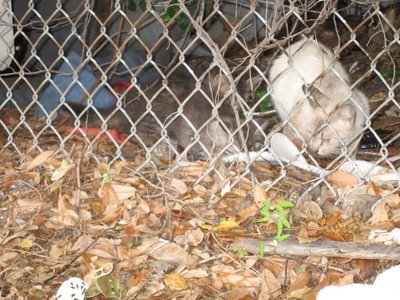
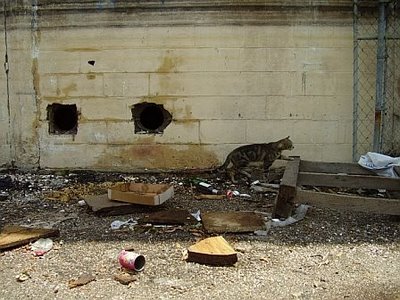


If you have not already done so, please visit
http://katrinacreaturesandcrittters.blogspot.com/ and see why volunteers are
still desperately needed in New Orleans and then, please forward this info
to everyone and anyone you know........colleges will be letting out for
summer and if anyone has contacts with students who might be willing to help
Animal Rescue New Orleans or Alley Cat Allies with ongoing (but very
undermanned) trapping.
We need to get babies like the one on the blog, living with his starving
mother (although I am doing my best to fatten her up while she waits to be
trapped) and his sibling in the drain pipe you see him in.........how many
more days, weeks, months, and god help us, years, will my heart, and surely
so many of yours, have to break into a million more pieces?
Lise McComiskey
New Orleans, LA
To volunteer go to AnimalRescueNewOrleans.com
Group in Japan Seeks to Bring Awareness to Horrible Treatment of Companion Animals: Information and How You Can Help
Well, not surprised that Japan is right there with China in its treatment of animals. Read on about it and see how you can help.
Article:
Dear friends of animals,
Excuse me, writing you this mail suddenly.
But the animals in Japan and we need your help.
My name is Lydia Tanabe and I am the spokesman of Small Animals Support
Association (SASA) Japan.
We are rescuing abused animals, but also spread information about other
issues of cruelty against animals.
In Japan one big problem is the companion animal problem.
Our cooperation partner in Germany is showing the problem also in English.
http://www.tierrechteportal.de/Sasa/index.html
There are no really law protecting animals, there are no really shelters for
the abused companion animals,
Japan is killing its dogs and cats in gas chambers or send it to Researching
Institutes.
Petshops let the animals die, which are not sold, people also throwing their
companion in the garbage.
We estimate the killed companion animals in Japan at 10 millions each year
or more.
But Japan is still importing more and more animals.
The mind of Japans people have to change, but we also need a law, which can
protect all these animals.
Therefore we decided to make a worldwide petition for the animals.
Together with other Japanese groups fighting for the animals, we made this
petition.
Now a German animal group made us also an online petition.
We will start in English and German now.
(For security reasons the list of signers will actualized every 24 hours.)
English: http://www.stimmen-der-tiere-ev.de/SASA/eng/index.php
German: http://www.stimmen-der-tiere-ev.de/SASA/index.php
Also it is possible to print the petition and bring it at veterinarians,
shelters or schools.
English: http://www.tierrechteportal.de/Sasa/SASA.doc
German: http://www.tierrechteportal.de/Sasa/SASAPetition.doc
Japanese: http://www.sasajapan.org/Probe.html
We need help from all over the world.
This is a chance, which will never come so soon again.
So I want to ask you, if it would be possible for you, to help us.
A link would help most, I guess.
But we would be very grateful, if you could sign the petition and also ask
your members or friends.
Please help us and the animals in Japan!
For you it is only a click, for the animals it means all, their lives.
Sincerely Yours
Lydia Tanabe
Spokesman of SASA Japan
mailto:info@sasajapan.org
mailto:tanabe@sasajapan.org
www.sasajapan.org
Minami Aoyama 1-3-6 MBE 125
Minato-ku
Tokyo 107-0062
Japan
Article:
Dear friends of animals,
Excuse me, writing you this mail suddenly.
But the animals in Japan and we need your help.
My name is Lydia Tanabe and I am the spokesman of Small Animals Support
Association (SASA) Japan.
We are rescuing abused animals, but also spread information about other
issues of cruelty against animals.
In Japan one big problem is the companion animal problem.
Our cooperation partner in Germany is showing the problem also in English.
http://www.tierrechteportal.de/Sasa/index.html
There are no really law protecting animals, there are no really shelters for
the abused companion animals,
Japan is killing its dogs and cats in gas chambers or send it to Researching
Institutes.
Petshops let the animals die, which are not sold, people also throwing their
companion in the garbage.
We estimate the killed companion animals in Japan at 10 millions each year
or more.
But Japan is still importing more and more animals.
The mind of Japans people have to change, but we also need a law, which can
protect all these animals.
Therefore we decided to make a worldwide petition for the animals.
Together with other Japanese groups fighting for the animals, we made this
petition.
Now a German animal group made us also an online petition.
We will start in English and German now.
(For security reasons the list of signers will actualized every 24 hours.)
English: http://www.stimmen-der-tiere-ev.de/SASA/eng/index.php
German: http://www.stimmen-der-tiere-ev.de/SASA/index.php
Also it is possible to print the petition and bring it at veterinarians,
shelters or schools.
English: http://www.tierrechteportal.de/Sasa/SASA.doc
German: http://www.tierrechteportal.de/Sasa/SASAPetition.doc
Japanese: http://www.sasajapan.org/Probe.html
We need help from all over the world.
This is a chance, which will never come so soon again.
So I want to ask you, if it would be possible for you, to help us.
A link would help most, I guess.
But we would be very grateful, if you could sign the petition and also ask
your members or friends.
Please help us and the animals in Japan!
For you it is only a click, for the animals it means all, their lives.
Sincerely Yours
Lydia Tanabe
Spokesman of SASA Japan
mailto:info@sasajapan.org
mailto:tanabe@sasajapan.org
www.sasajapan.org
Minami Aoyama 1-3-6 MBE 125
Minato-ku
Tokyo 107-0062
Japan
Website Answers Questions about Vegetarian Cats and Dogs
Not really news, but I’m sure a few readers would like to know about this.
For those of you who have questions or still have doubts about vegan diets for cats and dogs, here is a link were you can get a CD of the Book "Vegetarian Cats & Dogs" by James Peden.
http://www.vegepet.com/
It will answer all the nutritional questions people often have.
For those of you who have questions or still have doubts about vegan diets for cats and dogs, here is a link were you can get a CD of the Book "Vegetarian Cats & Dogs" by James Peden.
http://www.vegepet.com/
It will answer all the nutritional questions people often have.
A Growing Number of Metal Musicians Think Wearing Dead Animals Isn't the Way to Go
An interesting article that brings animal rights to a new perspective. Entertaining reading. Also, written by a 16 year old, so definitely different perspective than what we usually get.
Article:
Metal ain’t murder
Is there such a thing as a kinder, gentler hardcore? The youthful PETA2 and various metalheads think so.
http://www.metrotimes.com/editorial/story.asp?id=9206
by Kent Alexander
5/17/2006
Where the hell would metal be without leather, huh? How would the music "look" without the Jim Morrison pants, the motorcycle jackets, the studded wrist bands, and, of course, the Rob Halford-style homoerotic posturing?
It's a funny question because so much of metal has long been about the appearance of badassedness. But a growing number of metal musicians think wearing dead animals isn't the way to go. To them, animals are more important as living, breathing creatures than as a sweaty, stinky pair of pants. It seems that animal rights have finally come into their own amid the bloody power chords of the denim-and-leather set.
Where can you find info about these animal-loving hardcores? Well, there's PETA2, the more youthful and musically aligned offshoot of the well-known and often maligned animal rights group PETA.
PETA2 brings to light such strident riff-torturers as Napalm Death, Chimera and the oh-so aptly named Cattle Decapitation. Each band offers short opinions on the animal-rights issues at PETA2.com.
So what are metalheads doing to help animals?
PETA2 publicist Angela Modzelewski says bands are getting involved because "they really care about animals, and about the horrible conditions in factory farms and slaughterhouses."
The bands' involvement doesn't stop with simple PETA2.com editorials. They're spreading the message of animal rights through song and attitude. PETA2 even sponsors shows in its home state of Virginia.
One of many pro-animal voices speaking up from the underground is Liam Wilson, the Aldous Huxley-quoting guitarist for metalcore schizophrenics Dillinger Escape Plan.
Wilson is a lively sounding neo-hippie vegan who's digging life with his band. He's been a vegan since his teens — he discovered early on how diet and lifestyle improved how he felt physically and emotionally.
"I didn't want a hierarchy in my life that revolved around my diet," Wilson says. "Beyond just the animal rights thing, I think it was just an issue of health. I didn't feel like I was a healthy person [before]."
Wilson, who grew up a hardcore-loving kid, says his vegan journey began as a quest for better health, but expanded his politics. He's become proactive, and sees the world becoming a much better place through a gentler attitude toward life and green things.
"I want to attack the animal-rights issue from a health point of view," he says. "I think that if you're not eating [meat] and using these [animal] products, then, by default, the world will become more animal-friendly."
Then there's Wilson's experience with psychedelic 'shrooms, and their inherent mind-expanding qualities. "I came out of that [experience] with a kind of epiphany about life in general," Wilson says. "Kind of like the same cliché reaction that a lot of hippies may give you."
His refusal to eat anything with eyes blends into his beliefs of what can make a better world. "I feel like a lot of the world's problems and diseases, like diabetes, can be practically eradicated if people realize what they put into themselves is really — 90 percent of the time — not good."
But what's the best tactic to Wilson? Shutting down the meat industry by force, or just showing people the truth?
"I feel like those [militant] people can't explain themselves very well. Violence breeds violence. It is more about educating people. I don't mean that PETA's 100 percent in the right either ..."
So you won't see Wilson in your town bombing meat markets and slaughterhouses.
"There is a place for that," he says, "but it's really not my place."
Though Wilson is one of the many metal-riffers appearing in ads on the PETA2 site, the endorsement doesn't mean he's siding with any particular group just yet. "[Not] until I see a more sophisticated organization."
By getting Wilson's endorsement, PETA2 knew who they were trying to reach.
"We wanted to reach anyone who would be interested in Dillinger Escape Plan and what Liam had to say about why he's vegan," Modzelewski says
With the help of Scott Coland, a PETA2 rep, Wilson had a chance to put his views on video.
Sort of.
"I met Coland on the Take Action tour about three years ago, and I learned what PETA2 was all about. He asked if he could do a video interview that would play on the PETA2 site."
Wilson's major gripe with that interview is what PETA snipped out: "When we were done doing the interview," Wilson says, "I had said a lot of things about why I'm vegan."
In the video, Wilson was trying to explain his progressive views of vegetarianism, which extends to a kind of pro-drug humanism. He had alluded to his experiences with 'shrooms and recommended Terence McKenna's book Food of the Gods, which details the history of narcotics and human evolution.
"When I saw the edited version of that interview," Wilson continues, "it was really chopped up, and it just sounded really stereotypical. They just had me regurgitate what they have everyone else regurgitate. And it pissed me off. That wasn't really the full story; I don't necessarily think there is one path." But, he adds, laughing, "I guess I can't tell kids to take drugs and go vegan."
Wilson says he wants another chance at a PETA interview.
"Hopefully, I'll try to work on getting a written interview [on PETA2] that explains my point of view, which I think is different from a lot of people."
Hopefully it'll keep him from whining about it.
Wilson has a lot to say about vegan issues, but what about the metal scene? As a metalhead working with PETA, does he think the hardcore scene will accept a more "sensitive" metalhead or is it full of Neanderthals?
"I feel that most of my really sophisticated friends are in this scene," Wilson says. "So I feel that it's the kind of thing that pulls in all kinds of people. To say that the hardcore metal scene is more primitive than any other organization or group or fan base is silly. To me, the human race as a population is pretty subpar. I feel that the average intelligence of most Americans is far less than it probably should be. I don't think that's a symptom of hardcore metal."
Whoa.
Kent Alexander is a 16-year-old Metro Times intern.
Article:
Metal ain’t murder
Is there such a thing as a kinder, gentler hardcore? The youthful PETA2 and various metalheads think so.
http://www.metrotimes.com/editorial/story.asp?id=9206
by Kent Alexander
5/17/2006
Where the hell would metal be without leather, huh? How would the music "look" without the Jim Morrison pants, the motorcycle jackets, the studded wrist bands, and, of course, the Rob Halford-style homoerotic posturing?
It's a funny question because so much of metal has long been about the appearance of badassedness. But a growing number of metal musicians think wearing dead animals isn't the way to go. To them, animals are more important as living, breathing creatures than as a sweaty, stinky pair of pants. It seems that animal rights have finally come into their own amid the bloody power chords of the denim-and-leather set.
Where can you find info about these animal-loving hardcores? Well, there's PETA2, the more youthful and musically aligned offshoot of the well-known and often maligned animal rights group PETA.
PETA2 brings to light such strident riff-torturers as Napalm Death, Chimera and the oh-so aptly named Cattle Decapitation. Each band offers short opinions on the animal-rights issues at PETA2.com.
So what are metalheads doing to help animals?
PETA2 publicist Angela Modzelewski says bands are getting involved because "they really care about animals, and about the horrible conditions in factory farms and slaughterhouses."
The bands' involvement doesn't stop with simple PETA2.com editorials. They're spreading the message of animal rights through song and attitude. PETA2 even sponsors shows in its home state of Virginia.
One of many pro-animal voices speaking up from the underground is Liam Wilson, the Aldous Huxley-quoting guitarist for metalcore schizophrenics Dillinger Escape Plan.
Wilson is a lively sounding neo-hippie vegan who's digging life with his band. He's been a vegan since his teens — he discovered early on how diet and lifestyle improved how he felt physically and emotionally.
"I didn't want a hierarchy in my life that revolved around my diet," Wilson says. "Beyond just the animal rights thing, I think it was just an issue of health. I didn't feel like I was a healthy person [before]."
Wilson, who grew up a hardcore-loving kid, says his vegan journey began as a quest for better health, but expanded his politics. He's become proactive, and sees the world becoming a much better place through a gentler attitude toward life and green things.
"I want to attack the animal-rights issue from a health point of view," he says. "I think that if you're not eating [meat] and using these [animal] products, then, by default, the world will become more animal-friendly."
Then there's Wilson's experience with psychedelic 'shrooms, and their inherent mind-expanding qualities. "I came out of that [experience] with a kind of epiphany about life in general," Wilson says. "Kind of like the same cliché reaction that a lot of hippies may give you."
His refusal to eat anything with eyes blends into his beliefs of what can make a better world. "I feel like a lot of the world's problems and diseases, like diabetes, can be practically eradicated if people realize what they put into themselves is really — 90 percent of the time — not good."
But what's the best tactic to Wilson? Shutting down the meat industry by force, or just showing people the truth?
"I feel like those [militant] people can't explain themselves very well. Violence breeds violence. It is more about educating people. I don't mean that PETA's 100 percent in the right either ..."
So you won't see Wilson in your town bombing meat markets and slaughterhouses.
"There is a place for that," he says, "but it's really not my place."
Though Wilson is one of the many metal-riffers appearing in ads on the PETA2 site, the endorsement doesn't mean he's siding with any particular group just yet. "[Not] until I see a more sophisticated organization."
By getting Wilson's endorsement, PETA2 knew who they were trying to reach.
"We wanted to reach anyone who would be interested in Dillinger Escape Plan and what Liam had to say about why he's vegan," Modzelewski says
With the help of Scott Coland, a PETA2 rep, Wilson had a chance to put his views on video.
Sort of.
"I met Coland on the Take Action tour about three years ago, and I learned what PETA2 was all about. He asked if he could do a video interview that would play on the PETA2 site."
Wilson's major gripe with that interview is what PETA snipped out: "When we were done doing the interview," Wilson says, "I had said a lot of things about why I'm vegan."
In the video, Wilson was trying to explain his progressive views of vegetarianism, which extends to a kind of pro-drug humanism. He had alluded to his experiences with 'shrooms and recommended Terence McKenna's book Food of the Gods, which details the history of narcotics and human evolution.
"When I saw the edited version of that interview," Wilson continues, "it was really chopped up, and it just sounded really stereotypical. They just had me regurgitate what they have everyone else regurgitate. And it pissed me off. That wasn't really the full story; I don't necessarily think there is one path." But, he adds, laughing, "I guess I can't tell kids to take drugs and go vegan."
Wilson says he wants another chance at a PETA interview.
"Hopefully, I'll try to work on getting a written interview [on PETA2] that explains my point of view, which I think is different from a lot of people."
Hopefully it'll keep him from whining about it.
Wilson has a lot to say about vegan issues, but what about the metal scene? As a metalhead working with PETA, does he think the hardcore scene will accept a more "sensitive" metalhead or is it full of Neanderthals?
"I feel that most of my really sophisticated friends are in this scene," Wilson says. "So I feel that it's the kind of thing that pulls in all kinds of people. To say that the hardcore metal scene is more primitive than any other organization or group or fan base is silly. To me, the human race as a population is pretty subpar. I feel that the average intelligence of most Americans is far less than it probably should be. I don't think that's a symptom of hardcore metal."
Whoa.
Kent Alexander is a 16-year-old Metro Times intern.
Tuesday, May 16, 2006
Canadian Federal Fisheries Minister Apologizes To HSUS For Suggesting That Several Members Had Been Charged With Interfering With Baby Seal Slaughter
Little late now as the slaughter is done. And mostly for pr.
Article:
Federal fisheries minister apologizes to U.S. Humane Society
http://canadaeast.com/apps/pbcs.dll/article?AID=/
20060515/CPA/37138024
ST. JOHN'S, N.L. (CP) - Federal Fisheries Minister Loyola Hearn has apologized to the Humane Society of the United States for suggesting that several members of the animal rights group had been charged with interfering with the annual seal hunt in the Gulf of St. Lawrence.
While it's true some members of the anti-sealing group were arrested, Hearn issued a brief statement Monday saying he has since learned no one was actually charged. "I apologize for suggesting that charges had been laid," Hearn said in a news release.
In March, Hearn took the unusual step of banning five society members and one British animal protection worker from the hunt after their boat apparently violated the terms of their observer permits by getting too close to a sealing vessel in the gulf.
Speaking to reporters on March 31, Hearn said: "If you step over that line and try to interfere in any way with the hunt, then you can be arrested and charged, as people were last week. These people will not be going back to the hunt."
Earlier this month, the humane society served Hearn with a libel notice, claiming the minister had tried to "criminalize" the process by falsely suggesting charges had been laid.
The notice said none of the seven people involved in a confrontation with sealers on the ice floes had been charged with any offences, and Hearn's words implied they deliberately intended to disrupt the hunt.
The group had demanded the apology be made at a news conference, but a spokesman for the minister said Monday that won't be happening.
Canadian fishery officials are reviewing the rules and considering new restrictions on observers of the hunt.
The hunt, which closed last month, was one of the most turbulent in decades.
Besides clashes between sealers and protesters, celebrities including ex-Beatle Paul McCartney and actress Brigitte Bardot spearheaded new efforts to stop it.
Article:
Federal fisheries minister apologizes to U.S. Humane Society
http://canadaeast.com/apps/pbcs.dll/article?AID=/
20060515/CPA/37138024
ST. JOHN'S, N.L. (CP) - Federal Fisheries Minister Loyola Hearn has apologized to the Humane Society of the United States for suggesting that several members of the animal rights group had been charged with interfering with the annual seal hunt in the Gulf of St. Lawrence.
While it's true some members of the anti-sealing group were arrested, Hearn issued a brief statement Monday saying he has since learned no one was actually charged. "I apologize for suggesting that charges had been laid," Hearn said in a news release.
In March, Hearn took the unusual step of banning five society members and one British animal protection worker from the hunt after their boat apparently violated the terms of their observer permits by getting too close to a sealing vessel in the gulf.
Speaking to reporters on March 31, Hearn said: "If you step over that line and try to interfere in any way with the hunt, then you can be arrested and charged, as people were last week. These people will not be going back to the hunt."
Earlier this month, the humane society served Hearn with a libel notice, claiming the minister had tried to "criminalize" the process by falsely suggesting charges had been laid.
The notice said none of the seven people involved in a confrontation with sealers on the ice floes had been charged with any offences, and Hearn's words implied they deliberately intended to disrupt the hunt.
The group had demanded the apology be made at a news conference, but a spokesman for the minister said Monday that won't be happening.
Canadian fishery officials are reviewing the rules and considering new restrictions on observers of the hunt.
The hunt, which closed last month, was one of the most turbulent in decades.
Besides clashes between sealers and protesters, celebrities including ex-Beatle Paul McCartney and actress Brigitte Bardot spearheaded new efforts to stop it.
Mother’s Day, Dairy and Veal: What is the Connection? And, Why Does Wolfgang Puck Support Cruelty?

Baby Calves Chained By the Neck

His Crime Was Being Born a Male: Now He Doesn't Even See His Mother
More information on veal can be found at: www.noveal.org
Here is the answer to the first question: “Veal is a by-product of the dairy industry. In order for dairy cows to produce milk, they must be impregnated and give birth. Approximately half of the calves born are female, and they are used to replace older cows in the milking herd. The other half are male, and because they are of no use to the dairy industry, they are used for veal.”
Here is the answer to the second question: “Wolfgang Puck [proudly serves veal and] also continues to serve foie gras in his restaurants. Birds raised for foie gras suffer terribly when they are force fed enormous quantities of food multiple times each day. Their livers swell up to ten times their normal size, so that chefs like Mr. Puck can cook their diseased organs as a "delicacy."
Wolfgang Puck has opposed legislation to protect animals from abuse and has ignored requests from citizens and humane organizations to remove items of egregious animal suffering from his menu. His refusal to address the concerns of the public is unacceptable.”
Article:
http://www.indybay.org/news/2006/05/1823433.php
On Sunday, May 14, activists gathered at Wolfgang Puck’s Spago restaurant in Palo Alto to protest the cruel treatment of veal calves, whose flesh Puck serves. The protest coincided with Mother’s Day to highlight the plight of calves, who are separated from their mothers at very young ages to be turned into veal. The protestors distributed leaflets about veal production and held signs urging customers to say no to veal.
Wolfgang Puck has refused to stop serving this inhumane and decadent item, and also serves foie gras, the artificially fattened livers of force-fed ducks. For more information on his commitment to cruelty, and to take action, see wolfgangpuckcruelty.org.
A spokesperson for Wolfgang Puck confirmed that the veal used in the restaurant chain is white, milk-fed veal. Calves raised for milk-fed veal are confined in tiny crates, in which they cannot walk, turn around, or even lie down comfortably. When representatives from Farm Sanctuary worked to educate Mr. Puck and his affiliates about the plight of veal calves, they responded with misinformation, excuses, and ultimately, silence.
Veal production causes enormous suffering. In raising calves for milk-fed veal, farmers confine the animals in tiny crates. The calves are fed iron- and fiber-deficient diets. These animals are separated from their mothers, lead miserable lives in crates, and are then slaughtered for Spago’s wealthy clientele.
Veal is a by-product of the dairy industry. In order for dairy cows to produce milk, they must be impregnated and give birth. Approximately half of the calves born are female, and they are used to replace older cows in the milking herd. The other half are male, and because they are of no use to the dairy industry, they are used for veal.
Wolfgang Puck also continues to serve foie gras in his restaurants. Birds raised for foie gras suffer terribly when they are force fed enormous quantities of food multiple times each day. Their livers swell up to ten times their normal size, so that chefs like Mr. Puck can cook their diseased organs as a "delicacy."
Wolfgang Puck has opposed legislation to protect animals from abuse and has ignored requests from citizens and humane organizations to remove items of egregious animal suffering from his menu. His refusal to address the concerns of the public is unacceptable.
The protest was coordinated by Farm Sanctuary and Stanford University’s Animal Rights on the Farm. Some photos and portions of text courtesy of Farm Sanctuary and noveal.org.
More information on veal can be found at: www.noveal.org
Students At Stanford University Complete A Full Week Of Activities For World Week For Animals In Laboratories
Article:
http://www.indybay.org/news/2006/05/1821421.php
Stanford students have just completed a successful World Week for Animals in Laboratories. Stanford’s campus-wide animal rights group, Animal Rights on the Farm, and the law school group, Student Animal Legal Defense Fund, planned a series of events and protests for World Week, an annual event to highlight the suffering of animals used in research and testing. The students demands were modest: accountability for animal welfare violations, transparency of the procedures and animals used, shifting funds toward alternative models of research, and stopping some of the most gruesome experiments, such as the cocaine addiction studies on juvenile monkeys. ARF and SALDF have a new petition, urging the administration to implement some of these reforms. Please consider signing it. http://www.petitiononline.com/arf123/petition.html
From Monday, April 24 through Wednesday, April 26, People for the Ethical Treatment of Animals had an animal liberation exhibit on campus, documenting the common oppression of humans and animals. Suffering is unique, but pain knows no species.
On Monday, April 24, there was a protest against Stanford Animal Experiments on campus, demanding transparency, accountability, and a commitment to developing and funding alternatives to animal research. On Thursday, April 27, there was a protest at the Research Animal Facility on Stanford’s campus. On Friday, April 28th, Professor Steven Best of the University of Texas, El Paso, gave a speech on Animal Rights and the Left. Dr. Best examined the issues around oppression and exploitation and explained why progressives should care about animal rights. World Week ended on Saturday, April 29, with a final protest at the Research Animal Facility. Approximately 25 people attended, plus 5 dogs. The students at Stanford are looking forward to planning World Week for next year.
http://www.indybay.org/news/2006/05/1821421.php
Stanford students have just completed a successful World Week for Animals in Laboratories. Stanford’s campus-wide animal rights group, Animal Rights on the Farm, and the law school group, Student Animal Legal Defense Fund, planned a series of events and protests for World Week, an annual event to highlight the suffering of animals used in research and testing. The students demands were modest: accountability for animal welfare violations, transparency of the procedures and animals used, shifting funds toward alternative models of research, and stopping some of the most gruesome experiments, such as the cocaine addiction studies on juvenile monkeys. ARF and SALDF have a new petition, urging the administration to implement some of these reforms. Please consider signing it. http://www.petitiononline.com/arf123/petition.html
From Monday, April 24 through Wednesday, April 26, People for the Ethical Treatment of Animals had an animal liberation exhibit on campus, documenting the common oppression of humans and animals. Suffering is unique, but pain knows no species.
On Monday, April 24, there was a protest against Stanford Animal Experiments on campus, demanding transparency, accountability, and a commitment to developing and funding alternatives to animal research. On Thursday, April 27, there was a protest at the Research Animal Facility on Stanford’s campus. On Friday, April 28th, Professor Steven Best of the University of Texas, El Paso, gave a speech on Animal Rights and the Left. Dr. Best examined the issues around oppression and exploitation and explained why progressives should care about animal rights. World Week ended on Saturday, April 29, with a final protest at the Research Animal Facility. Approximately 25 people attended, plus 5 dogs. The students at Stanford are looking forward to planning World Week for next year.
Monday, May 15, 2006
Group Is New Zealand Calling For A Nationwide Ban On The Use Of Leg-Hold Or Gin Traps: What Is a Leg Hold Trap?
A great move. These are deadly and unnecessary killing mechanisms.
More information on leg hold traps can be found here: http://www.hsus.org/about_us/our_50th_anniversary_19542004/
fifty_years_of_success_scenes_from_the_hsuss_first_five_decades/
death_grip_steeljaw_leghold_traps.html
Article:
Animal rights group calls for gin trap ban
http://www.radionz.co.nz/news/latest/200605131322/1848e075
Posted at 1:22pm on 13 May 2006
An animal rights group is calling for a nationwide ban on the use of leg-hold or gin traps.
The traps are commonly used to catch possums for the fur trade, but also claim the lives of native species like kiwi and weka, and domestic pets.
Auckland Animal Action spokesperson, Rochelle Rees says councils and ultimately the government should ban the traps, which she likens to "antiquated torture devices".
She says the traps have been banned in 89 countries, and New Zealand needs to follow suit.
Forest and Bird says there are alternative methods of catching possums that will not target native birds.
More information on leg hold traps can be found here: http://www.hsus.org/about_us/our_50th_anniversary_19542004/
fifty_years_of_success_scenes_from_the_hsuss_first_five_decades/
death_grip_steeljaw_leghold_traps.html
Article:
Animal rights group calls for gin trap ban
http://www.radionz.co.nz/news/latest/200605131322/1848e075
Posted at 1:22pm on 13 May 2006
An animal rights group is calling for a nationwide ban on the use of leg-hold or gin traps.
The traps are commonly used to catch possums for the fur trade, but also claim the lives of native species like kiwi and weka, and domestic pets.
Auckland Animal Action spokesperson, Rochelle Rees says councils and ultimately the government should ban the traps, which she likens to "antiquated torture devices".
She says the traps have been banned in 89 countries, and New Zealand needs to follow suit.
Forest and Bird says there are alternative methods of catching possums that will not target native birds.
Campaign Continues To Expose Horror of the Live Import of Animals from Australia to the Middle East View the Horrible Film Footage
Again, the problem is money and ridiculous custom. As is stated, “Egypt imports live cattle and sheep in order to slaughter them according to the Islamic practice of halal in which the animal must be slaughtered with a razor-sharp knife without being stunned.”
Well, this may be fine and well for the humans, but for the vicims being slaughtered, it’s complete hell. Again, here is the video proof. This includes actual footage of the horrible treatment that occurs to sheep. You can see it here at:
http://geari.blogspot.com/2006/03/unbelievable
-video-exposes_08.html
Article:
Sheep takes fight for rights to Cairo
http://english.aljazeera.net/NR/exeres/
BC5B984C-8948-4185-9311-69B827A4F006.htm
Sunday 14 May 2006, 19:10 Makka Time, 16:10 GMT
Activists want a full ban on live exports to the Middle East
An activist dressed as a giant sheep has opened the latest stage of an animal rights campaign for a permanent ban on Australian livestock exports to the Middle East.
Dressed in a heavy woolly outfit, Jason Baker of the group People for the Ethical Treatment of Animals (PETA), presented a bouquet to the Australian embassy in Cairo.
He said the stunt was to thank the Australian government for imposing a temporary ban on live animal exports to Egypt, and push for the ban to be made permanent.
Australian live animal exports were temporarily suspended after a film shown on Australian television showed Australian exported sheep and cattle dragged off ships by their legs and ears and slaughtered within sight of other animals.
Footage released by PETA last week showed cattle being stabbed, slashed and stunned with knives and metal poles in Egyptian abattoirs.
"The Australians have done the right thing by suspending exports. But temporary bans will not work.This industry is too cruel," said Baker, who is PETA's Asia Pacific director.
Australia is the world's largest exporter of live animals, with the Middle East being its most important market.
Slaughter
Egypt imports live cattle and sheep in order to slaughter them according to the Islamic practice of halal in which the animal must be slaughtered with a razor-sharp knife without being stunned.
PETA said Egypt had not answered its petitions on the issue so far but Australian ambassador Robert Bowker said there was "no thought being given to a permanent ban".
"What the Australian and Egyptian governments are doing is to bring about an arrangement to improve the treatment of animals and to resume exports as soon as possible," Bowker told AFP.
PETA kicked off its campaign in Dubai last week and was set to continue in other countries in the Middle region including Bahrain, Kuwait and Oman.
"I'm hot and I'm dying of thirst," the PETA activist said sweating in his woolly costume in the Cairo heat. "But this is nothing compared with the suffering of the animals."
Well, this may be fine and well for the humans, but for the vicims being slaughtered, it’s complete hell. Again, here is the video proof. This includes actual footage of the horrible treatment that occurs to sheep. You can see it here at:
http://geari.blogspot.com/2006/03/unbelievable
-video-exposes_08.html
Article:
Sheep takes fight for rights to Cairo
http://english.aljazeera.net/NR/exeres/
BC5B984C-8948-4185-9311-69B827A4F006.htm
Sunday 14 May 2006, 19:10 Makka Time, 16:10 GMT
Activists want a full ban on live exports to the Middle East
An activist dressed as a giant sheep has opened the latest stage of an animal rights campaign for a permanent ban on Australian livestock exports to the Middle East.
Dressed in a heavy woolly outfit, Jason Baker of the group People for the Ethical Treatment of Animals (PETA), presented a bouquet to the Australian embassy in Cairo.
He said the stunt was to thank the Australian government for imposing a temporary ban on live animal exports to Egypt, and push for the ban to be made permanent.
Australian live animal exports were temporarily suspended after a film shown on Australian television showed Australian exported sheep and cattle dragged off ships by their legs and ears and slaughtered within sight of other animals.
Footage released by PETA last week showed cattle being stabbed, slashed and stunned with knives and metal poles in Egyptian abattoirs.
"The Australians have done the right thing by suspending exports. But temporary bans will not work.This industry is too cruel," said Baker, who is PETA's Asia Pacific director.
Australia is the world's largest exporter of live animals, with the Middle East being its most important market.
Slaughter
Egypt imports live cattle and sheep in order to slaughter them according to the Islamic practice of halal in which the animal must be slaughtered with a razor-sharp knife without being stunned.
PETA said Egypt had not answered its petitions on the issue so far but Australian ambassador Robert Bowker said there was "no thought being given to a permanent ban".
"What the Australian and Egyptian governments are doing is to bring about an arrangement to improve the treatment of animals and to resume exports as soon as possible," Bowker told AFP.
PETA kicked off its campaign in Dubai last week and was set to continue in other countries in the Middle region including Bahrain, Kuwait and Oman.
"I'm hot and I'm dying of thirst," the PETA activist said sweating in his woolly costume in the Cairo heat. "But this is nothing compared with the suffering of the animals."
Veganism Creates $2.8B Market
An excellent article that points out this growing market.
Article:
Veganism creates $2.8B market
http://www.azstarnet.com/allheadlines/129192.php
By Levi J. Long
ARIZONA DAILY STAR
Interested in veganism?
The shoes are fashionable.
And the food isn't bad either.
No longer considered a "hippie fad," the vegan lifestyle is translating into business opportunities for some local entrepreneurs, resulting in part from a growing $50 billion a year natural-products industry.
"People think vegans are grungy, granola eaters," said Ana Terrazas, who has been a vegan for 25 years.
"But it is becoming more mainstream, and businesses are thinking about that."
In Tucson, that means a Web site for vegan consumers, a new line of vegan brownies and a new restaurant devoted to vegan palates.
For those not in the know, veganism is defined as a person who avoids using eggs, dairy, honey, meat, poultry and fish, and does not buy products derived from animals, such as fur or leather, according to the Vegetarian Resource Group, based in Baltimore, Md. There are more than 1.7 million vegans, in the United States, according to a 2000 poll conducted by the group.
Choices for vegan consumers are growing along with demand, as more niche businesses cater to vegans, and main-stream grocery stores carry more products, said John Cunningham, consumer research manager for the vegetarian group.
The market for foods replacing meat and other animal products is estimated at $2.8 billion, according to Mintel International Group Ltd., a research consumer company.
"It would behoove a company to introduce new vegan products, because they would be able to reach the widest market," said Cunningham, who added that vegan products have potential to carry over to mainstream consumers.
Success for such products, however, depends on marketing, Cunningham said.
But because vegan products are such a niche business, vegans usually spread the word quickly, he said.
Local business owners already are seeing an impact with their new enterprises.
With its blend of exposed brick, natural wood and Japanese inspired interiors, the crowd at Lovin Spoonfuls, 2990 N. Campbell Ave., ranges from those who prefer soy-based foods to those who consume the occasional grilled steak.
"I enjoy a good T-bone now and then. But the salads here are the best," said Ross Conway, a construction worker who craved something a bit different for lunch last week.
The eight-month-old cafe is Tucson's latest vegan-specific restaurant serving breakfast, lunch and dinner.
"We appeal to vegans, veggies and nonveggies alike," said Peggy Raisglid, owner of Lovin Spoonfuls.
When Raisglid opened the café, she wanted to trump certain stereotypes about vegan cuisine.
"We wanted to show people that vegan dishes can be delicious. It could be something tasty, not grainy," said Raisglid, vice president of the Vegetarian Resource Group of Tucson.
Tinkering with taste is also the focus of M. TwoFeathers, owner of Epic Vegan Treats and the Epic Café at 745 N. Fourth Ave.
TwoFeathers launched a line of vegan seed cookies, brownies and snack bars last fall and said he hopes to market them across the country this year.
The café sold about 5,000 of the goods each year before repackaging them and changing the dairy-free recipe, which uses organic items and have no trans fats.
The café now sells 10,000 of the vegan baked goods annually, TwoFeathers said.
The potential for markets outside Tucson is there, said TwoFeathers. Starbucks, Wild Oats and Whole Foods are possible outlets for such goods.
"I mean, just because you're vegan doesn't mean you don't want junk food," he said.
The growth in vegan products extends beyond food. Run out of the garage of his Civano home, David Sudarsky's thevegetariansite.com Web site stocks more than 500 pairs of vegan shoes.
The Web site sells such brands as Ethical Wares and Ecolution, makers of hemp shoes, wallets and accessories. The Web site also sells a range of products, including lip balm and vitamins.
Turned off by the fur trade and the meat industry, Sudarsky first tried vegetarianism 13 years ago before becoming a vegan.
"In most cities, you can't walk into a store to find vegan stuff," he said.
That was one reason he started the Web site, he said. He now orders products from different companies and ships them to clients around the world.
Since going online six years ago, Sudarsky said he has seen 20 percent annual growth in sales, with increasing orders from Canada, Europe and Japan.
After quitting his job as an astrophysicist to pursue the business full time, Sudarsky said he doesn't have any regrets.
"It's good to know that you're providing a quality product that doesn't conflict with your beliefs," he said.
Article:
Veganism creates $2.8B market
http://www.azstarnet.com/allheadlines/129192.php
By Levi J. Long
ARIZONA DAILY STAR
Interested in veganism?
The shoes are fashionable.
And the food isn't bad either.
No longer considered a "hippie fad," the vegan lifestyle is translating into business opportunities for some local entrepreneurs, resulting in part from a growing $50 billion a year natural-products industry.
"People think vegans are grungy, granola eaters," said Ana Terrazas, who has been a vegan for 25 years.
"But it is becoming more mainstream, and businesses are thinking about that."
In Tucson, that means a Web site for vegan consumers, a new line of vegan brownies and a new restaurant devoted to vegan palates.
For those not in the know, veganism is defined as a person who avoids using eggs, dairy, honey, meat, poultry and fish, and does not buy products derived from animals, such as fur or leather, according to the Vegetarian Resource Group, based in Baltimore, Md. There are more than 1.7 million vegans, in the United States, according to a 2000 poll conducted by the group.
Choices for vegan consumers are growing along with demand, as more niche businesses cater to vegans, and main-stream grocery stores carry more products, said John Cunningham, consumer research manager for the vegetarian group.
The market for foods replacing meat and other animal products is estimated at $2.8 billion, according to Mintel International Group Ltd., a research consumer company.
"It would behoove a company to introduce new vegan products, because they would be able to reach the widest market," said Cunningham, who added that vegan products have potential to carry over to mainstream consumers.
Success for such products, however, depends on marketing, Cunningham said.
But because vegan products are such a niche business, vegans usually spread the word quickly, he said.
Local business owners already are seeing an impact with their new enterprises.
With its blend of exposed brick, natural wood and Japanese inspired interiors, the crowd at Lovin Spoonfuls, 2990 N. Campbell Ave., ranges from those who prefer soy-based foods to those who consume the occasional grilled steak.
"I enjoy a good T-bone now and then. But the salads here are the best," said Ross Conway, a construction worker who craved something a bit different for lunch last week.
The eight-month-old cafe is Tucson's latest vegan-specific restaurant serving breakfast, lunch and dinner.
"We appeal to vegans, veggies and nonveggies alike," said Peggy Raisglid, owner of Lovin Spoonfuls.
When Raisglid opened the café, she wanted to trump certain stereotypes about vegan cuisine.
"We wanted to show people that vegan dishes can be delicious. It could be something tasty, not grainy," said Raisglid, vice president of the Vegetarian Resource Group of Tucson.
Tinkering with taste is also the focus of M. TwoFeathers, owner of Epic Vegan Treats and the Epic Café at 745 N. Fourth Ave.
TwoFeathers launched a line of vegan seed cookies, brownies and snack bars last fall and said he hopes to market them across the country this year.
The café sold about 5,000 of the goods each year before repackaging them and changing the dairy-free recipe, which uses organic items and have no trans fats.
The café now sells 10,000 of the vegan baked goods annually, TwoFeathers said.
The potential for markets outside Tucson is there, said TwoFeathers. Starbucks, Wild Oats and Whole Foods are possible outlets for such goods.
"I mean, just because you're vegan doesn't mean you don't want junk food," he said.
The growth in vegan products extends beyond food. Run out of the garage of his Civano home, David Sudarsky's thevegetariansite.com Web site stocks more than 500 pairs of vegan shoes.
The Web site sells such brands as Ethical Wares and Ecolution, makers of hemp shoes, wallets and accessories. The Web site also sells a range of products, including lip balm and vitamins.
Turned off by the fur trade and the meat industry, Sudarsky first tried vegetarianism 13 years ago before becoming a vegan.
"In most cities, you can't walk into a store to find vegan stuff," he said.
That was one reason he started the Web site, he said. He now orders products from different companies and ships them to clients around the world.
Since going online six years ago, Sudarsky said he has seen 20 percent annual growth in sales, with increasing orders from Canada, Europe and Japan.
After quitting his job as an astrophysicist to pursue the business full time, Sudarsky said he doesn't have any regrets.
"It's good to know that you're providing a quality product that doesn't conflict with your beliefs," he said.
Friday, May 12, 2006
Google to Buy Only “Cage-Free” Eggs: Yet, Will Still Buy Veal: Contradictory Actions


Veal: Literally, babies taken from their mothers and put in chains. Come on Google, if you truly care about animal welfare, veal must go! Pictures from http://www.noveal.org/photos.htm
 Life in hell for chickens in caged facility.
Hey, I applaud their effort to addressing animal cruelty via cage-free eggs, but why buy veal?! There’s hardly anything worse than veal. Let’s hope they stop buying it. Maybe someone needs to contact them about this.
If they're serious and this is more than just a pr move, then they will have to stop buying veal. Doing so would make a huge difference. Yet, if they do not, then I'd say the egg move is a pr move.
For more information on why veal is cruel, including pictures, see http://www.noveal.org/
For an entertaining cartoon about veal see http://www.noveal.org/forgetaboutit/
Article:
Google uses clout to free hens
FIRM TO BUY CAGE-FREE EGGS FOR SAKE OF ANIMAL WELFARE
http://www.mercurynews.com/mld/mercurynews/business/
special_packages/google/14552520.htm
By Paul Rogers
Mercury News
Multiple hens are crammed in a single wire cage at a Maryland farm.
Erica Meier / Humane Society of the United States
Multiple hens are crammed in a single wire cage at a Maryland farm.
Google, which makes billions of dollars helping computer users navigate the Internet, will turn its attention today to something completely different:
Eggs.
In a growing animal welfare trend that is being embraced by natural foods markets, universities and technology companies, Google officials plan to announce their employee cafeterias will no longer serve eggs that come from hens crammed into small cages.
While that may sound like a small thing, Google employs roughly 6,000 workers, consumes about 300,000 eggs a year and uses 7,000 pounds of liquid egg products in its baking and cooking. By year end, the company will have 12 cafes on its Mountain View campus.
Animal rights groups urged the switch, noting that at many large farms, six or more hens are confined in a single wire cage. For 12 to 18 months they cannot flap their wings or forage for food, and egg industry guidelines require only 67 square inches of space for each bird to live out its life -- an area two-thirds the size of a sheet of notebook paper.
``This is a matter of common decency,'' said Paul Shapiro, director of the factory-farming campaign at the Humane Society of the United States, in Washington D.C. ``These animals are completely at our mercy. It should be a source of shame for us how miserably we treat them.''
The egg campaign, championed by the Humane Society, is the 2006 version of previous efforts by environmental and animal rights groups to steer shoppers toward socially responsible food choices. In recent years they have urged consumers not to buy certain types of tuna or swordfish because of overfishing; veal, because calves are confined in tight pens; or vegetables and fruits grown with pesticides.
Google officials say the decision is part of a wider effort to incorporate environmental and social values into food choices.
``We're happy to do it,'' said John Dickman, Google's global food services manager. ``There's a ripple effect that I think will happen. Other companies also will want to ensure humane treatment of animals.''
He said that while the company does buy veal occasionally, its seafood menu features only fish approved by the Monterey Bay Aquarium Seafood Watch Program. Its produce is mostly local, and its meats contain no nitrates or antibiotics.
In November, Bon Appétit Management, a Palo Alto company that operates 400 cafeterias for major corporate clients, including Oracle, Cisco, Yahoo and Nordstrom, also announced it will buy eggs only from cage-free hens. It purchases 8 million eggs a year.
America Online made a similar move last month. Markets such as Whole Foods and Wild Oats have done the same, and in February Trader Joe's announced it wouldn't sell any eggs from caged hens under its brand name. Dozens of universities, from Ohio State to Vassar, have also made the switch.
Farm industry leaders say the concerns about animal cruelty are misplaced.
``We don't have any problem with a consumer choice to buy cage-free eggs,'' said Gene Gregory, senior vice president for United Egg Producers in Atlanta, the leading trade association for egg farmers.
``We think that it is a shame, though, that people are being misled.''
At least 95 percent of the 300 million laying hens in the United States live in wire cages known as ``battery cages,'' because they are stacked in batteries, or arrays.
The cages allow farmers to reduce disease, and death rates are lower for birds living in cages than for birds that roam outside or on henhouse floors, Gregory said.
``We don't believe it is cruel,'' he said. ``I grew up on a farm when everything was free roaming. But the cages provide so many more benefits for the health and welfare of the birds.''
In a 2003 study of egg farms in the United Kingdom, hens in cages had a 5 percent mortality rate compared with 8 percent for both barn-raised and free-range chickens.
There are three ways to raise eggs. They can be produced by hens in tight cages. They can be produced by hens that walk around indoor henhouses, a type of egg known as ``cage free.'' Or they are ``free range,'' laid by chickens that live outdoors.
``Cage free'' eggs can cost up to twice as much in a supermarket as eggs from hens in cages. Higher costs are due to increased labor costs, and more broken eggs. Google's costs will increase only a few cents a dozen, Dickman said, because of volume buying.
Joy Mench, a professor of animal science at the University of California-Davis, said chickens tightly confined in cages do lose their natural behavior. Yet there's no clear answer on which system is better, she said. If henhouses are not kept clean, chickens roaming out of cages can have higher rates of disease, she noted.
``I've seen some good non-cage systems and some horrible non-cage systems,'' she said. ``Mortality and disease rates can be similar under both systems if management is good.'
Even Zoos in India are Abusive: Group Sues Zoos with Cruelty to Animals
Yep, even in India they like to abuse animals. Let’s hope the suit works.
Article
Animal rights group sues Indian zoos in Supreme Court
http://www.gg2.net/viewnews.asp?nid=4130&tid=
breaking_news&catid=Breaking%20News
News : PETA sues Indian zoos
PETA sues Indian zoos
THE ANIMAL rights group People for the Ethical Treatment of Animals (PETA) said it had brought a case before India`s Supreme Court charging 37 zoos across the country with cruelty to animals.
"Although zoos make high-sounding claims, they are guilty of a total failure to treat their captives humanely, educate people or preserve species," Anuradha Sawhney, PETA Indias chief, said in a statement.
"We are better educated by nature documentaries which peek into animals worlds without disturbing them."
The group filed the case after investigating conditions in the zoos in question, the statement said.
PETA said animals, including elephants, were kept chained and shackled, nocturnal animals were kept in bright sunlight and acquatic animals had inadequate water.
Zoo enclosures were often too small for the animals they housed and some animals had been stolen from zoos by their caretakers, it said.
A month ago, a black bear disappeared from the Delhi zoo, Indian media reported, not long after two jaguar cubs died after eating disinfectant that had been left lying around.
The Supreme Court had ordered the zoos named in the case to respond to the charges, the PETA statement said.
Article
Animal rights group sues Indian zoos in Supreme Court
http://www.gg2.net/viewnews.asp?nid=4130&tid=
breaking_news&catid=Breaking%20News
News : PETA sues Indian zoos
PETA sues Indian zoos
THE ANIMAL rights group People for the Ethical Treatment of Animals (PETA) said it had brought a case before India`s Supreme Court charging 37 zoos across the country with cruelty to animals.
"Although zoos make high-sounding claims, they are guilty of a total failure to treat their captives humanely, educate people or preserve species," Anuradha Sawhney, PETA Indias chief, said in a statement.
"We are better educated by nature documentaries which peek into animals worlds without disturbing them."
The group filed the case after investigating conditions in the zoos in question, the statement said.
PETA said animals, including elephants, were kept chained and shackled, nocturnal animals were kept in bright sunlight and acquatic animals had inadequate water.
Zoo enclosures were often too small for the animals they housed and some animals had been stolen from zoos by their caretakers, it said.
A month ago, a black bear disappeared from the Delhi zoo, Indian media reported, not long after two jaguar cubs died after eating disinfectant that had been left lying around.
The Supreme Court had ordered the zoos named in the case to respond to the charges, the PETA statement said.
Subscribe to:
Posts (Atom)
Search for More Content

Custom Search
