Unfortunately, the Japanese were not going to see the obvious cruelty in the horrible dolphin slaughter. Perhaps the presence of mercury in their meat will be the only thing that does.
To see video proof of the horror of the annual Japanese dolphin slaughter see our posting on it at http://geari.blogspot.com/search?q=dolphin+japan
Article:
Mercury risk poses threat to Japanese dolphin hunt
http://www.iht.com/articles/2008/02/20/
asia/dolphin.php
By Martin Fackler
Published: February 20, 2008
TAIJI, Japan: For years, Western activists have traveled to this remote port to protest the annual dolphin "drive." And for years, local fishermen have ignored them, herding the animals into a small cove and slashing them until the tide flows red. But now a new menace may succeed where activists have failed: mercury.
This town of 3,500 residents on a majestic, rocky stretch of coast is fiercely proud of its centuries-old tradition of hunting dolphins and whaling. Residents are used to the international scorn that accompanies the dolphin drive, almost as much an annual ritual as the drive itself, and have closed ranks in the face of rising outrage - until now.
Dolphin meat is a prized local delicacy, served raw as sashimi or boiled with soy sauce. But in June, laboratory tests showed high levels of mercury in dolphin and pilot whale, a small whale that resembles a dolphin, caught and sold here. At the urging of two town council members, schools promised to stop serving pilot whale for lunch, and some local supermarkets removed it and dolphin from their shelves.
Rather than embrace the changes, this tight-knit community has been divided, with most local officials and the fishermen's union insisting that the mercury threat is being overblown, while a minority here has begun to question a tradition.
"We are not against whaling," including the dolphin hunts, said Junichiro Yamashita, one of the council members, who paid for the mercury tests himself after the town refused to pay. "This is a small town,
The problems are not limited to Taiji. Japan is one of the world's largest consumers of whales and dolphins, yet the Health and Agriculture ministries, as well as the media, have said little about the growing mercury levels in whale and dolphin meat.
Indeed, the whaling industry seems to enjoy a protected status here, mainly as a symbol of tradition, defended against foreign interference.
"There is a real danger in whale and dolphin meat, but word is not getting out," said Tetsuya Endo, a professor at the Health Sciences University of Hokkaido and an expert on mercury in sea animals.
Japan kills 1,000 minke and other great whales every year in controversial research whaling off the coast of Antarctica and in the northern Pacific. Japan calls the hunt "research" in order to avoid an international ban on commercial whaling, but then sells the meat to supermarkets. One hundred more whales and 21,000 dolphins are killed annually in coastal waters, according to Japan's Fisheries Agency.
Still, the meat is hardly a vital food source: only a minority of Japanese eat whale, and dolphin is even less common, consumed in a handful of rural areas and regional cities like Osaka.
Taiji is the best known source of dolphin meat, partly because it kills the most animals, about 2,000 annually, in a season that runs from September to April. In Taiji, fishermen use a method called oikomi, or "the drive," in which they bang on metal poles to create a wall of sound that pushes panicked dolphin and pilot whales into a cove for killing.
Gruesome photos of the blood-filled cove, and protests by mostly Western environmental groups, seem to have only strengthened the town's resolve to hold fast to its customs. According to the town's whaling museum, the people of Taiji have hunted coastal whales for 400 years. With few other sources of livelihood, whaling is a mainstay of the local economy.
"We are a whaling community, and we don't want to lose that," said Katsutoshi Mihara, chairman of Taiji's town council. "Here, all boys grew up dreaming of hunting whales." (The Japanese word for whaling, hogei, also encompasses hunting dolphins.)
The mayor and most town leaders point to a Health Ministry report that said the meats are safe in moderation.
Strong proponents of whaling like Mihara say they fear that the mercury scare may damage the popularity of dolphin meat, which accounts for about a third of the town's $3 million fishing industry, according to the fishermen's association. Dolphin also fetches higher prices than other locally caught seafood: in a Taiji supermarket, a pound, or about half a kilogram, of frozen dolphin meat recently sold for about ¥1,500, or $14, roughly the price of sashimi-grade tuna.
Taiji's mercury debate comes amid rising worldwide concern over mercury in other, more globally accepted types of seafood, particularly tuna. Like tuna, dolphins and small whales are predators that appear to be accumulating mercury as they feed on fish in the world's increasingly contaminated oceans.
In fact, dolphins can build up far more mercury than tuna because dolphins live to about 40 years, versus a decade for large tuna species, said Endo, of the University of Hokkaido.
When consumed by humans over an extended period, mercury can cause birth defects, brain damage and death. In fact, the world's worst case of mercury poisoning occurred in Japan in the 1950s, when thousands were killed, made ill or crippled in the city of Minamata from mercury dumped into the sea as industrial waste.
Endo participated in the studies that first brought mercury risks in dolphin to light. Since 2000, he has tested hundreds of samples of dolphin and whale meat around the country. In dolphin and pilot whale, he has typically found mercury levels ranging from 10 to 100 parts per million, far above the Japanese government's advisory level of 0.4 parts per million.
The most contaminated sample he ever found was from the internal organs of a pilot whale sold in a Taiji supermarket - 2,000 parts per million.
Despite the extreme sensitivity to mercury poisoning in Japan because of the Minamata case, the Health and Agriculture ministries have done little to inform the public about mercury in whale and dolphin meat, say Endo and other biologists. While the Health Ministry has done its own surveys of dolphin and pilot whale that show mercury levels of 10 to 50 times the advisory level, the only warning it has issued is for pregnant women.
Ministry officials say broader warnings are not needed because the higher levels are not a health risk for most people if they eat the meat infrequently, giving the body time to discharge the mercury. But critics accuse the government and media of ignoring the mercury issue, including the dispute in Taiji.
The same wall of silence exists in Taiji, many residents said. Yamashita and the other council member who raised the mercury issue, Hisato Ryono, said local newspapers had not written about their warnings, and city hall has said little in public about mercury.
To get word out, the two paid to have 1,900 fliers printed and sent to locals.
Several residents said they were shocked and alarmed when they read the fliers last summer. They also said they were angry at the town government's failure to address the concerns over mercury, adding that they no longer ate dolphin meat.
The residents refused to give their names for fear of being ostracized by their neighbors. "The flier is all I know about the mercury issue," said one 42-year-old woman, who said she was worried because her third-grade child had eaten pilot whale meat at school.
Older residents dismissed the mercury fears, saying they had eaten dolphin all their lives without ill effect.
Such generational differences may be what finally ends the dolphin hunt. Most of those under 40 no longer eat the meat, according to many residents.
"We're not saying that consumption of dolphin should disappear, but I think it's inevitable that it will," said Ryono, the council member. "As the older generation disappears, so will demand for dolphin meat."
Showing posts sorted by relevance for query dolphin japan. Sort by date Show all posts
Showing posts sorted by relevance for query dolphin japan. Sort by date Show all posts
Wednesday, February 20, 2008


Sunday, June 13, 2010
Oscar-Winning Documentary "The Cove," Exposes the Truth of the Horror of the Annual Dolphin Hunt / Slaughter in Japan: As a Result, Japan Bans Film
Leave it to Japan to not only be cruel, but to attempt to hide their cruelty. They do it with whaling, so why not do it with murdering Dolphins? Sick and sad.
Article:
Japan dolphin hunt film triggers censorship debate
http://news.yahoo.com/s/ap/as_japan_dolphin_hunt_movie
By JAY ALABASTER, Associated Press Writer Jay Alabaster, Associated Press Writer – Thu Jun 10, 7:54 am ET
TOKYO – Controversy over "The Cove," an Oscar-winning documentary about the annual dolphin hunt in a Japanese village, has widened into a debate over free speech in the country.
Three theaters last week canceled showings of the movie after they were swamped with angry phone calls and threatened with noisy protests by nationalist groups. It was banned on a U.S. military base in Japan as too controversial, and 23 other theaters are still deciding whether to show the film, according to Japanese distributor Unplugged.
After the cancellations, a group of Japanese journalists, academics and film directors signed a letter urging the theaters not to back down and saying the issue "underlines the weakness of freedom of speech in Japan." Freedom of speech is guaranteed in Japan's constitution, but many
Japanese are wary of unruly demonstrations.
Nationalist groups, known for blasting slogans from truck convoys and handheld loudspeakers, often use the threat of protests as leverage. (Two years ago, angry phone calls led several theaters to cancel "Yasukuni," a movie about a Japanese war shrine that honors fallen soldiers, including executed leaders convicted as war criminals.) Below is a trailer for "The Cove":
On Wednesday, over 600 people crammed into a civic hall in Tokyo for a rare chance to see "The Cove," with lines forming hours before the doors opened and viewers spilling out into the lobby to watch via a video feed. Outside of small private showings, it was the first time the movie has been screened in Japan since October, when it was shown at the Tokyo International Film Festival.
The event had originally been planned to discuss the movie, which shows bloody scenes of a dolphin slaughter filmed by hidden cameras and portrays local fishermen as rough goons. But instead the event focused on the theater cancellations, reflecting the changing debate around the film.
"Protesters only threatened to do bad things, and then theaters got scared and pulled out," said Hiroyuki Shinoda, chief editor of "Tsukuru" magazine, which organized the showing.
Shinoda, who signed the protest letter last week, urged those present to contact theaters and ask that the movie be shown.
Ric O'Barry, a former trainer for the "Flipper" TV show who is the central character of "The Cove," made a surprise appearance at the screening. He is now a dolphin activist, but on Wednesday talked instead about freedom of speech and the large number of awards the movie has won.
"Those awards are given for entertainment value, and for that reason alone the Japanese people should be able to see it and make up their own mind," he said. It won best documentary at the Academy Awards this year.
Outside the hall, about two dozen police and plainclothes officers were on duty, but no protests took place, although a few people quietly handed out flyers calling for the movie to be banned. One flyer linked the movie with Sea Shepherd, an anti-whaling group that clashes with Japan's whaling fleet each year.
"Freedom of expression doesn't need to be recognized for a movie made by terrorists," it read.
"The Cove" includes an interview with Sea Shepherd founder Paul Watson. It is presented as the first documentary from The Oceanic Preservation Society, a group headed by Director Louie Psihoyos that lists Sea Shepherd as a partner.
Various right-wing groups consider the movie to be anti-Japanese, saying that dolphin hunts occur in other parts of the world and that any portrayal of animals being slaughtered for food would be bloody and unpleasant to watch.
The groups have led noisy protests outside of Unplugged's headquarters and the home of its president.
In Taiji, the small village where the hunt occurs, the local government and fishing cooperative defend dolphin hunting as a local custom with a long history. The mostly bottlenose dolphins killed in the hunt are not endangered, and hunts are also carried out in other parts of Japan — although very few Japanese have ever eaten dolphin meat.
A Japanese scientist and Taiji lawmaker who appear in the film say they agreed to do so without knowing it would be about the dolphin hunt, which Psihoyos has said is not true.
In the version of "The Cove" shown Tuesday and intended for release in Japan, disclaimers have been added saying those interviewed in the movie are not protesting or supporting dolphin issues. Unlike the U.S. version, the faces of most Japanese are blurred out.
A Japanese message states that data presented in the movie were gathered by and are the responsibility of the film's creators. The movie cites information about mercury levels in dolphins and falsely labeled dolphin meat that has been challenged by government officials.
Article:
Japan dolphin hunt film triggers censorship debate
http://news.yahoo.com/s/ap/as_japan_dolphin_hunt_movie
By JAY ALABASTER, Associated Press Writer Jay Alabaster, Associated Press Writer – Thu Jun 10, 7:54 am ET
TOKYO – Controversy over "The Cove," an Oscar-winning documentary about the annual dolphin hunt in a Japanese village, has widened into a debate over free speech in the country.
Three theaters last week canceled showings of the movie after they were swamped with angry phone calls and threatened with noisy protests by nationalist groups. It was banned on a U.S. military base in Japan as too controversial, and 23 other theaters are still deciding whether to show the film, according to Japanese distributor Unplugged.
After the cancellations, a group of Japanese journalists, academics and film directors signed a letter urging the theaters not to back down and saying the issue "underlines the weakness of freedom of speech in Japan." Freedom of speech is guaranteed in Japan's constitution, but many
Japanese are wary of unruly demonstrations.
Nationalist groups, known for blasting slogans from truck convoys and handheld loudspeakers, often use the threat of protests as leverage. (Two years ago, angry phone calls led several theaters to cancel "Yasukuni," a movie about a Japanese war shrine that honors fallen soldiers, including executed leaders convicted as war criminals.) Below is a trailer for "The Cove":
On Wednesday, over 600 people crammed into a civic hall in Tokyo for a rare chance to see "The Cove," with lines forming hours before the doors opened and viewers spilling out into the lobby to watch via a video feed. Outside of small private showings, it was the first time the movie has been screened in Japan since October, when it was shown at the Tokyo International Film Festival.
The event had originally been planned to discuss the movie, which shows bloody scenes of a dolphin slaughter filmed by hidden cameras and portrays local fishermen as rough goons. But instead the event focused on the theater cancellations, reflecting the changing debate around the film.
"Protesters only threatened to do bad things, and then theaters got scared and pulled out," said Hiroyuki Shinoda, chief editor of "Tsukuru" magazine, which organized the showing.
Shinoda, who signed the protest letter last week, urged those present to contact theaters and ask that the movie be shown.
Ric O'Barry, a former trainer for the "Flipper" TV show who is the central character of "The Cove," made a surprise appearance at the screening. He is now a dolphin activist, but on Wednesday talked instead about freedom of speech and the large number of awards the movie has won.
"Those awards are given for entertainment value, and for that reason alone the Japanese people should be able to see it and make up their own mind," he said. It won best documentary at the Academy Awards this year.
Outside the hall, about two dozen police and plainclothes officers were on duty, but no protests took place, although a few people quietly handed out flyers calling for the movie to be banned. One flyer linked the movie with Sea Shepherd, an anti-whaling group that clashes with Japan's whaling fleet each year.
"Freedom of expression doesn't need to be recognized for a movie made by terrorists," it read.
"The Cove" includes an interview with Sea Shepherd founder Paul Watson. It is presented as the first documentary from The Oceanic Preservation Society, a group headed by Director Louie Psihoyos that lists Sea Shepherd as a partner.
Various right-wing groups consider the movie to be anti-Japanese, saying that dolphin hunts occur in other parts of the world and that any portrayal of animals being slaughtered for food would be bloody and unpleasant to watch.
The groups have led noisy protests outside of Unplugged's headquarters and the home of its president.
In Taiji, the small village where the hunt occurs, the local government and fishing cooperative defend dolphin hunting as a local custom with a long history. The mostly bottlenose dolphins killed in the hunt are not endangered, and hunts are also carried out in other parts of Japan — although very few Japanese have ever eaten dolphin meat.
A Japanese scientist and Taiji lawmaker who appear in the film say they agreed to do so without knowing it would be about the dolphin hunt, which Psihoyos has said is not true.
In the version of "The Cove" shown Tuesday and intended for release in Japan, disclaimers have been added saying those interviewed in the movie are not protesting or supporting dolphin issues. Unlike the U.S. version, the faces of most Japanese are blurred out.
A Japanese message states that data presented in the movie were gathered by and are the responsibility of the film's creators. The movie cites information about mercury levels in dolphins and falsely labeled dolphin meat that has been challenged by government officials.
Thursday, December 01, 2005
Your support of the captive dolphin industry when you go to Sea World, etc. directly supports dolphin slaughter. Is it really worth it?
Read on to see what I mean....
Sick, sick, sick issue this is. You'll see in the article below. And you'll see, they not only kill dolphins to eat, but also to supply the international dolphin captivity industry, to be kept in aquariums, trained to perform at dolphinariums or for swim-with-dolphin
programs. So you see, your support of the captive dolphin industry when you go to Sea World, etc. directly supports dolphin slaughter. Is it really worth it?
http://www.japantimes.co.jp/cgi-bin/
getarticle.pl5?fe20051130a1.htm
'Secret' dolphin slaughter defies protests
By BOYD HARNELL
Special to The Japan Times
Japan's annual slaughter of thousands of dolphins
began Oct. 8 in the traditional whaling town of Taiji
on the Kii Peninsula of Honshu's Wakayama Prefecture.
These "drive fisheries" triggered demonstrations, held
under the "Japan Dolphin Day" banner, in 28 countries.
The protests went almost entirely unreported in Japan,
where only very few people are aware of what goes on.
The culling, spanning a period of six months, is
officially condoned as part of traditional culture,
and is described as "pest control" by practitioners.
However, it is the inhumane way in which the mammals
are killed, by stabbing and spearing them, that
especially provokes such widespread revulsion.
Taiji fishermen begin the oikomi (fishery drive) by
going out to sea in motor boats to locate pods of
dolphins. They then place long steel poles with
flared, bell-like ends into the water and bang them to
create a wall of sound that amplifies underwater and
drives their prey into a narrow cove. Once there, the
dolphins' escape is cut off by nets strung across the
mouth of the cove. The following day -- after they
have rested so, it is thought, their meat becomes more
tender -- they are herded into another cove nearby
where the slaughter is carried out. Much of the meat
is then processed for human consumption -- even though
eating it could well be a very foolhardy thing to do.
A video with footage shot at Taiji in January 2004 by
One Voice, a French-based animal rights group, and
other footage from a similar oikomi in Futo, Shizuoka
Prefecture, by a cameraman who requested anonymity,
shows dolphins thrashing about wildly as they try to
escape and the water turns red.
Drive fisheries appear to be carried out in as much
secrecy as possible, and the killing cove in Hatagiri
Bay at Taiji is hidden between two mountains. There, a
gigantic tarp is strung over the shoreline to cut off
the view from land, and paths leading to the cove are
closed off with chains and posted with signs reading
"No Trespassing!" and "Keep Out, Danger!" said Ric
O'Barry an official with One Voice.
O'Barry, a former trainer of the dolphins used in the
U.S. television series "Flipper," recently returned
home to Miami from Taiji after shooting footage of
freshly killed dolphins being lifted onto a pier in
the harbor there. Speaking prior to his departure,
O'Barry said that the Taiji dolphin-killers are proud
of what they do, and boast of a tradition dating back
400 years. "However," he commented, "if they are so
proud of this, why do they take such pains to hide
their activity?"
O'Barry said he met with the local Taiji fishery group
and offered them a subsidy to stop the killings, but
was rebuffed and told the dolphins were "pests" that
competed with the commercial fishery. Noting that
there are no scientific studies showing dolphins are
responsible for falling fish stocks in the area,
O'Barry cited overfishing as the probable cause.
But it is not just those doing the killing who make
every effort to hide it from the world. Japanese
officials also strongly discourage outsiders from
seeing, recording or protesting the blood-letting.
During a fishery drive on Nov. 18, 2003, two members
of the Washington state-based Sea Shepherd
Conservation Society were arrested by police from
Taiji's neighboring town of Shingu for jumping into
freezing waters and releasing 15 dolphins trapped in a
net awaiting slaughter. The pair, Alex Cornelisson
from the Netherlands and American Allison
Lance-Watson, were held without bail and only released
on Dec. 9, 2003, after being indicted and fined for
"forceful interference with Japanese commerce."
Meanwhile, two other Sea Shepherd members staying in a
trailer park in Taiji had their cameras, film,
computer and some personal belongings confiscated by
police, according to an online news release from the
group. Undeterred, Sea Shepherd is offering a $10,000
reward to anyone who provides the best footage of the
drive fishery.
In response to allegations that the oikomi dolphins
suffer from shock and die slowly, in a Sept. 19, 2005,
letter to British-based animal welfare and
conservation charity the Born Free Foundation, Jun
Koda, Counselor of the Japanese Embassy in London,
said: "In some small parts of our country we have a
long tradition of consuming dolphin meat. Japanese
fishermen are careful to minimize suffering as soon as
possible and cause as little pain to the dolphins as
possible."
Koda went on to say that the dolphin "almost instantly
meets its end within a maximum of 30 seconds and does
not suffer any pain."
A rebuttal from Born Free said the data in which Koda
based his claim is taken from Faeroe Island dolphin
hunts in the North Atlantic, which have not been
subject to independent scrutiny and hence have no
bearing on the Japanese culls. Koda's assertions are
also countered by observers from One Voice and Sea
Shepherd, who have reported seeing wounded dolphins
writhe in pain for almost six minutes before
succumbing to their wounds.
Meanwhile, another Japanese official was equally
forthright in countering critics' objections to
killing dolphins for food. In a telephone interview
this month, Hideki Moronuki, assistant director of the
whaling section in the Far Seas Fishery Division of
the Ministry of Agriculture, Forestry and Fisheries,
expressed the view that, "If someone eats a cow, why
should one object to a dolphin being eaten; they're
all mammals."
He added, "If Australians want to eat kangaroos, we
don't care. . . . Please do not care what Japanese do.
. . . Dolphins and whales are part of Japanese food
culture."
Furthermore, speaking in English, Moronuki expressed
his view that dolphins are killed humanely in the
fishery drives. Then, comparing the slaughter of a
dolphin to that of a cow or a pig, he declared:
"Killing is killing."
O'Barry believes this is the attitude of most Japanese
fishermen. "They don't think of dolphins as
intelligent, highly complex animals that love to play
and interact with people," he said.
But such sentiments are not confined to welfare and
conservation groups.
On April 6, 2005, U.S. Sen. Frank Lautenberg, a
Democrat from New Jersey, sponsored Senate Resolution
99, "Expressing the sense of the Senate to condemn the
inhumane and unnecessary slaughter of small cetaceans
. . . in certain nations." The submission, currently
referred to the Committee on Foreign Relations, not
only cites the fact that "those responsible for the
slaughter prevent documentation or data from the
events from being recorded or made public," but it
describes how, "each year tens of thousands of small
cetaceans are herded into small coves in certain
nations, are slaughtered with spears and knives, and
die as a result of blood loss and hemorrhagic shock."
C.W. Nicol, the renowned environmentalist, author,
whaling expert and Japan Times columnist, recently
made an M.B.E. by Queen Elizabeth II, witnessed the
Taiji dolphin slaughter while living there in 1978.
Speaking last week, he said: "It's been a cancer in my
gut ever since. It's no good to kill an animal
inhumanely, and to do so is not to the advantage of
Japan."
However, not all the captured dolphins are killed.
Every year, an unknown number of healthy young
specimens are selected and removed from the killing
coves to be sold into the international dolphin
captivity industry, to be kept in aquariums, trained
to perform at dolphinariums or for swim-with-dolphin
programs. At Taiji, those involved appear to reap rich
rewards in this way, and O'Barry said he was told
there that the fishery drives would stop and those
carrying them out would go back to catching lobsters
and crabs if they were not offered huge sums for
"show" dolphins.
Echoing this, Nicol said he vehemently opposes the
dolphin massacre, adding, that "dolphins not selected
for dolphinariums should be returned to the sea."
However, in a further, darkly ironic twist, serious
health issues would seem to surround meat from the
slaughtered animals, which is available at
supermarkets in Shizuoka Prefecture and Kyushu.
At present, Hiroyuki Uchimi of the Japanese health
ministry's Food Safety Division explained, the
provisional advisory safety levels set in 1973, and
still in effect for methyl mercury, are 2 micrograms a
week for pregnant women and 3.4 micrograms a week for
all others, including children, for each kilogram of
body weight.
But according to Tetsuya Endo, a member of the
Pharmaceutical Sciences faculty at Hokkaido's Health
Science University, mercury in a sample of the meat he
tested in 2003 from a supermarket in Ito, Shizuoka
Prefecture, was 14.2 times higher than the
government's maximum advisory level. "It is terrible,"
he said this month.
Endo's finding was amply supported by those of a
2000-2003 joint survey of small cetacean food products
sold in Japan by the Daichi College of Pharmaceutical
Sciences in Fukuoka, Kyushu, the university where Endo
works, and the School of Biological Sciences in
Auckland, New Zealand. Published in 2005, this found
that all dolphin food products "exceeded the
provisional permitted levels of 0.4 micrograms per wet
gram for total mercury and 0.3 micrograms per wet gram
for methyl mercury set by the Japanese government. The
highest level of methyl mercury was about 26
micrograms per wet gram in a food sample from a
striped dolphin, 87 times higher than the permitted
level." Methyl mercury is a particularly dangerous
form of mercury, a neurotoxic metal.
The paper concluded, "The consumption of red meat from
small cetaceans . . . could pose a health problem for
not only pregnant women, but also for the general
population."
Despite this -- and that Senate Resolution 99, which
cites "warnings regarding high levels of mercury and
other contaminants in meat from small cetaceans caught
off coastal regions" -- health warnings are not posted
on the labels of such food products sold in Japan.
In addition, critics of the drive fisheries claim
there is little monitoring of government culling
quotas, already the highest in the world. At present,
these quotas set by the Ministry of Agriculture,
Forestry and Fisheries -- with drive fishery licenses
then issued by prefectural governments to local
fishery cooperatives -- stipulate that in the current
2005/06 season, 21,120 small cetaceans can be killed,
besides those selected for captivity. O'Barry
estimates that "more than 400,000 dolphins have been
killed in Japan by dolphin hunters over the past two
decades."
O'Barry, who added that he is passionate about banning
dolphin hunts, said he even reversed his position on
hunting cetaceans "to be clowns" in aquarium shows
after Cathy, one of the dolphins that portrayed
Flipper, died in his arms. As a trainer, O'Barry said
he discovered that dolphins were among the very few
creatures in the animal kingdom that were not only
highly intelligent, but also self-aware, like gorillas
and humans, as evidenced by recognition of themselves
when they saw their reflection in a mirror or watched
themselves on a TV monitor.
Perhaps a similar self-awareness on the part of
dolphin hunters would point a way forward. This may
already be happening, as film-maker Hardy Jones of the
California-based Blue Voice conservation group found
last month when he was in Futo, where recently there
has been a drastic decline in dolphin catches.
In a phone interview last week, Jones explained that
while in Futo he heard from a source close to former
dolphin hunter Izumi Ishii that "Ishii has switched
from hunting dolphins to conducting 'dolphin watch'
tours. So far this year he's taken 2,600 tourists, who
pay 4,000 yen each to enjoy seeing dolphins in the
wild."
As Jones observed, "With Ishii making more money from
the tours than he ever did as a dolphin hunter, he is
setting a great example for the Taiji fishermen to
follow as well."
Boyd Harnell is a Japan-based journalist who has
worked for Time Life TV, UPI, Kyodo News and other
media outlets.
The Japan Times: Nov. 30, 2005
Sick, sick, sick issue this is. You'll see in the article below. And you'll see, they not only kill dolphins to eat, but also to supply the international dolphin captivity industry, to be kept in aquariums, trained to perform at dolphinariums or for swim-with-dolphin
programs. So you see, your support of the captive dolphin industry when you go to Sea World, etc. directly supports dolphin slaughter. Is it really worth it?
http://www.japantimes.co.jp/cgi-bin/
getarticle.pl5?fe20051130a1.htm
'Secret' dolphin slaughter defies protests
By BOYD HARNELL
Special to The Japan Times
Japan's annual slaughter of thousands of dolphins
began Oct. 8 in the traditional whaling town of Taiji
on the Kii Peninsula of Honshu's Wakayama Prefecture.
These "drive fisheries" triggered demonstrations, held
under the "Japan Dolphin Day" banner, in 28 countries.
The protests went almost entirely unreported in Japan,
where only very few people are aware of what goes on.
The culling, spanning a period of six months, is
officially condoned as part of traditional culture,
and is described as "pest control" by practitioners.
However, it is the inhumane way in which the mammals
are killed, by stabbing and spearing them, that
especially provokes such widespread revulsion.
Taiji fishermen begin the oikomi (fishery drive) by
going out to sea in motor boats to locate pods of
dolphins. They then place long steel poles with
flared, bell-like ends into the water and bang them to
create a wall of sound that amplifies underwater and
drives their prey into a narrow cove. Once there, the
dolphins' escape is cut off by nets strung across the
mouth of the cove. The following day -- after they
have rested so, it is thought, their meat becomes more
tender -- they are herded into another cove nearby
where the slaughter is carried out. Much of the meat
is then processed for human consumption -- even though
eating it could well be a very foolhardy thing to do.
A video with footage shot at Taiji in January 2004 by
One Voice, a French-based animal rights group, and
other footage from a similar oikomi in Futo, Shizuoka
Prefecture, by a cameraman who requested anonymity,
shows dolphins thrashing about wildly as they try to
escape and the water turns red.
Drive fisheries appear to be carried out in as much
secrecy as possible, and the killing cove in Hatagiri
Bay at Taiji is hidden between two mountains. There, a
gigantic tarp is strung over the shoreline to cut off
the view from land, and paths leading to the cove are
closed off with chains and posted with signs reading
"No Trespassing!" and "Keep Out, Danger!" said Ric
O'Barry an official with One Voice.
O'Barry, a former trainer of the dolphins used in the
U.S. television series "Flipper," recently returned
home to Miami from Taiji after shooting footage of
freshly killed dolphins being lifted onto a pier in
the harbor there. Speaking prior to his departure,
O'Barry said that the Taiji dolphin-killers are proud
of what they do, and boast of a tradition dating back
400 years. "However," he commented, "if they are so
proud of this, why do they take such pains to hide
their activity?"
O'Barry said he met with the local Taiji fishery group
and offered them a subsidy to stop the killings, but
was rebuffed and told the dolphins were "pests" that
competed with the commercial fishery. Noting that
there are no scientific studies showing dolphins are
responsible for falling fish stocks in the area,
O'Barry cited overfishing as the probable cause.
But it is not just those doing the killing who make
every effort to hide it from the world. Japanese
officials also strongly discourage outsiders from
seeing, recording or protesting the blood-letting.
During a fishery drive on Nov. 18, 2003, two members
of the Washington state-based Sea Shepherd
Conservation Society were arrested by police from
Taiji's neighboring town of Shingu for jumping into
freezing waters and releasing 15 dolphins trapped in a
net awaiting slaughter. The pair, Alex Cornelisson
from the Netherlands and American Allison
Lance-Watson, were held without bail and only released
on Dec. 9, 2003, after being indicted and fined for
"forceful interference with Japanese commerce."
Meanwhile, two other Sea Shepherd members staying in a
trailer park in Taiji had their cameras, film,
computer and some personal belongings confiscated by
police, according to an online news release from the
group. Undeterred, Sea Shepherd is offering a $10,000
reward to anyone who provides the best footage of the
drive fishery.
In response to allegations that the oikomi dolphins
suffer from shock and die slowly, in a Sept. 19, 2005,
letter to British-based animal welfare and
conservation charity the Born Free Foundation, Jun
Koda, Counselor of the Japanese Embassy in London,
said: "In some small parts of our country we have a
long tradition of consuming dolphin meat. Japanese
fishermen are careful to minimize suffering as soon as
possible and cause as little pain to the dolphins as
possible."
Koda went on to say that the dolphin "almost instantly
meets its end within a maximum of 30 seconds and does
not suffer any pain."
A rebuttal from Born Free said the data in which Koda
based his claim is taken from Faeroe Island dolphin
hunts in the North Atlantic, which have not been
subject to independent scrutiny and hence have no
bearing on the Japanese culls. Koda's assertions are
also countered by observers from One Voice and Sea
Shepherd, who have reported seeing wounded dolphins
writhe in pain for almost six minutes before
succumbing to their wounds.
Meanwhile, another Japanese official was equally
forthright in countering critics' objections to
killing dolphins for food. In a telephone interview
this month, Hideki Moronuki, assistant director of the
whaling section in the Far Seas Fishery Division of
the Ministry of Agriculture, Forestry and Fisheries,
expressed the view that, "If someone eats a cow, why
should one object to a dolphin being eaten; they're
all mammals."
He added, "If Australians want to eat kangaroos, we
don't care. . . . Please do not care what Japanese do.
. . . Dolphins and whales are part of Japanese food
culture."
Furthermore, speaking in English, Moronuki expressed
his view that dolphins are killed humanely in the
fishery drives. Then, comparing the slaughter of a
dolphin to that of a cow or a pig, he declared:
"Killing is killing."
O'Barry believes this is the attitude of most Japanese
fishermen. "They don't think of dolphins as
intelligent, highly complex animals that love to play
and interact with people," he said.
But such sentiments are not confined to welfare and
conservation groups.
On April 6, 2005, U.S. Sen. Frank Lautenberg, a
Democrat from New Jersey, sponsored Senate Resolution
99, "Expressing the sense of the Senate to condemn the
inhumane and unnecessary slaughter of small cetaceans
. . . in certain nations." The submission, currently
referred to the Committee on Foreign Relations, not
only cites the fact that "those responsible for the
slaughter prevent documentation or data from the
events from being recorded or made public," but it
describes how, "each year tens of thousands of small
cetaceans are herded into small coves in certain
nations, are slaughtered with spears and knives, and
die as a result of blood loss and hemorrhagic shock."
C.W. Nicol, the renowned environmentalist, author,
whaling expert and Japan Times columnist, recently
made an M.B.E. by Queen Elizabeth II, witnessed the
Taiji dolphin slaughter while living there in 1978.
Speaking last week, he said: "It's been a cancer in my
gut ever since. It's no good to kill an animal
inhumanely, and to do so is not to the advantage of
Japan."
However, not all the captured dolphins are killed.
Every year, an unknown number of healthy young
specimens are selected and removed from the killing
coves to be sold into the international dolphin
captivity industry, to be kept in aquariums, trained
to perform at dolphinariums or for swim-with-dolphin
programs. At Taiji, those involved appear to reap rich
rewards in this way, and O'Barry said he was told
there that the fishery drives would stop and those
carrying them out would go back to catching lobsters
and crabs if they were not offered huge sums for
"show" dolphins.
Echoing this, Nicol said he vehemently opposes the
dolphin massacre, adding, that "dolphins not selected
for dolphinariums should be returned to the sea."
However, in a further, darkly ironic twist, serious
health issues would seem to surround meat from the
slaughtered animals, which is available at
supermarkets in Shizuoka Prefecture and Kyushu.
At present, Hiroyuki Uchimi of the Japanese health
ministry's Food Safety Division explained, the
provisional advisory safety levels set in 1973, and
still in effect for methyl mercury, are 2 micrograms a
week for pregnant women and 3.4 micrograms a week for
all others, including children, for each kilogram of
body weight.
But according to Tetsuya Endo, a member of the
Pharmaceutical Sciences faculty at Hokkaido's Health
Science University, mercury in a sample of the meat he
tested in 2003 from a supermarket in Ito, Shizuoka
Prefecture, was 14.2 times higher than the
government's maximum advisory level. "It is terrible,"
he said this month.
Endo's finding was amply supported by those of a
2000-2003 joint survey of small cetacean food products
sold in Japan by the Daichi College of Pharmaceutical
Sciences in Fukuoka, Kyushu, the university where Endo
works, and the School of Biological Sciences in
Auckland, New Zealand. Published in 2005, this found
that all dolphin food products "exceeded the
provisional permitted levels of 0.4 micrograms per wet
gram for total mercury and 0.3 micrograms per wet gram
for methyl mercury set by the Japanese government. The
highest level of methyl mercury was about 26
micrograms per wet gram in a food sample from a
striped dolphin, 87 times higher than the permitted
level." Methyl mercury is a particularly dangerous
form of mercury, a neurotoxic metal.
The paper concluded, "The consumption of red meat from
small cetaceans . . . could pose a health problem for
not only pregnant women, but also for the general
population."
Despite this -- and that Senate Resolution 99, which
cites "warnings regarding high levels of mercury and
other contaminants in meat from small cetaceans caught
off coastal regions" -- health warnings are not posted
on the labels of such food products sold in Japan.
In addition, critics of the drive fisheries claim
there is little monitoring of government culling
quotas, already the highest in the world. At present,
these quotas set by the Ministry of Agriculture,
Forestry and Fisheries -- with drive fishery licenses
then issued by prefectural governments to local
fishery cooperatives -- stipulate that in the current
2005/06 season, 21,120 small cetaceans can be killed,
besides those selected for captivity. O'Barry
estimates that "more than 400,000 dolphins have been
killed in Japan by dolphin hunters over the past two
decades."
O'Barry, who added that he is passionate about banning
dolphin hunts, said he even reversed his position on
hunting cetaceans "to be clowns" in aquarium shows
after Cathy, one of the dolphins that portrayed
Flipper, died in his arms. As a trainer, O'Barry said
he discovered that dolphins were among the very few
creatures in the animal kingdom that were not only
highly intelligent, but also self-aware, like gorillas
and humans, as evidenced by recognition of themselves
when they saw their reflection in a mirror or watched
themselves on a TV monitor.
Perhaps a similar self-awareness on the part of
dolphin hunters would point a way forward. This may
already be happening, as film-maker Hardy Jones of the
California-based Blue Voice conservation group found
last month when he was in Futo, where recently there
has been a drastic decline in dolphin catches.
In a phone interview last week, Jones explained that
while in Futo he heard from a source close to former
dolphin hunter Izumi Ishii that "Ishii has switched
from hunting dolphins to conducting 'dolphin watch'
tours. So far this year he's taken 2,600 tourists, who
pay 4,000 yen each to enjoy seeing dolphins in the
wild."
As Jones observed, "With Ishii making more money from
the tours than he ever did as a dolphin hunter, he is
setting a great example for the Taiji fishermen to
follow as well."
Boyd Harnell is a Japan-based journalist who has
worked for Time Life TV, UPI, Kyodo News and other
media outlets.
The Japan Times: Nov. 30, 2005
Monday, November 20, 2006
Coalition of Marine Scientists Has Launched a Campaign to Halt Japan's Annual Dolphin Slaughter: Dolphins Herded Into Shallow Coves to Be Slaughtered
It’s about time that this group steps up against this barbaric and unnecessary practice
Article:
WP: Scientists fight Japan's dolphin hunt
Others defend value of tradition
http://www.msnbc.msn.com/id/15791885/
Scientists fight Japan's dolphin hunt
By Rick Weiss
The Washington Post
Updated: 11:13 p.m. MT Nov 19, 2006
A coalition of marine scientists has launched a campaign to halt Japan's annual "dolphin drive," in which thousands of bottlenose dolphins are herded into shallow coves to be slaughtered with knives and clubs.
The government-sanctioned event, which extends through the fall and winter, has been under fire for years from environmental and animal rights activists.
But in a potentially influential escalation of that battle, mainstream scientists and administrators of zoos and aquariums -- some of whom have been criticized for buying surviving dolphins for use in their shows -- have united to condemn the practice.
The campaign pits the emerging science of animal intelligence against a centuries-old cultural tradition.
In an online statement being released today, the organizers -- including many of the world's leading dolphin scientists and the man who trained the television star Flipper -- say the hunt is nothing less than a ritual massacre of creatures that, according to a growing body of research, are not just intelligent but sophisticatedly self-aware.
The statement calls for the Japanese government to stop issuing permits allowing the hunt and for a halt to the purchase of dolphins caught in the drive. It also aims to get 1 million people to sign an online petition to the government.
Diana Reiss, director of the marine mammal research program at the New York Aquarium's Osborn Laboratories of Marine Science, said in a statement that the hunt is "a brutal and inhumane practice that violates all standards for animal welfare."
With co-worker Lori Marino of Emory University, Reiss showed five years ago that dolphins can recognize themselves in a mirror, an aspect of cognitive complexity that previously had been documented only in humans and chimpanzees.
'Kind of our cultural activity'
Takumi Fukuda, the fisheries attache at the Japanese Embassy in Washington, defended the event as a centuries-old national tradition.
"It is kind of our cultural activity," he said. "We think it is important."
Fukuda said the government has already limited the practice to economic development zones, where fishermen are struggling to get by. And he said the government issues permits for only the number of animals that can safely be culled without threatening the species' survival.
This year 21,000 dolphins can be killed, Fukuda said, of which 15,000 or 16,000 have already been killed.
Although little discussed within Japan, the dolphin drive has gained international notoriety, especially as opponents have secretly filmed the event. Fishermen use nets and noise to herd hundreds of dolphins, pilot whales and other marine mammals into shallow waters, then kill the animals according to local traditions.
Most fishermen use knives to cause them to bleed to death, turning the waters red.
Sometimes live dolphins are hoisted on ropes tied around their tail fins, said Paul Boyle, a former director of the New York Aquarium and now chief executive of the Ocean Project, an umbrella organization for more than 800 institutions worldwide working to increase awareness of oceanic issues through collaborations with zoos and museums.
Dolphins are essentially weightless in water but weigh as much as 800 pounds on land, Boyle said. When they are hung, their backbones, which resemble human spines, are wrenched apart.
"It must be excruciatingly painful," Boyle said, noting that humans complain bitterly when experiencing pain from a ruptured disc in the spine. "When we show people video from past events, every person has the same response. They say it is the most inhumane thing they have ever seen."
The hunt -- centered largely on the towns of Taiji and Futo -- has in recent years been visually obscured by the erection of white tents on floating platforms.
It is "quite natural . . . no one wants to expose the killing scene to the public, like no meat company wants to release pictures from the killing scene in their slaughterhouses," Fukuda said. "We should understand that all animal killing scenes contain certain cruelty."
The new move to use public pressure caps two years of talks between a committee of marine mammal experts and Japanese government officials. The scientists presented peer-reviewed scientific information about dolphin brain anatomy, intelligence, social behavior, ecology and physiology -- all of which ultimately proved pointless, said Reiss, who was involved in the negotiations.
Fate of the meat
Details, including the citizens petition and a statement from scientists, are being posted at http://www.actfordolphins.org.
Adding to the controversy is the fate of the meat obtained from the hunt. In years past, most was eaten in Japan. Opponents say dolphin is not popular among Japanese and the meat is mostly used for fertilizer or pet food, a claim Japanese officials deny.
Fukuda said the hunt is consistent with Japanese philosophy. "Our way of thinking is that marine resources should be used, based on a sustainable-use basis," he said.
He added that there is a growing awareness among fishermen of a need for more humane methods.
"We understand and think it is necessary to shorten the time until the dolphin dies, so we have been trying to shorten the times," he said.
But critics said there is no appropriate way to hunt animals as smart and complex as dolphins.
Hal Whitehead, who studies whale and dolphin social systems at Dalhousie University in Halifax, Nova Scotia, said dolphins are among the few animals known to live in multicultural communities, in which groups of individuals that have been taught to do things -- such as catch prey -- in different ways live together.
"Whales and dolphins are at least as sophisticated as the nonhuman great apes," Whitehead said, noting that Japan has been a leader in gaining protections for monkeys and apes.
Because dolphins learn from one another, he said, major cullings can have a serious impact on surviving individuals' ability to persevere. "When you remove a bunch of animals, you remove not only them but the knowledge that they have."
The World Association of Zoos and Aquariums, which represents more than 12,000 zoos and aquariums globally, passed a resolution in 2004 prohibiting the procurement of cetaceans from dolphin drives. But a number of smaller enterprises, many of them in Asia, have reportedly continued to do so.
Article:
WP: Scientists fight Japan's dolphin hunt
Others defend value of tradition
http://www.msnbc.msn.com/id/15791885/
Scientists fight Japan's dolphin hunt
By Rick Weiss
The Washington Post
Updated: 11:13 p.m. MT Nov 19, 2006
A coalition of marine scientists has launched a campaign to halt Japan's annual "dolphin drive," in which thousands of bottlenose dolphins are herded into shallow coves to be slaughtered with knives and clubs.
The government-sanctioned event, which extends through the fall and winter, has been under fire for years from environmental and animal rights activists.
But in a potentially influential escalation of that battle, mainstream scientists and administrators of zoos and aquariums -- some of whom have been criticized for buying surviving dolphins for use in their shows -- have united to condemn the practice.
The campaign pits the emerging science of animal intelligence against a centuries-old cultural tradition.
In an online statement being released today, the organizers -- including many of the world's leading dolphin scientists and the man who trained the television star Flipper -- say the hunt is nothing less than a ritual massacre of creatures that, according to a growing body of research, are not just intelligent but sophisticatedly self-aware.
The statement calls for the Japanese government to stop issuing permits allowing the hunt and for a halt to the purchase of dolphins caught in the drive. It also aims to get 1 million people to sign an online petition to the government.
Diana Reiss, director of the marine mammal research program at the New York Aquarium's Osborn Laboratories of Marine Science, said in a statement that the hunt is "a brutal and inhumane practice that violates all standards for animal welfare."
With co-worker Lori Marino of Emory University, Reiss showed five years ago that dolphins can recognize themselves in a mirror, an aspect of cognitive complexity that previously had been documented only in humans and chimpanzees.
'Kind of our cultural activity'
Takumi Fukuda, the fisheries attache at the Japanese Embassy in Washington, defended the event as a centuries-old national tradition.
"It is kind of our cultural activity," he said. "We think it is important."
Fukuda said the government has already limited the practice to economic development zones, where fishermen are struggling to get by. And he said the government issues permits for only the number of animals that can safely be culled without threatening the species' survival.
This year 21,000 dolphins can be killed, Fukuda said, of which 15,000 or 16,000 have already been killed.
Although little discussed within Japan, the dolphin drive has gained international notoriety, especially as opponents have secretly filmed the event. Fishermen use nets and noise to herd hundreds of dolphins, pilot whales and other marine mammals into shallow waters, then kill the animals according to local traditions.
Most fishermen use knives to cause them to bleed to death, turning the waters red.
Sometimes live dolphins are hoisted on ropes tied around their tail fins, said Paul Boyle, a former director of the New York Aquarium and now chief executive of the Ocean Project, an umbrella organization for more than 800 institutions worldwide working to increase awareness of oceanic issues through collaborations with zoos and museums.
Dolphins are essentially weightless in water but weigh as much as 800 pounds on land, Boyle said. When they are hung, their backbones, which resemble human spines, are wrenched apart.
"It must be excruciatingly painful," Boyle said, noting that humans complain bitterly when experiencing pain from a ruptured disc in the spine. "When we show people video from past events, every person has the same response. They say it is the most inhumane thing they have ever seen."
The hunt -- centered largely on the towns of Taiji and Futo -- has in recent years been visually obscured by the erection of white tents on floating platforms.
It is "quite natural . . . no one wants to expose the killing scene to the public, like no meat company wants to release pictures from the killing scene in their slaughterhouses," Fukuda said. "We should understand that all animal killing scenes contain certain cruelty."
The new move to use public pressure caps two years of talks between a committee of marine mammal experts and Japanese government officials. The scientists presented peer-reviewed scientific information about dolphin brain anatomy, intelligence, social behavior, ecology and physiology -- all of which ultimately proved pointless, said Reiss, who was involved in the negotiations.
Fate of the meat
Details, including the citizens petition and a statement from scientists, are being posted at http://www.actfordolphins.org.
Adding to the controversy is the fate of the meat obtained from the hunt. In years past, most was eaten in Japan. Opponents say dolphin is not popular among Japanese and the meat is mostly used for fertilizer or pet food, a claim Japanese officials deny.
Fukuda said the hunt is consistent with Japanese philosophy. "Our way of thinking is that marine resources should be used, based on a sustainable-use basis," he said.
He added that there is a growing awareness among fishermen of a need for more humane methods.
"We understand and think it is necessary to shorten the time until the dolphin dies, so we have been trying to shorten the times," he said.
But critics said there is no appropriate way to hunt animals as smart and complex as dolphins.
Hal Whitehead, who studies whale and dolphin social systems at Dalhousie University in Halifax, Nova Scotia, said dolphins are among the few animals known to live in multicultural communities, in which groups of individuals that have been taught to do things -- such as catch prey -- in different ways live together.
"Whales and dolphins are at least as sophisticated as the nonhuman great apes," Whitehead said, noting that Japan has been a leader in gaining protections for monkeys and apes.
Because dolphins learn from one another, he said, major cullings can have a serious impact on surviving individuals' ability to persevere. "When you remove a bunch of animals, you remove not only them but the knowledge that they have."
The World Association of Zoos and Aquariums, which represents more than 12,000 zoos and aquariums globally, passed a resolution in 2004 prohibiting the procurement of cetaceans from dolphin drives. But a number of smaller enterprises, many of them in Asia, have reportedly continued to do so.
Wednesday, September 01, 2010
Annual Cruel Dolphin Slaughter Begins in Taiji, Japan: The Documentary “The Cove” Has Attempted to Expose this Unspeakable Horror
I usually don’t make such a statement as really, almost all of the issues I cover are of extreme cruelty. But, this practice really pushes me to state it as one of the cruelest. This is literally a dolphin slaughter of extreme cruelty and proportion.
I’m hoping that in my life time this will end. One group has attempted to expose this practice.
Perhaps you’ve heard of the documentary “The Cove” that has attempted to expose this unspeakable horror. They literally had to go undercover to get the footage necessary to show the world just how horrible the Taiji dolphin slaughter is.
Here is the trailer for the movie:
The website for the movie is at http://www.thecovemovie.com/ and also lets you know what you can do to end this practice - http://www.takepart.com/thecove .
Japan, with its illegal continuation of whaling is still one of the world’s cruelest countries. It cares nothing for life. We can only hope that one day they wake up and end their love of death and cruelty.
Article:
Dolphin hunt kicks off in Japan 'Cove' town
http://www.google.com/hostednews/afp/article/ALeqM5hiTLwbby8nMONbMgY-
L91WPmDWFA
(AFP) – 7 hours ago
TOKYO — Fishermen from the Japanese town depicted in Oscar-winning eco-documentary "The Cove" kicked off their annual dolphin hunting season Wednesday, undeterred by international criticism.
A flotilla of boats went to sea in the morning but failed to catch any of the sea mammals on the first day, said a local government official from Taiji in southwestern Wakayama prefecture, who asked not to be named.
Every year, fishermen in Taiji herd about 2,000 dolphins into a secluded bay, select several dozen for sale to aquariums and marine parks and harpoon the rest for meat, a practice long deplored by animal rights activists.
The Taiji official said several foreigners with cameras were seen walking around town, but that there had been no protests and no confrontations between animal rights activists and pro-dolphin-hunting nationalist groups.
"I have no idea what the foreigners' intentions are, but there is nothing unusual going on in the town. Our stance remains the same. The town will continue hunting dolphins no matter what they say," said the official.
"The Cove", directed by Louie Psihoyos, won the Academy Award for best documentary this year, and has been followed up by a series that has started screening on cable channel Animal Planet called "Blood Dolphins".
The team that shot "The Cove" over several years often worked clandestinely and at night to elude local authorities and angry fishermen, setting up disguised cameras underwater and in forested hills around the rocky cove.
Individual fishermen in Taiji routinely decline to speak to foreign media, but they have the support of many local people in the town of 3,700 who defend hunting dolphins, porpoises and small whales as a centuries-old tradition.
Right-wing nationalist groups in Japan -- known for their ear-splitting street demonstrations using megaphones -- have attacked "The Cove" as anti-Japanese and tried to stop its screenings by harassing movie theatres.
Such harassment forced the film's distributor to scrap screenings in June, but it managed the first commercial showing at a police-guarded Tokyo theatre in July, despite a brief skirmish between right-wingers and supporters.
The official said Taiji had expected protesters against the dolphin hunts to flock to the town Wednesday but he told AFP: "I see no impact from the movie. The town's stance to continue dolphin hunting will not change either."
Activist Ric O?Barry, a central character in "The Cove", wrote in his blog that his campaign, Save Japan Dolphins, had called off a visit to Taiji after receiving news that "extreme nationalist groups are set to confront us".
Instead, he said he and other volunteers would on Thursday visit the US embassy in Tokyo "to symbolically present 1.7 million signatures from 151 countries" in a campaign to end the annual dolphin hunts.
Monday, August 08, 2005
Whale Burgers - Yep, You Heard Me...Help Put an End to this Practice
Amazing group fighting to end issues affecting dolphins and whales. Unfortunately, some countries still view whales as food and hence partake in whale burgers. Read below to see about taking part in these issues.
In this edition we highlight an alarming increase in the number of captive dolphin displays in
DOLPHINS DYING TO ENTERTAIN
Bottlenose dolphins have recently been imported to
Dolphins continue to be captured from the wild to supply the increasing demands of a growing captivity industry, putting the future of wild dolphin populations at risk and causing great suffering to individual animals. Yet, despite these damaging impacts, the number of marine parks displaying dolphins in
We believe that Zoomarine, who are responsible for the new Italian marine park, may be breaking Italian laws surrounding the use of captive dolphins. We are fighting to end trade in live dolphins. Please join our campaign by sending a campaign e-card to the relevant authorities in
http://uk.wdcs.org/go/NL050805captive1
WHALES TURNED INTO BURGERS
In a highly controversial attempt to revive flagging sales of whale meat,
The burgers have recently gone on sale in dozens of supermarkets throughout
Both countries kill whales despite an international ban on commercial whaling.
To read more, please go to:
http://uk.wdcs.org/go/NL050805WHALING1
***********************************
GREY WHALES FACE THREAT OF TRANSPORTATION
Two scientists at the
To read more on this, please go to:
http://uk.wdcs.org/go/NL050805greywhal
***********************************
HOW YOU CAN HELP SAVE WHALES AND DOLPHINS
There are many ways that you can contribute to WDCS's work, and now, if you live in the UK, you can even help protect whales and dolphins when you purchase your car insurance.
By taking out your car insurance with Endsleigh, you can contribute to life-saving funds, as a contribution is made to WDCS with every policy bought.
For a free, no obligation quote, please call 0800 028 3571, or go to http://uk.wdcs.org/go/NL050805insure
Make sure you quote WDCS as a reference.
************************************
WHALE AND DOLPHIN NEWS IN BRIEF
DOLPHIN CAPTIVITY BANNED IN
WDCS is pleased to be able to report that keeping dolphins and whales in captivity, and also swimming with the animals, has been banned in
http://uk.wdcs.org/go/NL050805CAPTIVE2
ICELAND'S WHALE HUNT CONTINUES
http://uk.wdcs.org/go/NL050805whaling2
NEW DOLPHIN SPECIES
A new dolphin species has been identified by scientists off the coast of north
http://uk.wdcs.org/go/NL050805species
NEW EXHIBITION OPENS AT WDCS WILDLIFE CENTRE
A fantastic new attraction opened last month at the WDCS Wildlife Centre in
http://uk.wdcs.org/go/NL050805WLC
WDCS GOES TO JAPAN EXPO
This month, WDCS is honored to attend the first World Exposition of the 21st Century, which is taking place at
http://uk.wdcs.org/go/NL050805WW
If you wish to contact us, please e-mail info@wdcs.org. We regret that we are not able to respond to replies to this e-mail.
Friday, June 09, 2006
Whale and Dolphin News
This is from a different group at http://www.wdcs.org. They are committed to bring news regarding whales and dolphins. As usual, there are many unfortunate issues to deal with, including Japan illegally whaling. Please read on.
It’s now less than two weeks until the start of this year’s meeting of the International Whaling Commission, where the fate of the world’s whales hangs in the balance. With whaling countries killing more whales every year, adding new, endangered species to their target list and pushing for a full-scale resumption of commercial whaling, our work at this meeting has never been more crucial.
You too can join our campaign to end commercial whaling for good. Over the coming weeks, we’ll bring you all the whaling news from the meeting and highlight how you can get involved in our campaign, starting with Save the Whale Week!
WHALE AND DOLPHIN NEWS IN BRIEF
Japan’s North Pacific hunt starts
Four ships, including a factory storage vessel, have set sail from Japan for its annual whale hunt in the North Pacific in defiance of the moratorium on commercial whaling.
http://www.wdcs.org/dan/publishing.nsf/allnews/
0A6360AD295A728B80257178003274D1
WDCS and CMS join forces to seek solutions
WDCS and CMS (Convention of Migratory Species of Wild Animals) are calling on all countries that have any interaction with the world’s oceans to start solving the problems that face whales and dolphins.
http://www.wdcs.org/dan/publishing.nsf/allnews/
D5CFADF2032B6F1A8025717600476267
Friendly dolphin is refloated in Cumbria, UK
Marra, the friendly bottlenose dolphin rescued earlier this year from a dock in Cumbria, has stranded and been refloated.
http://www.wdcs.org/dan/publishing.nsf/allnews/
1C685406EF618B58802571700031D2EA
Dolphins threatened by indiscriminate oil exploration
Dolphins and porpoises are being put at risk by UK Government plans to open up the whole of the Irish Sea, including supposedly protected areas, to allow businesses to prospect for oil and gas.
http://www.wdcs.org/dan/publishing.nsf/allnews/
32D7D16BF6DE45528025716F005B24BB
Japan hoping to boost whale meat sales
A new company has been set up in Japan in an effort to increase sales of whale meat by supplying the products to schools, hospitals and family restaurants.
http://www.wdcs.org/dan/publishing.nsf/allnews/
83F71F01C8A53C938025716B00327A61
SAVE THE WHALE WEEK
Imagine if you could help WDCS stop commercial whaling and protect whales and dolphins all over the world by throwing a party. Well that’s just what we’re asking you to do.
July 6th – 15th 2006 is our very first Save the Whale Week and we are asking people to get involved by having a party or organising an event to raise money. This is your chance to stand up to the unnecessary cruelty these wonderful animals face.
All you need to do is get yourself a FREE Save the Whale Week Party Pack and organise a party or event, get sponsored.
It’s a chance to raise money and have fun while you’re doing it!
To get hold of your free party pack, please go to:
http://www.wdcs.org/savethewhaleweek, e-mail events@wdcs.org or call our Events team on +44 (0)1249 449500
JOIN US IN WALES TO WATCH DOLPHINS
Join our travel wing, out of the blue, on a short break to see bottlenose dolphins and other wildlife of the beautiful Cardigan Bay area.
The trip includes the chance to see bottlenose dolphins, harbour porpoises, seals and seabirds, as well as enjoying scenic coastal walks in this beautiful, remote part of Wales.
We’ve got limited availability left for this summer – so book now to be sure of a place!
For more information please call Rob or Lucy on 01249 449 533/ 547
http://www.wdcs.org/outoftheblue
It’s now less than two weeks until the start of this year’s meeting of the International Whaling Commission, where the fate of the world’s whales hangs in the balance. With whaling countries killing more whales every year, adding new, endangered species to their target list and pushing for a full-scale resumption of commercial whaling, our work at this meeting has never been more crucial.
You too can join our campaign to end commercial whaling for good. Over the coming weeks, we’ll bring you all the whaling news from the meeting and highlight how you can get involved in our campaign, starting with Save the Whale Week!
WHALE AND DOLPHIN NEWS IN BRIEF
Japan’s North Pacific hunt starts
Four ships, including a factory storage vessel, have set sail from Japan for its annual whale hunt in the North Pacific in defiance of the moratorium on commercial whaling.
http://www.wdcs.org/dan/publishing.nsf/allnews/
0A6360AD295A728B80257178003274D1
WDCS and CMS join forces to seek solutions
WDCS and CMS (Convention of Migratory Species of Wild Animals) are calling on all countries that have any interaction with the world’s oceans to start solving the problems that face whales and dolphins.
http://www.wdcs.org/dan/publishing.nsf/allnews/
D5CFADF2032B6F1A8025717600476267
Friendly dolphin is refloated in Cumbria, UK
Marra, the friendly bottlenose dolphin rescued earlier this year from a dock in Cumbria, has stranded and been refloated.
http://www.wdcs.org/dan/publishing.nsf/allnews/
1C685406EF618B58802571700031D2EA
Dolphins threatened by indiscriminate oil exploration
Dolphins and porpoises are being put at risk by UK Government plans to open up the whole of the Irish Sea, including supposedly protected areas, to allow businesses to prospect for oil and gas.
http://www.wdcs.org/dan/publishing.nsf/allnews/
32D7D16BF6DE45528025716F005B24BB
Japan hoping to boost whale meat sales
A new company has been set up in Japan in an effort to increase sales of whale meat by supplying the products to schools, hospitals and family restaurants.
http://www.wdcs.org/dan/publishing.nsf/allnews/
83F71F01C8A53C938025716B00327A61
SAVE THE WHALE WEEK
Imagine if you could help WDCS stop commercial whaling and protect whales and dolphins all over the world by throwing a party. Well that’s just what we’re asking you to do.
July 6th – 15th 2006 is our very first Save the Whale Week and we are asking people to get involved by having a party or organising an event to raise money. This is your chance to stand up to the unnecessary cruelty these wonderful animals face.
All you need to do is get yourself a FREE Save the Whale Week Party Pack and organise a party or event, get sponsored.
It’s a chance to raise money and have fun while you’re doing it!
To get hold of your free party pack, please go to:
http://www.wdcs.org/savethewhaleweek, e-mail events@wdcs.org or call our Events team on +44 (0)1249 449500
JOIN US IN WALES TO WATCH DOLPHINS
Join our travel wing, out of the blue, on a short break to see bottlenose dolphins and other wildlife of the beautiful Cardigan Bay area.
The trip includes the chance to see bottlenose dolphins, harbour porpoises, seals and seabirds, as well as enjoying scenic coastal walks in this beautiful, remote part of Wales.
We’ve got limited availability left for this summer – so book now to be sure of a place!
For more information please call Rob or Lucy on 01249 449 533/ 547
http://www.wdcs.org/outoftheblue
Monday, October 10, 2005
Russian animal rights group protests Japanese dolphin slaughter
We know so much about them now, including their incredible intelligence. No one can argue to me that their desire for the taste of dolphin flesh out weighs the suffering and environmental issues involved. The same goes to making them captive for the "entertainment" of humans.
Russian animal rights group protests Japanese dolphin slaughter
In connection with Japan Dolphin Day, internationally observed on October 8, Vita sent an appeal to Japanese Ambassador in Russia Issei Nomura, calling on
The dolphin hunt near the Japanese coast is "carried out in the cruelest way," the appeal says.
Japanese fishermen approach the migration routes of dolphins and other whales on small boats, Vita said in the document. "Once dolphins find themselves near the boats, fishermen surround them, put metal pipes underwater and start banging. Dolphins, hypersensitive to sound, lose their orientation, panic and try to escape the noise. They are so directed into a shallow bay. Then fishermen wound several dolphins with a knife or a spear, knowing that dolphins never abandon their wounded fellows. After that, the entire shoal is locked in the bay with nets, and they are killed with spears and knives the next morning," the document says.
"The dead and dying dolphins are thrown into the boats and later cut into pieces for sale at Japanese supermarkets and restaurants, often under the guise of meat of larger whales, which is more expensive. A number of dolphins are left alive for sale to dolphinariums in different parts of the world," the appeal reads.
Friday, September 22, 2006
More on Annual Japanese Dolphin Slaughter: Consortium of Scientists and Wildlife Officials Today Called On the Japanese Government to End the Practice
Very promising to see a group of scientists officially protesting this horrible event. There has been a website set up to help at www.actfordolphins.com
Here is a synopsis of the brutality that occurs:
Each September a months-long ritual starts up again in the Japanese villages of Taiji and Futo. Fishermen herd hundreds of dolphins into shallow bays by banging on partially submerged rods. Researchers say the dolphins are corralled into nets and then speared, hooked, hoisted by their tails [image -
http://www.livescience.com/php/multimedia/imagedisplay/img_
display.php?pic=060920_futo_02.jpg∩=Slaughtered+dolphins+
in+Futo%2C+Japan.+Credit%3A+Hardy+Jones%2FELSA+Nature+
Conservancy+], and finally eviscerated alive.
And, to make it worse, some of the species of victims are on the threatened species list:
“The hunts kill bottlenose, striped, spotted and Risso's dolphins, as well as false killer whales and short-finned pilot whales. Most of these species are included on the World Conservation Union’s Red List of Threatened Species.”
Article:
Scientists Protest Dolphin Slaughter
http://news.yahoo.com/s/space/20060921/
sc_space/scientistsprotestdolphinslaughter
LiveScience Staff
LiveScience.com Thu Sep 21, 10:45 AM ET
Each September a months-long ritual starts up again in the Japanese villages of Taiji and Futo. Fishermen herd hundreds of dolphins into shallow bays by banging on partially submerged rods. Researchers say the dolphins are corralled into nets and then speared, hooked, hoisted by their tails [image -
http://www.livescience.com/php/multimedia/imagedisplay/
img_display.php?pic=060920_futo_02.jpg∩=Slaughtered+
dolphins+in+Futo%2C+Japan.+Credit%3A+Hardy+Jones%2
FELSA+Nature+Conservancy+], and finally eviscerated alive.
A new consortium of scientists and wildlife officials today called on the Japanese goverment to end the practice.
The “Act for Dolphins” campaign includes members from the New York Aquarium, Emory University, and the World Association of Zoos and Aquariums (WAZA). The group called the annual hunt "inhumane by any ethical standard" and said it "should be discontinued immediately."
“The Japanese dolphin drive hunts are an abominable violation of any standard of animal welfare, and these hunts inflict measurable pain and suffering on animals that are intelligent, sentient, and socially complex,” said Diana Reiss, Senior Research Scientist and Director of the New York Aquarium’s Marine Mammal Research Program.
According to the researchers, the Japanese government claims that the dolphins compete with local fishermen for limited supplies of fish and that the drives are a type of pest control. Act for Dolphins officials say the Japanese government encourages the public to consume more dolphin meat, and it is also used for pet food and fertilizer.
At the group's website, (www.actfordolphins.com) more than 23,000 signatures have been gathered in an effort to convince the Japanese government to end the hunts.
“The Japanese dolphin hunts are an assault on intelligent, sentient, and emotional beings with brains that should make us all stop and think” said Lori Marino, Senior Lecturer in Neuroscience and Behavioral Biology at Emory University.
The hunts kill bottlenose, striped, spotted and Risso's dolphins, as well as false killer whales and short-finned pilot whales. Most of these species are included on the World Conservation Union’s Red List of Threatened Species.
Here is a synopsis of the brutality that occurs:
Each September a months-long ritual starts up again in the Japanese villages of Taiji and Futo. Fishermen herd hundreds of dolphins into shallow bays by banging on partially submerged rods. Researchers say the dolphins are corralled into nets and then speared, hooked, hoisted by their tails [image -
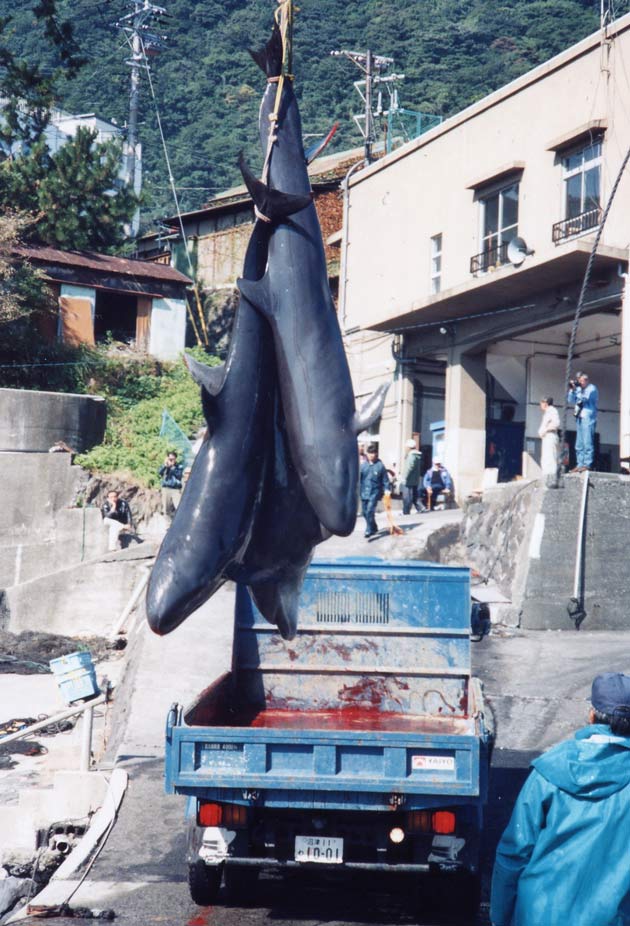
http://www.livescience.com/php/multimedia/imagedisplay/img_

display.php?pic=060920_futo_02.jpg∩=Slaughtered+dolphins+
in+Futo%2C+Japan.+Credit%3A+Hardy+Jones%2FELSA+Nature+
Conservancy+], and finally eviscerated alive.
And, to make it worse, some of the species of victims are on the threatened species list:
“The hunts kill bottlenose, striped, spotted and Risso's dolphins, as well as false killer whales and short-finned pilot whales. Most of these species are included on the World Conservation Union’s Red List of Threatened Species.”
Article:
Scientists Protest Dolphin Slaughter
http://news.yahoo.com/s/space/20060921/
sc_space/scientistsprotestdolphinslaughter
LiveScience Staff
LiveScience.com Thu Sep 21, 10:45 AM ET
Each September a months-long ritual starts up again in the Japanese villages of Taiji and Futo. Fishermen herd hundreds of dolphins into shallow bays by banging on partially submerged rods. Researchers say the dolphins are corralled into nets and then speared, hooked, hoisted by their tails [image -
http://www.livescience.com/php/multimedia/imagedisplay/

img_display.php?pic=060920_futo_02.jpg∩=Slaughtered+
dolphins+in+Futo%2C+Japan.+Credit%3A+Hardy+Jones%2
FELSA+Nature+Conservancy+], and finally eviscerated alive.
A new consortium of scientists and wildlife officials today called on the Japanese goverment to end the practice.
The “Act for Dolphins” campaign includes members from the New York Aquarium, Emory University, and the World Association of Zoos and Aquariums (WAZA). The group called the annual hunt "inhumane by any ethical standard" and said it "should be discontinued immediately."
“The Japanese dolphin drive hunts are an abominable violation of any standard of animal welfare, and these hunts inflict measurable pain and suffering on animals that are intelligent, sentient, and socially complex,” said Diana Reiss, Senior Research Scientist and Director of the New York Aquarium’s Marine Mammal Research Program.
According to the researchers, the Japanese government claims that the dolphins compete with local fishermen for limited supplies of fish and that the drives are a type of pest control. Act for Dolphins officials say the Japanese government encourages the public to consume more dolphin meat, and it is also used for pet food and fertilizer.
At the group's website, (www.actfordolphins.com) more than 23,000 signatures have been gathered in an effort to convince the Japanese government to end the hunts.
“The Japanese dolphin hunts are an assault on intelligent, sentient, and emotional beings with brains that should make us all stop and think” said Lori Marino, Senior Lecturer in Neuroscience and Behavioral Biology at Emory University.
The hunts kill bottlenose, striped, spotted and Risso's dolphins, as well as false killer whales and short-finned pilot whales. Most of these species are included on the World Conservation Union’s Red List of Threatened Species.
Thursday, June 23, 2005
More Easy Steps to Stop Whaling
In addition to last post, these easy actions need to be done.
International Fund for Animal Welfare
June 21, 2005
Several weeks ago, you sent more than 10,000 letters to several key countries asking them to vote against Japan's proposal to reopen the hunt for humpbacks in international waters.
Your heartfelt activism has already made an impact: In South Korea, the city of Ulsan (where this year's International Whaling Commission meeting is being held) has declared they will abandon plans to build a proposed whale and dolphin meat processing factory.
We are also encouraged by the early voting of the Government of China, which is asserting its leadership for whale conservation instead of just following Japan as it has done in past years.
The fate of humpback whales hangs in the balance
But the most important whaling votes are yet to come, including a resolution criticizing Japan's humpback whaling proposal. We need to keep the pressure on to make sure the songsters of the sea never have to face the cruelty and suffering of explosive harpoons ever again.
So far, Japan's efforts to push forward their pro-whaling agenda have been thwarted at this year's whale meeting, but Japan is working furiously to fly in other registered pro-whaling countries to shift the balance before the end of the week.
We can't come close to matching the millions of yen Japan's government is spending to push through their whaling agenda, but with your help (http://www.kintera.org/TR.asp?ID=M69547667416387215890665), we may be able to ensure conservation-minded countries carry the day at this year's meeting, protecting whales and the commission set up to protect them.
Please Tell As Many As You Can
In response to Japan's horrific proposal to slaughter humpback whales in international waters, we've created a Stop Whaling Action Center (http://www.kintera.org/TR.asp?ID=M69547677416387215890665) to collect as many signatures as we can from around the world. But we need your help to let others know about it (http://www.kintera.org/TR.asp?ID=M69547687416387215890665).
Can you help us reach 50,000 signatures?
Once you've signed the petition (http://www.kintera.org/TR.asp?ID=M69547697416387215890665), please pass it along to friends, family and neighbors who care about making sure we don't lose the songs of the sea forever. Simply click here to tell your friends (http://www.kintera.org/TR.asp?ID=M69547707416387215890665).
It's not too late to stop the killing of humpbacks in the open ocean. But we must act now. The crucial vote could come at any day during this week's IWC meeting.
It's also very expensive to send our team to Korea to fight to make sure the result of the IWC is whale conservation, not killing more whales. If you can make a contribution to support IFAW right now (http://www.kintera.org/TR.asp?ID=M69547717416387215890665), it would be greatly appreciated.
If we tell as many others as we can about the unfolding tragedy about to occur in our oceans, we can win this fight.
Sincerely,
Fred O'Regan
President and CEO
International Fund for Animal Welfare
June 21, 2005
Several weeks ago, you sent more than 10,000 letters to several key countries asking them to vote against Japan's proposal to reopen the hunt for humpbacks in international waters.
Your heartfelt activism has already made an impact: In South Korea, the city of Ulsan (where this year's International Whaling Commission meeting is being held) has declared they will abandon plans to build a proposed whale and dolphin meat processing factory.
We are also encouraged by the early voting of the Government of China, which is asserting its leadership for whale conservation instead of just following Japan as it has done in past years.
The fate of humpback whales hangs in the balance
But the most important whaling votes are yet to come, including a resolution criticizing Japan's humpback whaling proposal. We need to keep the pressure on to make sure the songsters of the sea never have to face the cruelty and suffering of explosive harpoons ever again.
So far, Japan's efforts to push forward their pro-whaling agenda have been thwarted at this year's whale meeting, but Japan is working furiously to fly in other registered pro-whaling countries to shift the balance before the end of the week.
We can't come close to matching the millions of yen Japan's government is spending to push through their whaling agenda, but with your help (http://www.kintera.org/TR.asp?ID=M69547667416387215890665), we may be able to ensure conservation-minded countries carry the day at this year's meeting, protecting whales and the commission set up to protect them.
Please Tell As Many As You Can
In response to Japan's horrific proposal to slaughter humpback whales in international waters, we've created a Stop Whaling Action Center (http://www.kintera.org/TR.asp?ID=M69547677416387215890665) to collect as many signatures as we can from around the world. But we need your help to let others know about it (http://www.kintera.org/TR.asp?ID=M69547687416387215890665).
Can you help us reach 50,000 signatures?
Once you've signed the petition (http://www.kintera.org/TR.asp?ID=M69547697416387215890665), please pass it along to friends, family and neighbors who care about making sure we don't lose the songs of the sea forever. Simply click here to tell your friends (http://www.kintera.org/TR.asp?ID=M69547707416387215890665).
It's not too late to stop the killing of humpbacks in the open ocean. But we must act now. The crucial vote could come at any day during this week's IWC meeting.
It's also very expensive to send our team to Korea to fight to make sure the result of the IWC is whale conservation, not killing more whales. If you can make a contribution to support IFAW right now (http://www.kintera.org/TR.asp?ID=M69547717416387215890665), it would be greatly appreciated.
If we tell as many others as we can about the unfolding tragedy about to occur in our oceans, we can win this fight.
Sincerely,
Fred O'Regan
President and CEO
Monday, February 27, 2006
Whale and Dolphin News in Brief
From wdcs.org
WHALE MEAT TURNED INTO DOG FOOD
Whale meat from
http://uk.wdcs.org/go/NL060223/whaling
GILL AND TANGLE NETS - WHAT ARE THEY AND HOW TO STOP THEM.
In recent weeks, large numbers of dead dolphins and porpoises, the victims of fishing nets, have washed up on the shores of south west
Gill and tangle nets, set to the sea bed, pose a real threat to dolphins and porpoises. Many fishermen that use these nets are now required under EU law to use acoustic 'pinger' devices designed to stop the animals from getting entangled and killed. However, the fishing industry has been reluctant to comply, arguing that the pingers are expensive and are unlikely to survive the rigours of the fishery.
Action is essential now. If pingers are not used, and demonstrated to be protecting dolphins and porpoises, then fishermen should not be allowed to continue using these nets. We are pressing the UK Government to take urgent and effective action.
Join us in our fight to save our dolphins and porpoises by sending an e-card to
http://uk.wdcs.org/go/NL060223/nets
CAPTIVE ORCAS IMPORTED TO
Despite receiving hundreds of letters of protest from WDCS supporters, the Spanish authorities have allowed the first import of orcas into the European Union for more than ten years.
Four orcas have been transported from Sea World,
A huge thank you to everyone who sent letters of protest to
http://uk.wdcs.org/go/NL060223/captivi
Following a number of whale strandings off the east coast of the
http://uk.wdcs.org/go/NL060223/strandi
UK: CORNWALL STUDY TO PROTECT DOLPHINS
In response to the large number of dolphin and porpoise deaths off the South West coast of England, WDCS scientists are monitoring populations in the area. This year, WDCS Consultant, Marijke de Boer is conducting a study in
http://uk.wdcs.org/go/NL060223/UKresea
US NAVY SONAR RANGE CHALLENGED
The civilian agency in charge of marine issues has challenged the US Navy’s plans to build an underwater sonar training range in the Atlantic Ocean.
http://uk.wdcs.org/go/NL060223/noise
TEN IRRAWADDY DOLPHINS DIE IN
The bodies of ten Irrawaddy dolphins, eight of them calves, have been found in
http://uk.wdcs.org/go/NL050223/irrawad
An unusual mass stranding of live Cuvier's beaked whales took place in
http://uk.wdcs.org/go/NL060223/strand2
UK: MARRA, THE TRAPPED DOLPHIN IS FREE
The bottlenose dolphin that was trapped in a dock in Maryport, UK since January 5th was freed by a team led by British Divers Marine Life Rescue (BDMLR).
http://uk.wdcs.org/go/NL060223/Marra
Wednesday, September 20, 2006
Japan At It Again: This Time, Beginning Annual Savage, Bloody Dolphin Slaughter
Yep, not only do they love to kill whales -
http://geari.blogspot.com/2006/02/
even-with-falling-consumer-demand.html - , the Japanese also love to slash up dolphins. And, it is literally, slashing.
The dolphin hunting season starts in October and continues through to March. The dolphins are driven into shallow bays and slashed to death then sold for meat. They kill about 20,000 dolphins every year.
"The water literally turns red with blood for a long time after the dolphins are killed – it's a blood bath that the whole world should be ashamed of."
Article:
Protests urge end to dolphin slaughter
http://www.news.com.au/story/0,10117,
20445444-1702,00.html?from=public_rss
September 20, 2006 02:54pm
Article from: AAP
Font size: + -
Send this article: Print Email
ANIMAL liberationists in Melbourne today joined protesters around the world in demanding the Japanese Government put an end to the slaughter of dolphins.
Two dozen protesters demonstrated outside the Japanese Consulate in Melbourne to bring public attention to the practice, which they say kills about 20,000 dolphins every year.
The demonstration was accompanied by protests around the world, including in London, New York, Paris, Mexico and Rome.
"The aim is to send a message to the Japanese Government that they can't hide the brutal and gruesome slaughter of dolphins that they sanction each year," said Animal Liberation Victoria spokesman Noah Hannibal.
Some of the protesters today wore white industrial bodysuits smeared in fake blood, while holding up posters condemning the brutal slaughter of dolphins and urging members of the public to sign a petition.
The dolphin hunting season starts in October and continues through to March where the dolphins are driven into shallow bays and slashed to death then sold for meat, Mr Hannibal said.
"It's a horrendous death for these animals," he said.
"The water literally turns red with blood for a long time after the dolphins are killed – it's a blood bath that the whole world should be ashamed of."
Mr Hannibal said the aim of the protest was to raise public awareness of dolphin slaughtering and prompt people to object to the Japanese Consulate.
"The Japanese Government is ashamed of this and they actually keep it hidden from the Japanese people," he said.
"They put tarps up all around the slaughter so no one can see it.
"(But) the world is watching and the fact that they give permits to kill in horrendously cruel ways 20,000 dolphins a year, they're going to be held accountable," he said.
http://geari.blogspot.com/2006/02/
even-with-falling-consumer-demand.html - , the Japanese also love to slash up dolphins. And, it is literally, slashing.
The dolphin hunting season starts in October and continues through to March. The dolphins are driven into shallow bays and slashed to death then sold for meat. They kill about 20,000 dolphins every year.
"The water literally turns red with blood for a long time after the dolphins are killed – it's a blood bath that the whole world should be ashamed of."
Article:
Protests urge end to dolphin slaughter
http://www.news.com.au/story/0,10117,
20445444-1702,00.html?from=public_rss
September 20, 2006 02:54pm
Article from: AAP
Font size: + -
Send this article: Print Email
ANIMAL liberationists in Melbourne today joined protesters around the world in demanding the Japanese Government put an end to the slaughter of dolphins.
Two dozen protesters demonstrated outside the Japanese Consulate in Melbourne to bring public attention to the practice, which they say kills about 20,000 dolphins every year.
The demonstration was accompanied by protests around the world, including in London, New York, Paris, Mexico and Rome.
"The aim is to send a message to the Japanese Government that they can't hide the brutal and gruesome slaughter of dolphins that they sanction each year," said Animal Liberation Victoria spokesman Noah Hannibal.
Some of the protesters today wore white industrial bodysuits smeared in fake blood, while holding up posters condemning the brutal slaughter of dolphins and urging members of the public to sign a petition.
The dolphin hunting season starts in October and continues through to March where the dolphins are driven into shallow bays and slashed to death then sold for meat, Mr Hannibal said.
"It's a horrendous death for these animals," he said.
"The water literally turns red with blood for a long time after the dolphins are killed – it's a blood bath that the whole world should be ashamed of."
Mr Hannibal said the aim of the protest was to raise public awareness of dolphin slaughtering and prompt people to object to the Japanese Consulate.
"The Japanese Government is ashamed of this and they actually keep it hidden from the Japanese people," he said.
"They put tarps up all around the slaughter so no one can see it.
"(But) the world is watching and the fact that they give permits to kill in horrendously cruel ways 20,000 dolphins a year, they're going to be held accountable," he said.
Wednesday, August 10, 2005
Infant Whale's Death at Vancouver Aquarium
Insane title for this article (see below). Let me give you a possible answer: captivity??
From: http://news.yahoo.com/news?tmpl=story&cid=1845&ncid=1845&e=
8&u=/cpress/20050809/ca_pr_on_na/whale_dies
Cause of infant whale's death at Vancouver aquarium may never be known
TIFFANY CRAWFORDTue Aug 9, 6:52 PM ET
VANCOUVER (CP) - Test results on the death of the Vancouver Aquarium's youngest beluga whale show Tuvaq was severely anemic when he died last month.
But scientists have been unable to link the condition to the infant whale's sudden and shocking death in the middle of a pool on July 17.
"It's only natural to try and say one is probably related to the other but there's no scientific basis for it and it has frustrated a lot of people so far," David Huff, the aquarium's veterinarian, told a news conference on Tuesday.
Huff said the two-year-old whale likely died from some kind of heart arythmia, but not a heart attack as some experts had previously speculated.
He called the lack of certainty into Tuvaq's cause of death "frustrating" but said the investigation was closed.
"The fact is the pathologists, who are about as academic as anybody around here, have signed off on the case and said this is as far as we've gone."
Huff said he compares the results to sudden infant death syndrome in human children.
"That's the most likely autopsy to produce nothing," said Huff, who stood in front of a tank where Laverne, a dolphin that was recently added to the aquarium, splashed about.
Laverne is a Pacific white-sided dolphin that was brought in to join Spinnaker, another dolphin at the aquarium.
A blood sample taken from Tuvaq four to six weeks before he died tested normal, said Huff.
The aquarium has ruled out disease and a lack of nutrition as possible causes of the death.
But Annelise Sorg of the Coalition for No Whales in Captivity wondered if Tuvaq had been chewing on the tank's plumbing and pumps and could have been poisoned.
"These animals are swimming in their own cesspool and I wonder if what wouldn't kill an adult beluga might kill a baby one," said Sorg.
Huff said the infant whale's fat deposits showed he was a healthy whale, suggesting the condition came on extremely fast.
"Tuvaq's blubber was very thick and if you've been dealing with a chronic debilitating disease that's been going on for a long time, the one thing (whales) can't hide is they do lose weight."
Meanwhile, marine experts at the aquarium say the new dolphin is getting along "very well" with Spinnaker.
"We want to do what's best for Spin and I feel that we've done that. Dolphins are social animals and having a companion such as Laverne is very important," said trainer Brian Sheehan.
Sorg said Spinnaker should be sent back to Japan where at least there he would be with a pod of dolphins that he was captured with.
"Captivity is unnatural," said Sorg. "It is wrong."
The aquarium sent its 23-year-old female beluga whale, Allua, to SeaWorld in San Diego on July 24. The whale was known as 'auntie' for nursing Tuvaq when his mother turned her back on him at birth.
Tuesday, August 03, 2010
Activist Brings Attention to the Cruelty of Dolphinariums (Captive Dolphin Activities)
I’m glad someone is finally speaking out about this. Seems many individuals are fooled by resorts and the like selling dolphinariums or captive dolphin activities as eco. Though this is in regard to Turkey, it applies to any entity in any part of the world fooling people and profiting off of this obvious cruelty.
As stated below, “[p]eople get into the water to be as free as dolphins, but, ironically, dolphins have no freedom anymore. They live captive lives in the pools where they are imprisoned…”
Article:
Activists urge boycott of Turkish dolphinariums
Sunday, August 1, 2010
İPEK EMEKSİZ
ISTANBUL - Hürriyet Daily News
Documentary producer Savaş Karataş holds posters urging people to boycott dolphinariums in Turkey.
A filmmaker who plans to swim the Dardanelles to raise awareness about the plight of captive dolphins joined a group of animal-rights activists Sunday in urging people not to visit the country’s dolphinariums.
“People get into the water to be as free as dolphins, but, ironically, dolphins have no freedom anymore. They live captive lives in the pools where they are imprisoned,” documentary producer Savaş Karataş told the Hürriyet Daily News & Economic Review on Sunday.
In a statement issued underwater along Istanbul’s Suadiye district coastline, the head of the Animal Rights Federation, or HAYTAP, objected to the use of dolphins for both entertainment and rehabilitative purposes, calling the latter unscientific as well as cruel.
“Treatment at dolphin aquatic parks, promoted as a way to give hope to families having children with disabilities, has no scientific basis,” said HAYTAP speaker Ege Sakin, adding that the ministries of health and environment should intervene to keep families from being deceived by such scams.
“The chlorinated water [in dolphinariums] burns the eyes of the dolphins and their sensitive skin is scratched by the nails of children using the animals as jet-skis,” Karataş said. “Since they are trapped within a too-small pool, they often hit the walls and close off their sonar systems from sending signals. As a result, they cannot communicate. They are deaf and numb.”
According to Karataş, the idea of opening dolphinariums in Turkey is an imitation of similar aqua-parks abroad, but Turkish authorities have mismanaged the capture and handling of dolphins. In European countries, he said, only dolphins that are defined as “orphans” – after being washed up onshore and separated from their families – can be used in such entertainment parks and must be treated first for any medical concerns.
“[In Turkey,] the Agriculture Ministry gave permission to capture 30 dolphins so it would not lose foreign currency by purchasing [orphan dolphins] from abroad,” Karataş said. “Around 24 dolphins were captured and one of them died during the operation.”
Animal rights have not been developed as a concept in Turkey and a law protecting them needs to be passed, Karataş said, explaining how he has initiated a “swim-in” protest, taking to the waters in the name of the captive dolphins that cannot in order to raise awareness about their treatment in the country’s approximately one dozen aquatic parks.
“I tried to show the tragedy of dolphins via my documentary. Now, I want to attract notice through swimming and make people question why they are participating in such entertainment shows where dolphins are unhappy,” Karataş said.
He already swam June 29 between Kaş, a tourist town in Turkey’s Antalya province and Kastelorizo, a small Greek island located 7.1 kilometers away in the southeastern Mediterranean; and July 18 in Istanbul’s Bosphorus for a distance of 6.5 kilometers. Another 6.5 kilometers await him in the Dardanelles off the coast of Çanakkale as he attempts to reach 20 kilometers in total.
Karataş previously shot the documentary “Saving Flipper” with the support of world-famous dolphin activist Richard O’Barry, who provided visual materials.
“We explained the journey of dolphins used as circus animals, brought from Japan to Turkey,” Karataş said. “Even if dolphins look like they are smiling during their performances, actually they are shedding tears.”
Noting that dolphins in aquatic parks are no different from the bears that were used to be forced to dance to live music on city streets, Karataş said: “Dolphins are in agony because [handlers] try to discipline them through hunger. Normally, they don’t eat dead fish, but they become accustomed to doing so since they have their performances at every meal time. Just for the sake of dead fish, they bounce balls and jump through hoops. How can we think that they are happy?”
Activists with HAYTAP are working with those in Greenpeace and the World Wildlife Fund to try and make dolphins’ voices heard. A sit-down strike is planned for Aug. 15 to demand the passing of an animal-rights law.
“If we cannot receive a result, we will go to Ankara on Oct. 4 and continue our action,” said Şule Baylan, the İzmir representative for the Protecting Nature and Animals Association, or DOHAYKO.
Friday, November 09, 2007
New Video From National Geographic Exposes the Horror of Japanese Dolphin Slaughter
This was emaild to me. The horrible truth is exposed via video. Please take the time to pass this along. As stated below, "Each year over 22,000 dolphins are hunted and slaughtered by Japanese fisherman during the six month hunting season."
Here is the link to the video:
http://video.nationalgeographic.com/video/player/news/animals-news/japan-dolphins-apvin.html
I thought you might be interested in this for your newsletter.
The Japanese tradition of dolphin hunting continued this year, despite international scrutiny and celebrity protesters. Heroes (NBC) Actress Hayden Panettiere was among the protesters who attempted to swim out to a pod of dolphins in danger.
Panettiere was visibly upset after fisherman prevented her and other protesters from reaching endangered dolphins.
Each year over 22,000 dolphins are hunted and slaughtered by Japanese fisherman during the six month hunting season. Japanese fishermen find the protests insulting to their cultural traditions.
Check out this compelling video from National Geographic.com:
http://video.nationalgeographic.com/video/player/news/animals-news/japan-dolphins-apvin.html
Jon ChappermPRm Public Relations5670 Wilshire Blvd., Ste. 2500 Los Angeles, CA 90036Phone: 323-933-3399, Ext. 4251 Fax: 323-939-7211Email: jchapper@mprm.com http://www.mprm.com/
Here is the link to the video:
http://video.nationalgeographic.com/video/player/news/animals-news/japan-dolphins-apvin.html
I thought you might be interested in this for your newsletter.
The Japanese tradition of dolphin hunting continued this year, despite international scrutiny and celebrity protesters. Heroes (NBC) Actress Hayden Panettiere was among the protesters who attempted to swim out to a pod of dolphins in danger.
Panettiere was visibly upset after fisherman prevented her and other protesters from reaching endangered dolphins.
Each year over 22,000 dolphins are hunted and slaughtered by Japanese fisherman during the six month hunting season. Japanese fishermen find the protests insulting to their cultural traditions.
Check out this compelling video from National Geographic.com:
http://video.nationalgeographic.com/video/player/news/animals-news/japan-dolphins-apvin.html
Jon ChappermPRm Public Relations5670 Wilshire Blvd., Ste. 2500 Los Angeles, CA 90036Phone: 323-933-3399, Ext. 4251 Fax: 323-939-7211Email: jchapper@mprm.com http://www.mprm.com/
Friday, June 24, 2005
The Japanese, and those in Norway, Iceland and Greenland Love to Kill Whales
This also includes a box which shows the numbers of Whales estimated to be slaughtered every year. I bet it's higher, as many do not report full facts.
In essence, the Japanese, and those in Norway, Iceland and Greenland love to kill whales. Surprisingly, even those in the Caribbean - St Vincent & Grenadines - like to kill whales too.
Reform likely on whaling process
In essence, the Japanese, and those in Norway, Iceland and Greenland love to kill whales. Surprisingly, even those in the Caribbean - St Vincent & Grenadines - like to kill whales too.
Reform likely on whaling process
| By Richard Black BBC environment correspondent in Ulsan, South Korea |
http://news.bbc.co.uk/2/hi/science/nature/4618763.stm
The International Whaling Commission's annual meeting has ended with the usual impasse between pro- and anti- groups.
Delegates in Ulsan, South Korea, could not agree on proposals to re-introduce commercial hunting, or on resolutions to reduce "scientific" whaling.
The latter will see whales killed at a higher rate in the next 12 months than at any time in the last two decades.
Support is now growing for a root and branch revision of the commission and the treaty which it administers.
Just about the only thing that unites pro- and anti-whaling nations is their frustration at the lack of progress on key issues, not only here in Ulsan but at previous annual meetings.
Constant conflict
The biggest issue of all is the Revised Management Scheme (RMS).
It is intended to be a comprehensive and globally accepted document establishing quotas and systems for all whaling fleets, making hunting sustainable, humane and policed.
| | [The convention] was adequate in 1946, but that's already about 60 years ago Giuseppe Raaphorst, Netherlands whaling commissioner |
Envisaged in 1992, it should, when introduced, bring to an end the current moratorium.
All members of the Commission might in principle support the RMS - the problem has been which RMS?
Japan, whose own version was rejected on a vote at this meeting, has been lambasted by conservation groups for preparing texts which, in their view, are weak on mechanisms to enforce compliance, come up short on animal welfare issues, and do not link RMS introduction to the end of scientific whaling, one of the principal loopholes in the current treaty, the International Convention for the Regulation of Whaling.
More conservation-minded nations have been equally determined in arguing that an RMS must cover these issues to a substantial degree.
Rune Frøvik, secretary of the High North Alliance, an umbrella group for fishermen and whalers in the Nordic countries, had harsh words for the IWC proceedings.
"They don't agree what should be on the agenda; it's just conflict all the time," he told the BBC News website.
"They say they want to continue with a process but in fact they are blocking progress.
"But when anti-whaling countries block the RMS, they are effectively endorsing whaling because legal whaling continues; it really says something about the IWC's relevance."
'Out of date'
The root cause of this situation, according to the whaling commissioner for the Netherlands, Giuseppe Raaphorst, is the convention itself; adopted in 1946, it was, he said, simply too old.
"It was adequate in 1946, but that's already about 60 years ago," he said.
| | THE LEGALITIES OF WHALING Objection - A country formally objects to the IWC moratorium, declaring itself exempt Scientific - A nation issues unilateral 'scientific permits'; any IWC member can do this Aboriginal - IWC grants permits to indigenous groups for subsistence food |
"Now whaling has become very problematic for many countries - actually most countries want it to be stopped - it's important that you have more control mechanisms and sanctions."
New Zealand's conservation minister Chris Carter agreed.
"At that time (1946) New Zealand was a whaling nation as well, we had a whaling industry," he told BBC News.
"We've moved on from there now; science tells us, public opinion tells us, increasing extinctions tell us that special creatures on Earth are at risk."
| | CURRENT MAXIMUM CATCHES Norway (objection) - 796 minke from the north Atlantic Japan (scientific) - 935 minke and 10 fin whales from Antarctic; 220 minke, 100 sei, 50 Bryde's and 10 sperm from north-west Pacific Iceland (scientific) - 39 minke from north Atlantic Greenland (aboriginal) - 187 minke and 10 fin Alaska & eastern Siberia (aboriginal) 140 grey and 67 bowhead St Vincent & Grenadines (aboriginal) 4 humpback Northern Hemisphere catches cover a calendar year; Southern Hemisphere figures span two calendar years |
The Netherlands and New Zealand are part of a developing movement which wants to resolve the impasse by re-examining the convention and the commission charged with administering it.
They believe it might be possible at ministerial level to tie whaling to other issues, such as trade or Japan's bid for a permanent seat on the United Nations Security Council.
Towards the end of this week-long meeting, the idea of a ministerial meeting was formalised in a resolution proposed by Ireland, Germany and South Africa.
It calls for further meetings of the IWC's RMS Working Group; and "...if appropriate, ministerial, diplomatic, or other high-level possibilities to resolve these issues among the Contracting Governments to the Convention."
Room for manoeuvre
The resolution was adopted by a substantial majority, and largely welcomed by conservation groups.
"We're certainly very pleased to be seeing an on-going process with the RMS," Philippa Brakes, science officer with the Whale and Dolphin Conservation Society, said.
"The resolution is nice and broad and incorporates the views of the entire commission; it moves us closer towards a higher-level diplomatic conference, which is a positive way to progress these issues."
I put the suggestion of a high-level conference to Joji Morishita, one of Japan's alternate (or deputy) commissioners, who retained his urbane poise throughout the week-long meeting in the face of some robust assaults from Australian and New Zealand delegates.
"This issue of whaling is so contentious that we don't like to extend that contention to other issues of international negotiations," he told me.
"But there might be some possibility by trading a different aspect of talks between countries.
"So it has a risk, but at the same time, technically, there might be some possibilities."
Story from BBC NEWS:Comments from delegates here suggest that a high-level meeting is likely, but probably not within the next 12 months.
The urgency of the issue, though, is illustrated by the number of whales that will be killed, legally, over the same period.
The figure is likely to approach 2,500 - more than in any year since the moratorium was imposed in 1986.
Next year's IWC meeting takes place in St Kitts and Nevis, one of the Caribbean states that usually puts itself in the pro-whaling camp.
http://news.bbc.co.uk/go/pr/fr/-/2/hi/science/nature/4618763.stm
Published: 2005/06/24 10:00:48 GMT
© BBC MMV
Subscribe to:
Posts (Atom)
Search for More Content

Custom Search
