Showing posts sorted by date for query dolphin japan. Sort by relevance Show all posts

Wednesday, September 01, 2010

Annual Cruel Dolphin Slaughter Begins in Taiji, Japan: The Documentary “The Cove” Has Attempted to Expose this Unspeakable Horror

I usually don’t make such a statement as really, almost all of the issues I cover are of extreme cruelty. But, this practice really pushes me to state it as one of the cruelest. This is literally a dolphin slaughter of extreme cruelty and proportion.

I’m hoping that in my life time this will end. One group has attempted to expose this practice.

Perhaps you’ve heard of the documentary “The Cove” that has attempted to expose this unspeakable horror. They literally had to go undercover to get the footage necessary to show the world just how horrible the Taiji dolphin slaughter is.

Here is the trailer for the movie:


The website for the movie is at http://www.thecovemovie.com/ and also lets you know what you can do to end this practice - http://www.takepart.com/thecove .

Japan, with its illegal continuation of whaling is still one of the world’s cruelest countries. It cares nothing for life. We can only hope that one day they wake up and end their love of death and cruelty.

Article:

Dolphin hunt kicks off in Japan 'Cove' town

http://www.google.com/hostednews/afp/article/ALeqM5hiTLwbby8nMONbMgY-

L91WPmDWFA

(AFP) – 7 hours ago

TOKYO — Fishermen from the Japanese town depicted in Oscar-winning eco-documentary "The Cove" kicked off their annual dolphin hunting season Wednesday, undeterred by international criticism.

A flotilla of boats went to sea in the morning but failed to catch any of the sea mammals on the first day, said a local government official from Taiji in southwestern Wakayama prefecture, who asked not to be named.

Every year, fishermen in Taiji herd about 2,000 dolphins into a secluded bay, select several dozen for sale to aquariums and marine parks and harpoon the rest for meat, a practice long deplored by animal rights activists.

The Taiji official said several foreigners with cameras were seen walking around town, but that there had been no protests and no confrontations between animal rights activists and pro-dolphin-hunting nationalist groups.

"I have no idea what the foreigners' intentions are, but there is nothing unusual going on in the town. Our stance remains the same. The town will continue hunting dolphins no matter what they say," said the official.

"The Cove", directed by Louie Psihoyos, won the Academy Award for best documentary this year, and has been followed up by a series that has started screening on cable channel Animal Planet called "Blood Dolphins".

The team that shot "The Cove" over several years often worked clandestinely and at night to elude local authorities and angry fishermen, setting up disguised cameras underwater and in forested hills around the rocky cove.

Individual fishermen in Taiji routinely decline to speak to foreign media, but they have the support of many local people in the town of 3,700 who defend hunting dolphins, porpoises and small whales as a centuries-old tradition.

Right-wing nationalist groups in Japan -- known for their ear-splitting street demonstrations using megaphones -- have attacked "The Cove" as anti-Japanese and tried to stop its screenings by harassing movie theatres.

Such harassment forced the film's distributor to scrap screenings in June, but it managed the first commercial showing at a police-guarded Tokyo theatre in July, despite a brief skirmish between right-wingers and supporters.

The official said Taiji had expected protesters against the dolphin hunts to flock to the town Wednesday but he told AFP: "I see no impact from the movie. The town's stance to continue dolphin hunting will not change either."

Activist Ric O?Barry, a central character in "The Cove", wrote in his blog that his campaign, Save Japan Dolphins, had called off a visit to Taiji after receiving news that "extreme nationalist groups are set to confront us".

Instead, he said he and other volunteers would on Thursday visit the US embassy in Tokyo "to symbolically present 1.7 million signatures from 151 countries" in a campaign to end the annual dolphin hunts.

Tuesday, August 03, 2010

Activist Brings Attention to the Cruelty of Dolphinariums (Captive Dolphin Activities)

I’m glad someone is finally speaking out about this. Seems many individuals are fooled by resorts and the like selling dolphinariums or captive dolphin activities as eco. Though this is in regard to Turkey, it applies to any entity in any part of the world fooling people and profiting off of this obvious cruelty.

As stated below, “[p]eople get into the water to be as free as dolphins, but, ironically, dolphins have no freedom anymore. They live captive lives in the pools where they are imprisoned…”

Article:

Activists urge boycott of Turkish dolphinariums


Sunday, August 1, 2010

İPEK EMEKSİZ
ISTANBUL - Hürriyet Daily News


Documentary producer Savaş Karataş holds posters urging people to boycott dolphinariums in Turkey.

A filmmaker who plans to swim the Dardanelles to raise awareness about the plight of captive dolphins joined a group of animal-rights activists Sunday in urging people not to visit the country’s dolphinariums.

“People get into the water to be as free as dolphins, but, ironically, dolphins have no freedom anymore. They live captive lives in the pools where they are imprisoned,” documentary producer Savaş Karataş told the Hürriyet Daily News & Economic Review on Sunday.

In a statement issued underwater along Istanbul’s Suadiye district coastline, the head of the Animal Rights Federation, or HAYTAP, objected to the use of dolphins for both entertainment and rehabilitative purposes, calling the latter unscientific as well as cruel.

“Treatment at dolphin aquatic parks, promoted as a way to give hope to families having children with disabilities, has no scientific basis,” said HAYTAP speaker Ege Sakin, adding that the ministries of health and environment should intervene to keep families from being deceived by such scams.

“The chlorinated water [in dolphinariums] burns the eyes of the dolphins and their sensitive skin is scratched by the nails of children using the animals as jet-skis,” Karataş said. “Since they are trapped within a too-small pool, they often hit the walls and close off their sonar systems from sending signals. As a result, they cannot communicate. They are deaf and numb.”

According to Karataş, the idea of opening dolphinariums in Turkey is an imitation of similar aqua-parks abroad, but Turkish authorities have mismanaged the capture and handling of dolphins. In European countries, he said, only dolphins that are defined as “orphans” – after being washed up onshore and separated from their families – can be used in such entertainment parks and must be treated first for any medical concerns.

“[In Turkey,] the Agriculture Ministry gave permission to capture 30 dolphins so it would not lose foreign currency by purchasing [orphan dolphins] from abroad,” Karataş said. “Around 24 dolphins were captured and one of them died during the operation.”

Animal rights have not been developed as a concept in Turkey and a law protecting them needs to be passed, Karataş said, explaining how he has initiated a “swim-in” protest, taking to the waters in the name of the captive dolphins that cannot in order to raise awareness about their treatment in the country’s approximately one dozen aquatic parks.

“I tried to show the tragedy of dolphins via my documentary. Now, I want to attract notice through swimming and make people question why they are participating in such entertainment shows where dolphins are unhappy,” Karataş said.

He already swam June 29 between Kaş, a tourist town in Turkey’s Antalya province and Kastelorizo, a small Greek island located 7.1 kilometers away in the southeastern Mediterranean; and July 18 in Istanbul’s Bosphorus for a distance of 6.5 kilometers. Another 6.5 kilometers await him in the Dardanelles off the coast of Çanakkale as he attempts to reach 20 kilometers in total.

Karataş previously shot the documentary “Saving Flipper” with the support of world-famous dolphin activist Richard O’Barry, who provided visual materials.

“We explained the journey of dolphins used as circus animals, brought from Japan to Turkey,” Karataş said. “Even if dolphins look like they are smiling during their performances, actually they are shedding tears.”

Noting that dolphins in aquatic parks are no different from the bears that were used to be forced to dance to live music on city streets, Karataş said: “Dolphins are in agony because [handlers] try to discipline them through hunger. Normally, they don’t eat dead fish, but they become accustomed to doing so since they have their performances at every meal time. Just for the sake of dead fish, they bounce balls and jump through hoops. How can we think that they are happy?”

Activists with HAYTAP are working with those in Greenpeace and the World Wildlife Fund to try and make dolphins’ voices heard. A sit-down strike is planned for Aug. 15 to demand the passing of an animal-rights law.

“If we cannot receive a result, we will go to Ankara on Oct. 4 and continue our action,” said Şule Baylan, the İzmir representative for the Protecting Nature and Animals Association, or DOHAYKO.

Sunday, June 13, 2010

Oscar-Winning Documentary "The Cove," Exposes the Truth of the Horror of the Annual Dolphin Hunt / Slaughter in Japan: As a Result, Japan Bans Film

Leave it to Japan to not only be cruel, but to attempt to hide their cruelty. They do it with whaling, so why not do it with murdering Dolphins? Sick and sad.

Article:

Japan dolphin hunt film triggers censorship debate
http://news.yahoo.com/s/ap/as_japan_dolphin_hunt_movie


By JAY ALABASTER, Associated Press Writer Jay Alabaster, Associated Press Writer – Thu Jun 10, 7:54 am ET

TOKYO – Controversy over "The Cove," an Oscar-winning documentary about the annual dolphin hunt in a Japanese village, has widened into a debate over free speech in the country.
Three theaters last week canceled showings of the movie after they were swamped with angry phone calls and threatened with noisy protests by nationalist groups. It was banned on a U.S. military base in Japan as too controversial, and 23 other theaters are still deciding whether to show the film, according to Japanese distributor Unplugged.

After the cancellations, a group of Japanese journalists, academics and film directors signed a letter urging the theaters not to back down and saying the issue "underlines the weakness of freedom of speech in Japan." Freedom of speech is guaranteed in Japan's constitution, but many

Japanese are wary of unruly demonstrations.
Nationalist groups, known for blasting slogans from truck convoys and handheld loudspeakers, often use the threat of protests as leverage. (Two years ago, angry phone calls led several theaters to cancel "Yasukuni," a movie about a Japanese war shrine that honors fallen soldiers, including executed leaders convicted as war criminals.) Below is a trailer for "The Cove":


On Wednesday, over 600 people crammed into a civic hall in Tokyo for a rare chance to see "The Cove," with lines forming hours before the doors opened and viewers spilling out into the lobby to watch via a video feed. Outside of small private showings, it was the first time the movie has been screened in Japan since October, when it was shown at the Tokyo International Film Festival.
The event had originally been planned to discuss the movie, which shows bloody scenes of a dolphin slaughter filmed by hidden cameras and portrays local fishermen as rough goons. But instead the event focused on the theater cancellations, reflecting the changing debate around the film.

"Protesters only threatened to do bad things, and then theaters got scared and pulled out," said Hiroyuki Shinoda, chief editor of "Tsukuru" magazine, which organized the showing.
Shinoda, who signed the protest letter last week, urged those present to contact theaters and ask that the movie be shown.
Ric O'Barry, a former trainer for the "Flipper" TV show who is the central character of "The Cove," made a surprise appearance at the screening. He is now a dolphin activist, but on Wednesday talked instead about freedom of speech and the large number of awards the movie has won.

"Those awards are given for entertainment value, and for that reason alone the Japanese people should be able to see it and make up their own mind," he said. It won best documentary at the Academy Awards this year.
Outside the hall, about two dozen police and plainclothes officers were on duty, but no protests took place, although a few people quietly handed out flyers calling for the movie to be banned. One flyer linked the movie with Sea Shepherd, an anti-whaling group that clashes with Japan's whaling fleet each year.
"Freedom of expression doesn't need to be recognized for a movie made by terrorists," it read.

"The Cove" includes an interview with Sea Shepherd founder Paul Watson. It is presented as the first documentary from The Oceanic Preservation Society, a group headed by Director Louie Psihoyos that lists Sea Shepherd as a partner.
Various right-wing groups consider the movie to be anti-Japanese, saying that dolphin hunts occur in other parts of the world and that any portrayal of animals being slaughtered for food would be bloody and unpleasant to watch.
The groups have led noisy protests outside of Unplugged's headquarters and the home of its president.

In Taiji, the small village where the hunt occurs, the local government and fishing cooperative defend dolphin hunting as a local custom with a long history. The mostly bottlenose dolphins killed in the hunt are not endangered, and hunts are also carried out in other parts of Japan — although very few Japanese have ever eaten dolphin meat.
A Japanese scientist and Taiji lawmaker who appear in the film say they agreed to do so without knowing it would be about the dolphin hunt, which Psihoyos has said is not true.
In the version of "The Cove" shown Tuesday and intended for release in Japan, disclaimers have been added saying those interviewed in the movie are not protesting or supporting dolphin issues. Unlike the U.S. version, the faces of most Japanese are blurred out.
A Japanese message states that data presented in the movie were gathered by and are the responsibility of the film's creators. The movie cites information about mercury levels in dolphins and falsely labeled dolphin meat that has been challenged by government officials.

Wednesday, February 20, 2008

Mercury in Dolphins may be only Issue that Stops Cruel Annual Japanese Dolphin Slaughter

Unfortunately, the Japanese were not going to see the obvious cruelty in the horrible dolphin slaughter. Perhaps the presence of mercury in their meat will be the only thing that does.

To see video proof of the horror of the annual Japanese dolphin slaughter see our posting on it at http://geari.blogspot.com/search?q=dolphin+japan

Article:

Mercury risk poses threat to Japanese dolphin hunt

http://www.iht.com/articles/2008/02/20/
asia/dolphin.php

By Martin Fackler

Published: February 20, 2008

TAIJI, Japan: For years, Western activists have traveled to this remote port to protest the annual dolphin "drive." And for years, local fishermen have ignored them, herding the animals into a small cove and slashing them until the tide flows red. But now a new menace may succeed where activists have failed: mercury.

This town of 3,500 residents on a majestic, rocky stretch of coast is fiercely proud of its centuries-old tradition of hunting dolphins and whaling. Residents are used to the international scorn that accompanies the dolphin drive, almost as much an annual ritual as the drive itself, and have closed ranks in the face of rising outrage - until now.

Dolphin meat is a prized local delicacy, served raw as sashimi or boiled with soy sauce. But in June, laboratory tests showed high levels of mercury in dolphin and pilot whale, a small whale that resembles a dolphin, caught and sold here. At the urging of two town council members, schools promised to stop serving pilot whale for lunch, and some local supermarkets removed it and dolphin from their shelves.

Rather than embrace the changes, this tight-knit community has been divided, with most local officials and the fishermen's union insisting that the mercury threat is being overblown, while a minority here has begun to question a tradition.

"We are not against whaling," including the dolphin hunts, said Junichiro Yamashita, one of the council members, who paid for the mercury tests himself after the town refused to pay. "This is a small town,

The problems are not limited to Taiji. Japan is one of the world's largest consumers of whales and dolphins, yet the Health and Agriculture ministries, as well as the media, have said little about the growing mercury levels in whale and dolphin meat.

Indeed, the whaling industry seems to enjoy a protected status here, mainly as a symbol of tradition, defended against foreign interference.

"There is a real danger in whale and dolphin meat, but word is not getting out," said Tetsuya Endo, a professor at the Health Sciences University of Hokkaido and an expert on mercury in sea animals.

Japan kills 1,000 minke and other great whales every year in controversial research whaling off the coast of Antarctica and in the northern Pacific. Japan calls the hunt "research" in order to avoid an international ban on commercial whaling, but then sells the meat to supermarkets. One hundred more whales and 21,000 dolphins are killed annually in coastal waters, according to Japan's Fisheries Agency.

Still, the meat is hardly a vital food source: only a minority of Japanese eat whale, and dolphin is even less common, consumed in a handful of rural areas and regional cities like Osaka.

Taiji is the best known source of dolphin meat, partly because it kills the most animals, about 2,000 annually, in a season that runs from September to April. In Taiji, fishermen use a method called oikomi, or "the drive," in which they bang on metal poles to create a wall of sound that pushes panicked dolphin and pilot whales into a cove for killing.

Gruesome photos of the blood-filled cove, and protests by mostly Western environmental groups, seem to have only strengthened the town's resolve to hold fast to its customs. According to the town's whaling museum, the people of Taiji have hunted coastal whales for 400 years. With few other sources of livelihood, whaling is a mainstay of the local economy.

"We are a whaling community, and we don't want to lose that," said Katsutoshi Mihara, chairman of Taiji's town council. "Here, all boys grew up dreaming of hunting whales." (The Japanese word for whaling, hogei, also encompasses hunting dolphins.)

The mayor and most town leaders point to a Health Ministry report that said the meats are safe in moderation.

Strong proponents of whaling like Mihara say they fear that the mercury scare may damage the popularity of dolphin meat, which accounts for about a third of the town's $3 million fishing industry, according to the fishermen's association. Dolphin also fetches higher prices than other locally caught seafood: in a Taiji supermarket, a pound, or about half a kilogram, of frozen dolphin meat recently sold for about ¥1,500, or $14, roughly the price of sashimi-grade tuna.

Taiji's mercury debate comes amid rising worldwide concern over mercury in other, more globally accepted types of seafood, particularly tuna. Like tuna, dolphins and small whales are predators that appear to be accumulating mercury as they feed on fish in the world's increasingly contaminated oceans.

In fact, dolphins can build up far more mercury than tuna because dolphins live to about 40 years, versus a decade for large tuna species, said Endo, of the University of Hokkaido.

When consumed by humans over an extended period, mercury can cause birth defects, brain damage and death. In fact, the world's worst case of mercury poisoning occurred in Japan in the 1950s, when thousands were killed, made ill or crippled in the city of Minamata from mercury dumped into the sea as industrial waste.

Endo participated in the studies that first brought mercury risks in dolphin to light. Since 2000, he has tested hundreds of samples of dolphin and whale meat around the country. In dolphin and pilot whale, he has typically found mercury levels ranging from 10 to 100 parts per million, far above the Japanese government's advisory level of 0.4 parts per million.

The most contaminated sample he ever found was from the internal organs of a pilot whale sold in a Taiji supermarket - 2,000 parts per million.

Despite the extreme sensitivity to mercury poisoning in Japan because of the Minamata case, the Health and Agriculture ministries have done little to inform the public about mercury in whale and dolphin meat, say Endo and other biologists. While the Health Ministry has done its own surveys of dolphin and pilot whale that show mercury levels of 10 to 50 times the advisory level, the only warning it has issued is for pregnant women.

Ministry officials say broader warnings are not needed because the higher levels are not a health risk for most people if they eat the meat infrequently, giving the body time to discharge the mercury. But critics accuse the government and media of ignoring the mercury issue, including the dispute in Taiji.

The same wall of silence exists in Taiji, many residents said. Yamashita and the other council member who raised the mercury issue, Hisato Ryono, said local newspapers had not written about their warnings, and city hall has said little in public about mercury.

To get word out, the two paid to have 1,900 fliers printed and sent to locals.

Several residents said they were shocked and alarmed when they read the fliers last summer. They also said they were angry at the town government's failure to address the concerns over mercury, adding that they no longer ate dolphin meat.

The residents refused to give their names for fear of being ostracized by their neighbors. "The flier is all I know about the mercury issue," said one 42-year-old woman, who said she was worried because her third-grade child had eaten pilot whale meat at school.

Older residents dismissed the mercury fears, saying they had eaten dolphin all their lives without ill effect.

Such generational differences may be what finally ends the dolphin hunt. Most of those under 40 no longer eat the meat, according to many residents.

"We're not saying that consumption of dolphin should disappear, but I think it's inevitable that it will," said Ryono, the council member. "As the older generation disappears, so will demand for dolphin meat."

Wednesday, January 09, 2008

Animal Rights News Year End Round Up for 2007 from DawnWatch

What better site to offer such an important synopsis.

Article:

DawnWatch Animal News year end round-up – 2007

http://www.indybay.org/newsitems/2008/01/07/18470939.php

by karen dawn

Monday Jan 7th, 2008 10:15 PM

DawnWatch Animal News year end round-up -- 2007

It's Christmas morning. Before I shut down my computer until January 3, 2008, I will enjoy fulfilling what has become a DawnWatch tradition -- a scan of the media stories of the year. Because I feel so blessed to do this work, Christmas morning seems the most perfect time to sum up a year of it.

For dogs, 2007 was the year of "fake fur" coats made from real dog fur, of the Menu pet food crisis, of celebrity pet store blunders, and the year of Michael Vick.

In February the Humane Society released a report telling us it had tested garments being sold at popular outlets and had found many garments labeled faux but containing real fur. Also, fur labeled as raccoon was sometimes from wild dog, or domestic dog, including a German shepherd-collie mix. The story got widespread media play, even in People magazine. While animal advocates may dislike the suggestion that dog fur coats are more repugnant than others, the dog angle got the media. The widespread coverage reminded the public that all fur coats were once live sentient animals.

On March 16, Menu Foods announced a recall of 91 pet food products sold under some of the country's best known brands. Early coverage reported 10-15 cats and dogs dying after eating canned and pouched foods. Sadly, that number was widely repeated by the media even when it became clear that it only included the cats and dogs who died in Menu's test lab -- not the true number of animals, which is estimated to be in the thousands. A superb piece published on the San Francisco Gate website, by Christie Keith, told us "Nearly one month passed from the date Menu got its first report of a death to the date it issued the recall. During that time, no veterinarians were warned to be on the lookout for unusual numbers of kidney failure in their patients. No pet owners were warned to watch their pets for its symptoms. And thousands and thousands of pet owners kept buying those foods and giving them to their dogs and cats." We have since learned, from the Toronto Globe and Mail, that the
chief financial officer of Menu Foods Income Fund sold nearly half his units in the pet food maker less than three weeks before the massive recall. He called the timing a "horrible coincidence."


This year the media occasionally featured Britney Spears and Paris Hilton. Falling into that focus were their purchases of puppies from a Bel Air pet store. For years, with limited success, animal folks have been trying to get the media to cover the horror of the puppy mills that supply pet stores. The Britney and Paris hook did the trick. The story gained momentum throughout the year, with Entertainment Tonight, in October, airing a puppy mill segment recorded for PETA by Charlize Theron some years ago. On the Saturday before Christmas, the biggest puppy buying day of the year, actorvist Carole Davis led others such as Law and Order's Richard Belzer and comedian Carol Leifer, in a protest outside the usually celebrity stocked pet store, and closed it down for the day. The protest got some great media, and you can watch the fun original video covering the event at http://www.youtube.com/watch?v=IyZdkCi-JzQ


In 2007, the hideous practice of dog fighting finally got massive media attention when Michael Vick was arrested for it. There were reports that he was involved in many dog deaths including the electrocution of a dog after she lost a fight. After failing polygraph tests while denying he killed dogs, Vick finally admitted to hanging a dog and eventually owned up to another dog killing. He was sentenced, in December, to twenty-three months in prison. The dogs taken live from his property have been retired to the Best Friends sanctuary. For a short time there was so much media ,Vick seemed to be the new Britney.


The scandal inspired a storyline on the hit drama series CSI, detailing the cruelties of dog fighting. It aired December 13 under the title "Lying Down With Dogs."

That brings us to the remarkable coverage this year of animal issues on mainstream television, in hit drama and comedy series:

In January, on the popular show "Veronica Mars," Veronica was hired to investigate the disappearance of a monkey stolen from the campus lab. We learn that while the animal rights kids were suspected, the monkey, Oscar, was actually taken by a science student who couldn't bear the thought of the monkey being euthanized, which was Oscar's fate at the lab. Thus millions of American teenagers learned the fates of monkeys who die in laboratories for trivial purposes. Of course, Veronica decided not to turn in the science student for his act of compassion.

Also in January, ABC's Boston Legal took a look at animal testing. Bethany defended Matthew, accused of harassing a woman named Bella who owned a cosmetic company that tested its products on animals. Matthew's organization had been protesting outside the business and saying it kills and tortures animals. When Bethany cross examined Bella, she said: "The truth is, you do kill and torture animals, do you not?...Your company uses rabbits..You lock them in stocks so that just their heads stick out. You clip their eyelids open and poor chemicals into their eyes while they are left there for two weeks to experience ulceration, bleeding, and massive iris deterioration. Do you not subject these animals to excruciating pain?...Sometimes the rabbits break their own necks trying to escape."


Later in the year, in December, David Kelly and Boston Legal took on meat and the environment. In one episode, the head of an environmental organization was distressed to see massive energy waste at the law firm's offices. He sued, claiming that the firm had misrepresented itself as green. Cross examining the head of the green group, the lawyer asked if he eats meat, and explained, "I only ask because studies show eating meat contributes more to greenhouse gases than driving a car. Denny says you two often have rib-eye together. Is that true?" When the defendant said he didn't believe eating meat is worse for the environment than driving a car, the lawyer responded, "It is. Contaminated runoff from slaughterhouses is a major source of water pollution. Livestock itself contributes 18% of greenhouse gases just from, pardon me, farting. That's more than all the planes, trains and automobiles put together."


Boston Legal takes its storylines from current affairs. How wonderful that this year both animal testing and the impact of meat diets on the planet were current affairs deemed important and topical.


Even on comedy shows, serious animal issues were tackled. In April, on The King of Queens, Doug found a live chicken for whom he developed affection. He and the audience were treated by his neighbor to a film about slaughterhouses. Doug went veggie. By the end of the episode he could no longer withstand the onslaught of the fast food advertising campaigns; he gorged on burgers. But the issue was portrayed in such a way that Doug's lack of will power, while funny, was also sad. In fact the topic of animals and meat was handled with surprising sensitivity throughout the episode.


The boys on HBO's Entourage rescued a racehorse who was bound for "the glue factory," reminding viewers of the fate of the losers.


And even reality TV got into the act. On Fox's "The Two Coreys," one Corey supported PETA and invited a PETA representative over to show slaughterhouse footage to the other.


HBO, known for its superb documentaries, this year aired "I am an Animal," about Ingrid Newkirk, the founder of PETA. If you missed it, you can get it "On Demand" or on Netflix. It is a fascinating documentary, which includes animal cruelty information everybody should know - and which, thanks to HBO, quite a few people now do know.

The Wall Street Journal covered Smithfield's announcement that it will phase out sow gestation crates. Those are individual cages in which sows spend much of their lives. They are too small for the animals to turn around or lie down in with legs outstretched. The phase-out will be over ten or twenty years, so we continue to push for bans. This year Oregon became the first state to pass a legislative ban on the crates. In 2008 we hope to make California the third state to do so by ballot initiative. The initiative will include bans on restrictive cages for calves raised for veal, and for laying hens.


Even Wolfgang Puck went welfare, announcing early this year that he would no longer sell foie gras, and that he would introduce animal welfare standards for the meat prepared in his food empire. He also vowed to introduce more vegetarian dishes.


Last year there was much news about elephants; this year some of it turned good. Los Angeles's Ruby was retired to the PAWS sanctuary in Northern California. And Maggie, the lone elephant in Africa for years, has just joined her. The Alaskan zoo finally agreed to let Maggie go after she collapsed in her barn twice in a week, unable to stand without the help of local firefighters. We thought we were going to lose her but she is now safe at the sanctuary.

While we continue to spread the word about the animal cruelty of circuses, unfortunately the widely watched Bachelor took a group date to one this year. But we see other signs of light. Last weekend, as Ringling arrived in Florida, the Palm Beach Post published a searing indictment by Florida radio host Duncan Strauss. You can read it at http://tinyurl.com/ywpr44

The Bachelor also swam with dolphins. The UK Independent did a piece in January focusing on the link between dolphin slaughter and the use of live dolphins for human entertainment -- such as in swim with dolphins programs. It told us that thousands of dolphins are chased and killed, with a few of the best specimens being sold live to the highest bidders, for tens of thousands of dollars each. Only a celebrity ensures coverage in America, and this year, during Japan's annual dolphin slaughter in November, the dolphins got Hayden Panettiere, the young star of Heroes. She accompanied Ric O'Barry to the Taiji killing beach. The media went mad. Shows such as "E" and "The Insider" covered the story. Even though they needed the celebrity hook, the coverage was not fluff. The Insider included horrifying footage and pointed viewers to http://www.savejapandolphins.org/ to get involved and try to help bring the annual slaughter to an end.


Paul Watson and Sea Shepherd's work for the whales was featured in a lengthy New Yorker story, and in an interview on NPR's Diane Rehm Show with the author of Whale Warriors.


Efforts to ban horse slaughter remained in the news through 2007. We learned from a Houston Chronicle front page story that the closure of US slaughterhouses has led to mass trucking of unwanted horses on long journeys to Mexico for slaughter - in facilities where no humane laws apply. The American Horse Slaughter Prevent Act, which would ban not only US horse slaughter but also the transport of horses to slaughter elsewhere, is now needed more that ever. At https://community.hsus.org/campaign/FED_2007_horse_slaughter3 you can send letters to your legislators urging their support.

Animal issues also got indirect but important coverage this year as those who refuse to eat or wear animals hit the trendy mainstream. 2007 was the year of Vegan Chic. We saw Today Show coverage of Vegan accessories, a piece in The Boston Globe on a professional image consultant whose specialty is vegan fashion, an article in Forbes magazine on a high-end vegan shoe-designer, and leading papers publishing articles such as "Style goes vegan."

The New York Times Dining Section featured vegan chef Isa Chandra Moskowitz on its cover, in an article titled, "Strict Vegan Ethics, Frosted With Hedonism." Newsweek broached marriages between vegans and omnivores. And, astounding to many of us, this year Gourmet Magazine announced that it would start running regular vegetarian features, and editor Ruth Reichl wrote "how much more food there would be if we all ate vegetables instead of feeding the plants to the animals and eating their meat." She also wrote, "It is becoming increasingly clear that we ought to change our ways. We live in a society that consumes more meat than any other group in history. There are currently more than three billion domesticated cattle, sheep and goats in the world - and that number does not include the 100 million pigs or the 9 billion chickens that we consume every year in this country alone. Livestock grazing and feed production now use 30 percent of the surface of the planet, and that takes
a toll on the environment. Eating so much meat takes a toll on us as well: Most health professionals agree that we would be better off if we consumed less meat and more vegetables."

The same magazine, in June, covered chicken slaughter, sharing gruesome details of standard practices. Gourmet!
Veganism's move to the mainstream got a push from Skinny Bitch, a vegan diet book that sold well from the start, but which hit the number one spot on the New York Times best seller list after Victoria Beckham was spotted with a copy. 850, 000 copies are now in print!

Vegan fighter Mac Danzig won Spike TV's "Ultimate Fighter" championship.

And the New York Times Magazine section's "7th Annual Year in Ideas" included "Vegansexuality," the term for those who seek intimate partners who share their compassionate lifestyle.

Perhaps vegetarianism saw its hottest mainstream spike when vegan actress Alicia Silverstone promoted vegetarianism in an advertising campaign - naked. If you missed the spot you can still see it at http://www.peta.org/feat/alicia_psa/index.asp.

And check out Jimmy Kimmel's monologue from his September 20 show. It includes a spoof on the ad that is well worth watching. The monologue is on line at http://www.youtube.com/watch?v=EYOVELcTnu4 and you can skip to 7:50 to watch the Alicia segment.

This year, at Thanksgiving, there were so many articles on vegetarian feasts that DawnWatch couldn't possibly cover them all. I had to "settle" for the New York Times Thanksgiving Day front page article on turkey rescue!

Activists taking the animal protection message into faith based communities made news with a lead article in The Los Angeles Times. The article noted the work of Best Friends, and of the new "animals and religion" program at HSUS, and of Bruce Friedrich from PETA. The Los Angeles Times also covered PETA's undercover investigation of a hen farm run by a Trappist Monastery in South Carolina. We learned that the monks were raising the hens under standard industry conditions, and learned the cruelty of those conditions. Just before Christmas the monastery announced that it will halt its egg farming business.

Also late this year, Foxnews.com published two groundbreaking pieces about shocking cruelty at a pig slaughterhouse - just in time for the Christmas ham season.

We wish Gretchen Wyler had been alive to see them - and all of this years' amazing coverage. In May we lost the Golden Age Broadway star who founded the Genesis Awards, an award show as glamorous as she was, which honors animal friendly media. We will miss her but know that her legacy, the Genesis Awards, is stronger than ever. What a media selection there will be to choose from this year!

I have been working on DawnWatch for eight years. Every year, as I look back and see the immense increase in the amount and depth of coverage of animal issues I get a little weepy. We are getting somewhere. I thank all of you who care. This year I particularly thank the many of you who made my job easier and helped out everybody, by sending me media tips and links when I could not find the time to dig them up. Many of you know I have spent most of the year writing and putting together a book. It is called "Thanking the Monkey: Rethinking the Way We Treat Animals," and will be published by Harper Collins in March. I so look forward to readings and to meeting some of the thousands of wonderful activists behind the email addresses I see on my screen. Your care and commitment is changing the world.


Wishing us all joyous holidays that renew our strength for the compassionate campaigns of 2008,
Yours and the animals',
Karen Dawn


(DawnWatch is an animal advocacy media watch that looks at animal issues in the media and facilitates one-click responses to the relevant media outlets. You can learn more about it, and sign up for alerts at http://www.DawnWatch.com. You may forward or reprint DawnWatch alerts if you do so unedited -- leave DawnWatch in the title and include this parenthesized tag line. If somebody forwards DawnWatch alerts to you, which you enjoy, please help the list grow by signing up. It is free.)

Friday, November 09, 2007

New Video From National Geographic Exposes the Horror of Japanese Dolphin Slaughter

This was emaild to me. The horrible truth is exposed via video. Please take the time to pass this along. As stated below, "Each year over 22,000 dolphins are hunted and slaughtered by Japanese fisherman during the six month hunting season."

Here is the link to the video:

http://video.nationalgeographic.com/video/player/news/animals-news/japan-dolphins-apvin.html

I thought you might be interested in this for your newsletter.

The Japanese tradition of dolphin hunting continued this year, despite international scrutiny and celebrity protesters. Heroes (NBC) Actress Hayden Panettiere was among the protesters who attempted to swim out to a pod of dolphins in danger.

Panettiere was visibly upset after fisherman prevented her and other protesters from reaching endangered dolphins.

Each year over 22,000 dolphins are hunted and slaughtered by Japanese fisherman during the six month hunting season. Japanese fishermen find the protests insulting to their cultural traditions.

Check out this compelling video from National Geographic.com:

http://video.nationalgeographic.com/video/player/news/animals-news/japan-dolphins-apvin.html

Jon ChappermPRm Public Relations5670 Wilshire Blvd., Ste. 2500 Los Angeles, CA 90036Phone: 323-933-3399, Ext. 4251 Fax: 323-939-7211Email: jchapper@mprm.com http://www.mprm.com/

Monday, November 20, 2006

Coalition of Marine Scientists Has Launched a Campaign to Halt Japan's Annual Dolphin Slaughter: Dolphins Herded Into Shallow Coves to Be Slaughtered

It’s about time that this group steps up against this barbaric and unnecessary practice

Article:

WP: Scientists fight Japan's dolphin hunt
Others defend value of tradition

http://www.msnbc.msn.com/id/15791885/


Scientists fight Japan's dolphin hunt

By Rick Weiss
The Washington Post
Updated: 11:13 p.m. MT Nov 19, 2006

A coalition of marine scientists has launched a campaign to halt Japan's annual "dolphin drive," in which thousands of bottlenose dolphins are herded into shallow coves to be slaughtered with knives and clubs.

The government-sanctioned event, which extends through the fall and winter, has been under fire for years from environmental and animal rights activists.

But in a potentially influential escalation of that battle, mainstream scientists and administrators of zoos and aquariums -- some of whom have been criticized for buying surviving dolphins for use in their shows -- have united to condemn the practice.

The campaign pits the emerging science of animal intelligence against a centuries-old cultural tradition.

In an online statement being released today, the organizers -- including many of the world's leading dolphin scientists and the man who trained the television star Flipper -- say the hunt is nothing less than a ritual massacre of creatures that, according to a growing body of research, are not just intelligent but sophisticatedly self-aware.

The statement calls for the Japanese government to stop issuing permits allowing the hunt and for a halt to the purchase of dolphins caught in the drive. It also aims to get 1 million people to sign an online petition to the government.

Diana Reiss, director of the marine mammal research program at the New York Aquarium's Osborn Laboratories of Marine Science, said in a statement that the hunt is "a brutal and inhumane practice that violates all standards for animal welfare."

With co-worker Lori Marino of Emory University, Reiss showed five years ago that dolphins can recognize themselves in a mirror, an aspect of cognitive complexity that previously had been documented only in humans and chimpanzees.

'Kind of our cultural activity'
Takumi Fukuda, the fisheries attache at the Japanese Embassy in Washington, defended the event as a centuries-old national tradition.

"It is kind of our cultural activity," he said. "We think it is important."

Fukuda said the government has already limited the practice to economic development zones, where fishermen are struggling to get by. And he said the government issues permits for only the number of animals that can safely be culled without threatening the species' survival.

This year 21,000 dolphins can be killed, Fukuda said, of which 15,000 or 16,000 have already been killed.

Although little discussed within Japan, the dolphin drive has gained international notoriety, especially as opponents have secretly filmed the event. Fishermen use nets and noise to herd hundreds of dolphins, pilot whales and other marine mammals into shallow waters, then kill the animals according to local traditions.

Most fishermen use knives to cause them to bleed to death, turning the waters red.

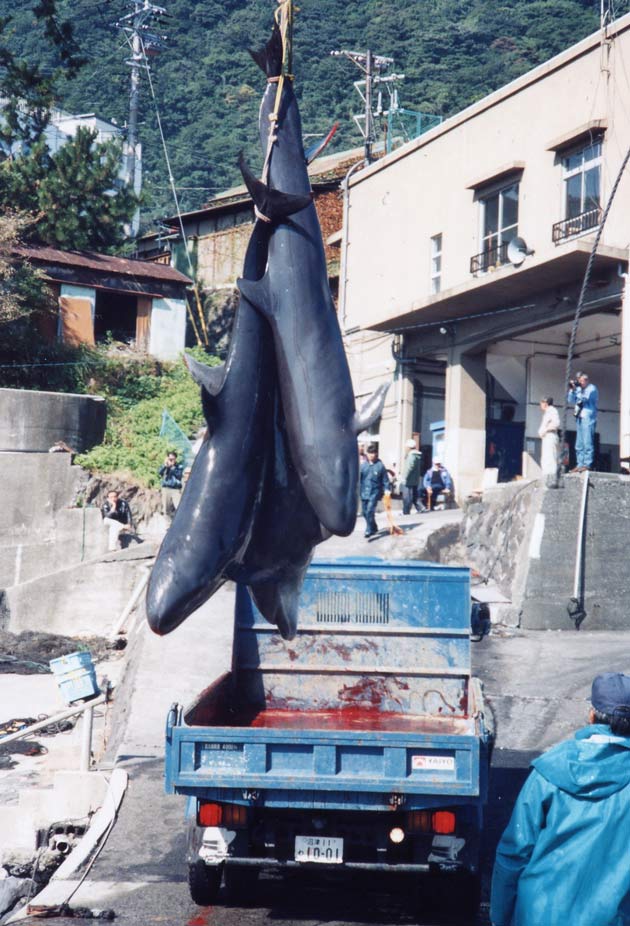
Sometimes live dolphins are hoisted on ropes tied around their tail fins, said Paul Boyle, a former director of the New York Aquarium and now chief executive of the Ocean Project, an umbrella organization for more than 800 institutions worldwide working to increase awareness of oceanic issues through collaborations with zoos and museums.

Dolphins are essentially weightless in water but weigh as much as 800 pounds on land, Boyle said. When they are hung, their backbones, which resemble human spines, are wrenched apart.

"It must be excruciatingly painful," Boyle said, noting that humans complain bitterly when experiencing pain from a ruptured disc in the spine. "When we show people video from past events, every person has the same response. They say it is the most inhumane thing they have ever seen."

The hunt -- centered largely on the towns of Taiji and Futo -- has in recent years been visually obscured by the erection of white tents on floating platforms.

It is "quite natural . . . no one wants to expose the killing scene to the public, like no meat company wants to release pictures from the killing scene in their slaughterhouses," Fukuda said. "We should understand that all animal killing scenes contain certain cruelty."

The new move to use public pressure caps two years of talks between a committee of marine mammal experts and Japanese government officials. The scientists presented peer-reviewed scientific information about dolphin brain anatomy, intelligence, social behavior, ecology and physiology -- all of which ultimately proved pointless, said Reiss, who was involved in the negotiations.

Fate of the meat
Details, including the citizens petition and a statement from scientists, are being posted at http://www.actfordolphins.org.

Adding to the controversy is the fate of the meat obtained from the hunt. In years past, most was eaten in Japan. Opponents say dolphin is not popular among Japanese and the meat is mostly used for fertilizer or pet food, a claim Japanese officials deny.

Fukuda said the hunt is consistent with Japanese philosophy. "Our way of thinking is that marine resources should be used, based on a sustainable-use basis," he said.

He added that there is a growing awareness among fishermen of a need for more humane methods.

"We understand and think it is necessary to shorten the time until the dolphin dies, so we have been trying to shorten the times," he said.

But critics said there is no appropriate way to hunt animals as smart and complex as dolphins.

Hal Whitehead, who studies whale and dolphin social systems at Dalhousie University in Halifax, Nova Scotia, said dolphins are among the few animals known to live in multicultural communities, in which groups of individuals that have been taught to do things -- such as catch prey -- in different ways live together.

"Whales and dolphins are at least as sophisticated as the nonhuman great apes," Whitehead said, noting that Japan has been a leader in gaining protections for monkeys and apes.

Because dolphins learn from one another, he said, major cullings can have a serious impact on surviving individuals' ability to persevere. "When you remove a bunch of animals, you remove not only them but the knowledge that they have."

The World Association of Zoos and Aquariums, which represents more than 12,000 zoos and aquariums globally, passed a resolution in 2004 prohibiting the procurement of cetaceans from dolphin drives. But a number of smaller enterprises, many of them in Asia, have reportedly continued to do so.

Thursday, October 19, 2006

Iceland Resume Whaling: An Excellent Article On Whaling And The Truth Of The Issues Surrounding It: Do That Many People Really Eat Whale?

I have to say, this is probably the best piece on whaling and the issues surrounding it that I have read. Not only does it show the idiocy of the act, but also that really, it’s only done for political reasons. Very few people eat whale as, like any thinking person, they’re disgusted by it! Also, at the very end, there’s a very good list of the different species of whales and their status in terms of endangered. A must read. Overall a very disturbing situation, but helpful one that will change.

Here are some quotes from the article below that discuss the reality of why Iceland whales and the true numbers in it’s population who actually eat whale.

“And there is barely a market for the catch. In 2004, just a quarter of the whale meat taken by the Icelandic whaling fleet was actually sold. The country's industrial freezers are full of unsold whale from previous seasons. A recent poll of Icelanders by anti-whalers found that only 1% of Icelanders eat whale meat once a week or more, while 82.4% of 16- to 24-year-olds never eat whale meat. Meanwhile, the international market is saturated. The Norwegians, who maintain whaling to keep their remote northern coastal communities politically sweet, failed to meet their quota of whales last year, yet still had to turn some of the catch into pet food. Meanwhile, the Japanese are reportedly handing it out to schoolchildren.

Whaling doesn't matter very much, culturally or economically, to anyone in Iceland. But behind this decision is a real fear that if we allow ourselves to be dictated to about whaling, then the world will start telling us what we can and cannot fish. This is what is really important. The real issue is fishing, and safeguarding our fishing grounds."

Article:

Death on the high seas

http://environment.guardian.co.uk/conservation
/story/0,,1925584,00.html

Iceland's decision to resume commercial whaling has made it an international pariah - and blown a 20-year moratorium on hunting out of the water. But since no one actually wants to eat whale, why are the harpoonists heading out again? John Vidal reports

Thursday October 19, 2006
The Guardian

Fishermen slaughter a 10m-long bottlenose whale / whaling
Fishermen slaughter a 10m-long bottlenose whale at the Wada port, east of Tokyo Photograph: Yoshika Zutsuno / AFP


I first tasted whale almost 10 years ago in the Faroe Islands. An unhappy hunter was getting drunk on one side of me, telling me about his urge to kill the largest creatures in the sea, and a secondary school headmaster who ran the islands' whaling association was kicking his shins under the table trying to keep him quiet. Even as the whaler slumped senseless in his cups, the plate of steaming minke arrived.

Article continues
Every mouthful was a political and cultural booby trap, every forkful an invitation to offend a nation of blubber lovers. But I was genuinely divided. The fatty blubber was, honestly, rather tasty; but the black flesh was tough and rank as old puffin or wildebeest. "Ah," said the headmaster, quite enjoying my mixed reaction. "When we eat whale, we don't eat it to enjoy. We eat it to remind us who we are." Ha ha.

Yesterday, 280,000 Icelanders were reminded who they are: pariahs of the big green world community of animal lovers. As their government announced the breaking of an international moratorium that has banned commercial whaling worldwide for 20 years, the Australian government called Iceland's decision "a disgrace", and just about every western environmental group leapt to fire cliches at them. Icelanders were condemned as "irresponsible", "unacceptable" and "insane", and the decision was "the thin end of a dangerous wedge" and "deliberately provocative". Japan and Norway, the world's only other significant-sized whaling countries, watched the reaction carefully and, despite all the outrage, may now move to follow Iceland's lead.

In fact, however, Iceland's decision has changed very little. The three main whaling countries have never accepted the ban and have been effectively whaling commercially ever since it was imposed. Diplomatically, they have called it "scientific" whaling and, under the cloak of research, have been allowed to carry on killing as before. Iceland has, since 2003, been given a "quota" of 39 minke whales a year, enabling its scientists to declare that whales eat a lot of fish and that stocks of minke and several other species in the north Atlantic are in good health. Not, of course, that there was any need to kill several hundred whales to find this out.

Iceland's decision to resume commercial whaling is probably based on fear, more than money or even self-image. Polls have repeatedly shown that 70-80% of Icelanders support commercial whaling and the government has long threatened to play the nationalist card. It also claims that the industry is economically essential to the country. This, though, is nonsense. All of Iceland's whaling is done by one company, owned by one powerful family in Reykjavik who are subsidised by the Icelandic government. While the government says it is economically essential to continue whaling, there is little evidence that it supports more than a few seasonal jobs. Indeed, whale watching is far more important to the country.

And there is barely a market for the catch. In 2004, just a quarter of the whale meat taken by the Icelandic whaling fleet was actually sold. The country's industrial freezers are full of unsold whale from previous seasons. A recent poll of Icelanders by anti-whalers found that only 1% of Icelanders eat whale meat once a week or more, while 82.4% of 16- to 24-year-olds never eat whale meat. Meanwhile, the international market is saturated. The Norwegians, who maintain whaling to keep their remote northern coastal communities politically sweet, failed to meet their quota of whales last year, yet still had to turn some of the catch into pet food. Meanwhile, the Japanese are reportedly handing it out to schoolchildren.

Sigrun Davidsdottir, an Icelandic novelist and economic analyst, says that whaling was never a major economic factor in Iceland. "Foreigners were whaling in Icelandic waters from the 15th century, even running whaling stations there. In 1916, Iceland banned whaling to protect its dwindling fish stocks. Whaling was only a seasonal activity and most products were exported. It amounted to roughly 2% of the export of fish products. As in Norway and Japan, the issue is about the right to whale.

"The Icelandic republic was only founded in 1944 - the country had been under Danish rule - and, in the Icelandic mind, the battle for independence is still going on. Whaling doesn't matter very much, culturally or economically, to anyone in Iceland. But behind this decision is a real fear that if we allow ourselves to be dictated to about whaling, then the world will start telling us what we can and cannot fish. This is what is really important. The real issue is fishing, and safeguarding our fishing grounds."

But whaling is far too important to be left to whalers. For north American, British and European environmental groups, it is now the most important symbol of man's abuse of the global commons, and arguably animal conservation's greatest global success. The commercial ban, which has prevented thousands of whales being killed, is both popular and politically important. For most western governments with active animal conservation groups, being on the side of the whales is the one time they can be seen to support green activists. Indeed, the genuine passion with which the British and American governments have fought to maintain the whaling ban is only matched by their deep ambivalence about green issues in many other international meetings.

Humans' attitudes to whales have turned full circle in only two generations. From medieval times, whales - and their first cousins, dolphins - were regarded as no more than an economic resource and were slaughtered in vast quantities for oil, meat, "baleen" and ambergris whenever they came near European or American shores. The operation was strictly coastal: watchmen manned lookout towers and when whales were sighted, rang a bell to alert the boat crews. But as boats improved, the slaughter of the whales reached epic proportions. Populations were devastated in all oceans as an unregulated industry spread around the world. By the middle of the 20th century, many whale populations were severely depleted and by 1945 it was quite likely that some would be completely exterminated within years rather than decades.

The tide turned in the 1970s with the birth of Greenpeace. Images of small boats bobbing in front of harpoonists, and individuals trying to save whales from commercial hunters were some of the most potent of the past 50 years - they spoke of opposition to authority, protection of the innocent and, especially, revulsion at previous generations' casual slaughter of life. Images of bloody whales, vivid accounts of lingering deaths and film of harpoons exploding deep in whales' flesh revolted a generation and kickstarted both the animal rights movement and international conservation efforts.

Here is Captain Paul Watson, one of the original Greenpeace activists and now of Sea Shepherd conservation society, talking about the first time he tried to save a whale: "Above us a muscular blond ape of a man swivelled a mounted 90mm cannon. Jutting out from its mouth: a grenade harpoon five feet in length, with foot-long barbed flanges pivoted on hinges. The hooked flanges were bound down with light rope, waiting for the shock of impact to unleash its awesome promise of destruction. He was concentrating on the whales, oblivious to our presence. We were proud traitors to our species with the innocence to believe that somehow, someway, we could reach our fellow man with a message to end the whale wars and to silence the harpoon cannons."

Along with the horror at how they were being killed came wonder and knowledge at how whales lived. They were given human attributes, found to sleep about eight hours a day, communicate with each other through song and give birth to a single calf. The young were found to mature late, the old to live for as long as humans.

Sceptical scientists say that this does not make them intelligent, but earlier this year new research suggested that whales and dolphins have something close to self-awareness. Bottlenose dolphins were shown to be able to recognise themselves in a mirror, a behaviour that until recently has only been recorded in humans and great apes. And some were found to carry sponges on the ends of their beaks to protect them when foraging for food on the seabed.

Mark Simmonds, director of science for the Whale and Dolphin Conservation Society, who published the evidence, is convinced that whales are emotional, intelligent beings: "Evidence of the typically human emotions - grief, parental love and joy - as well as the existence of complex social interactions and structures are indicators of the highly developed intelligence of whales and dolphins," he says. "In one example, despite the risk of dehydration, stranding and shark attack, a group of false killer whales floated for days in the shallows of the straits of Florida to protect an injured male. Such was their cohesion and reliance upon the group that individuals became agitated when rescuers tried to separate them, calming only when reunited."

Iceland's decision to resume commercial whaling comes at the most sensitive time for international whaling in a generation and threatens to set back marine conservation many years. Earlier this year, led by Japan and Norway, 30 small and poor developing countries with no real interest in whaling gained control of the International Whaling Commission (IWC), the body that regulates worldwide whaling. Spurred by Iceland, it is possible that Norway and Japan will now leave the IWC and take a number of small countries with them. At the very least, the pro-whaling nations now hold the majority of votes, and the IWC is being slowly driven to abandon its conservation and welfare mandate.

Meanwhile, the whale wars are set to intensify, with the Japanese fleet preparing to head to the southern ocean in a few weeks' time to kill endangered whales, and environmentalists ready to risk life and limb to stop them. "Iceland has just changed the rules. It's going to get bloody," said one conservationist yesterday.

Endangered? A guide to whales

Northern right whale The most endangered large whale in the world; the population is estimated to be about 350 animals. It was the first whale to be protected, in 1935, but numbers have barely recovered. Prized for centuries for its oils and bone.

Bowhead whale Commercial whaling severely depleted stocks in the early 1900s. Since the mid-1960s, the IWC has classified bowheads as protected and in the 1970s they were added to the Endangered Species List. Bowhead whales live exclusively in Arctic and sub-Arctic waters.

Blue whale The largest animal that has ever lived was down to perhaps 1,000 by 1950. Hunting stopped in 1967 and stocks are recovering. The latest estimate revealed 15,000 blue whales remaining worldwide. Pre-whaling populations were estimated at perhaps 300,000 individuals.

Fin whale Too fast for early whalers to catch, but nearly three-quarters of a million were killed from the early 1900s until the 1970s. They are now highly protected and numbers have recovered well.

Sei whale The global population is estimated at only 57,000, but numbers have plummeted following Japanese hunting. More than 25,000 were killed in 1964/5.

Beluga whale Highly sociable creatures that move in large pods. Numbers stand at around 100,000. One of the commonest whales, but populations are in peril in some areas.

Beaked whale Poorly known and believed to be very rare. Beaked whales are a deep-water, deep-diving species only rarely encountered by humans.

Sperm whale Sperm whales have the largest brain and were widely hunted because of the large quantity of sperm oil in their heads, which was sold for making candles and make-up. Populations have recovered, and are now stable at around 1 million.

Grey whale Hunted to the edge of extinction in the 1850s and again in the early 1900s. They were given full protection in 1947 and they have made a remarkable recovery. In 1999, there were 26,600 grey whales

Humpback whale Among the most endangered of the great whales. Population estimates suggest 2,000-4,000 remaining in the western North Atlantic. They are popular with whale watchers, and are known as the most vocal of all whales.

Minke whale At around 10 tonnes, the minke is the smallest of the seven great whales. Norway, Iceland and Japan argue that the minke is abundant and have been killing them regularly, even though they are on the endangered list.

Friday, September 22, 2006

More on Annual Japanese Dolphin Slaughter: Consortium of Scientists and Wildlife Officials Today Called On the Japanese Government to End the Practice


Very promising to see a group of scientists officially protesting this horrible event. There has been a website set up to help at www.actfordolphins.com

Here is a synopsis of the brutality that occurs:
Each September a months-long ritual starts up again in the Japanese villages of Taiji and Futo. Fishermen herd hundreds of dolphins into shallow bays by banging on partially submerged rods. Researchers say the dolphins are corralled into nets and then speared, hooked, hoisted by their tails [image -
http://www.livescience.com/php/multimedia/imagedisplay/img_
display.php?pic=060920_futo_02.jpg∩=Slaughtered+dolphins+
in+Futo%2C+Japan.+Credit%3A+Hardy+Jones%2FELSA+Nature+
Conservancy+], and finally eviscerated alive.

And, to make it worse, some of the species of victims are on the threatened species list:

“The hunts kill bottlenose, striped, spotted and Risso's dolphins, as well as false killer whales and short-finned pilot whales. Most of these species are included on the World Conservation Union’s Red List of Threatened Species.”


Article:

Scientists Protest Dolphin Slaughter

http://news.yahoo.com/s/space/20060921/
sc_space/scientistsprotestdolphinslaughter

LiveScience Staff

LiveScience.com Thu Sep 21, 10:45 AM ET

Each September a months-long ritual starts up again in the Japanese villages of Taiji and Futo. Fishermen herd hundreds of dolphins into shallow bays by banging on partially submerged rods. Researchers say the dolphins are corralled into nets and then speared, hooked, hoisted by their tails [image -
http://www.livescience.com/php/multimedia/imagedisplay/
img_display.php?pic=060920_futo_02.jpg∩=Slaughtered+
dolphins+in+Futo%2C+Japan.+Credit%3A+Hardy+Jones%2
FELSA+Nature+Conservancy+], and finally eviscerated alive.

A new consortium of scientists and wildlife officials today called on the Japanese goverment to end the practice.

The “Act for Dolphins” campaign includes members from the New York Aquarium, Emory University, and the World Association of Zoos and Aquariums (WAZA). The group called the annual hunt "inhumane by any ethical standard" and said it "should be discontinued immediately."

“The Japanese dolphin drive hunts are an abominable violation of any standard of animal welfare, and these hunts inflict measurable pain and suffering on animals that are intelligent, sentient, and socially complex,” said Diana Reiss, Senior Research Scientist and Director of the New York Aquarium’s Marine Mammal Research Program.

According to the researchers, the Japanese government claims that the dolphins compete with local fishermen for limited supplies of fish and that the drives are a type of pest control. Act for Dolphins officials say the Japanese government encourages the public to consume more dolphin meat, and it is also used for pet food and fertilizer.

At the group's website, (www.actfordolphins.com) more than 23,000 signatures have been gathered in an effort to convince the Japanese government to end the hunts.

“The Japanese dolphin hunts are an assault on intelligent, sentient, and emotional beings with brains that should make us all stop and think” said Lori Marino, Senior Lecturer in Neuroscience and Behavioral Biology at Emory University.

The hunts kill bottlenose, striped, spotted and Risso's dolphins, as well as false killer whales and short-finned pilot whales. Most of these species are included on the World Conservation Union’s Red List of Threatened Species.

Wednesday, September 20, 2006

Japan At It Again: This Time, Beginning Annual Savage, Bloody Dolphin Slaughter

Yep, not only do they love to kill whales -
http://geari.blogspot.com/2006/02/
even-with-falling-consumer-demand.html - , the Japanese also love to slash up dolphins. And, it is literally, slashing.

The dolphin hunting season starts in October and continues through to March. The dolphins are driven into shallow bays and slashed to death then sold for meat. They kill about 20,000 dolphins every year.

"The water literally turns red with blood for a long time after the dolphins are killed – it's a blood bath that the whole world should be ashamed of."

Article:

Protests urge end to dolphin slaughter

http://www.news.com.au/story/0,10117,

20445444-1702,00.html?from=public_rss

September 20, 2006 02:54pm
Article from: AAP

Font size: + -

Send this article: Print Email

ANIMAL liberationists in Melbourne today joined protesters around the world in demanding the Japanese Government put an end to the slaughter of dolphins.

Two dozen protesters demonstrated outside the Japanese Consulate in Melbourne to bring public attention to the practice, which they say kills about 20,000 dolphins every year.

The demonstration was accompanied by protests around the world, including in London, New York, Paris, Mexico and Rome.

"The aim is to send a message to the Japanese Government that they can't hide the brutal and gruesome slaughter of dolphins that they sanction each year," said Animal Liberation Victoria spokesman Noah Hannibal.

Some of the protesters today wore white industrial bodysuits smeared in fake blood, while holding up posters condemning the brutal slaughter of dolphins and urging members of the public to sign a petition.

The dolphin hunting season starts in October and continues through to March where the dolphins are driven into shallow bays and slashed to death then sold for meat, Mr Hannibal said.

"It's a horrendous death for these animals," he said.

"The water literally turns red with blood for a long time after the dolphins are killed – it's a blood bath that the whole world should be ashamed of."

Mr Hannibal said the aim of the protest was to raise public awareness of dolphin slaughtering and prompt people to object to the Japanese Consulate.

"The Japanese Government is ashamed of this and they actually keep it hidden from the Japanese people," he said.

"They put tarps up all around the slaughter so no one can see it.

"(But) the world is watching and the fact that they give permits to kill in horrendously cruel ways 20,000 dolphins a year, they're going to be held accountable," he said.

Friday, June 09, 2006

Whale and Dolphin News

This is from a different group at http://www.wdcs.org. They are committed to bring news regarding whales and dolphins. As usual, there are many unfortunate issues to deal with, including Japan illegally whaling. Please read on.

It’s now less than two weeks until the start of this year’s meeting of the International Whaling Commission, where the fate of the world’s whales hangs in the balance. With whaling countries killing more whales every year, adding new, endangered species to their target list and pushing for a full-scale resumption of commercial whaling, our work at this meeting has never been more crucial.

You too can join our campaign to end commercial whaling for good. Over the coming weeks, we’ll bring you all the whaling news from the meeting and highlight how you can get involved in our campaign, starting with Save the Whale Week!

WHALE AND DOLPHIN NEWS IN BRIEF

Japan’s North Pacific hunt starts
Four ships, including a factory storage vessel, have set sail from Japan for its annual whale hunt in the North Pacific in defiance of the moratorium on commercial whaling.
http://www.wdcs.org/dan/publishing.nsf/allnews/
0A6360AD295A728B80257178003274D1

WDCS and CMS join forces to seek solutions
WDCS and CMS (Convention of Migratory Species of Wild Animals) are calling on all countries that have any interaction with the world’s oceans to start solving the problems that face whales and dolphins.
http://www.wdcs.org/dan/publishing.nsf/allnews/
D5CFADF2032B6F1A8025717600476267

Friendly dolphin is refloated in Cumbria, UK
Marra, the friendly bottlenose dolphin rescued earlier this year from a dock in Cumbria, has stranded and been refloated.
http://www.wdcs.org/dan/publishing.nsf/allnews/
1C685406EF618B58802571700031D2EA

Dolphins threatened by indiscriminate oil exploration
Dolphins and porpoises are being put at risk by UK Government plans to open up the whole of the Irish Sea, including supposedly protected areas, to allow businesses to prospect for oil and gas.
http://www.wdcs.org/dan/publishing.nsf/allnews/
32D7D16BF6DE45528025716F005B24BB

Japan hoping to boost whale meat sales
A new company has been set up in Japan in an effort to increase sales of whale meat by supplying the products to schools, hospitals and family restaurants.
http://www.wdcs.org/dan/publishing.nsf/allnews/
83F71F01C8A53C938025716B00327A61


SAVE THE WHALE WEEK

Imagine if you could help WDCS stop commercial whaling and protect whales and dolphins all over the world by throwing a party. Well that’s just what we’re asking you to do.

July 6th – 15th 2006 is our very first Save the Whale Week and we are asking people to get involved by having a party or organising an event to raise money. This is your chance to stand up to the unnecessary cruelty these wonderful animals face.

All you need to do is get yourself a FREE Save the Whale Week Party Pack and organise a party or event, get sponsored.

It’s a chance to raise money and have fun while you’re doing it!

To get hold of your free party pack, please go to:
http://www.wdcs.org/savethewhaleweek, e-mail events@wdcs.org or call our Events team on +44 (0)1249 449500


JOIN US IN WALES TO WATCH DOLPHINS

Join our travel wing, out of the blue, on a short break to see bottlenose dolphins and other wildlife of the beautiful Cardigan Bay area.

The trip includes the chance to see bottlenose dolphins, harbour porpoises, seals and seabirds, as well as enjoying scenic coastal walks in this beautiful, remote part of Wales.

We’ve got limited availability left for this summer – so book now to be sure of a place!

For more information please call Rob or Lucy on 01249 449 533/ 547
http://www.wdcs.org/outoftheblue

Monday, February 27, 2006

Whale and Dolphin News in Brief

From wdcs.org

WHALE MEAT TURNED INTO DOG FOOD


Whale meat from Japan’s ever increasing whale hunts is being turned into dog food.

Japan’s stockpile of whale meat has doubled in the past decade as a result of an increase in the number of whales killed. Government officials have admitted that stockpiles are rising and they are looking to find new markets. WDCS was shocked to find a website selling whale meat for pets, claiming the products are ‘fished freshly out of the water’, ‘organic’, ‘safe and healthy’ and ‘made in factories where whale meat is processed for human consumption’.

http://uk.wdcs.org/go/NL060223/whaling


GILL AND TANGLE NETS - WHAT ARE THEY AND HOW TO STOP THEM.

In recent weeks, large numbers of dead dolphins and porpoises, the victims of fishing nets, have washed up on the shores of south west England. Each year, thousands die in this way threatening the survival of entire populations.

Gill and tangle nets, set to the sea bed, pose a real threat to dolphins and porpoises. Many fishermen that use these nets are now required under EU law to use acoustic 'pinger' devices designed to stop the animals from getting entangled and killed. However, the fishing industry has been reluctant to comply, arguing that the pingers are expensive and are unlikely to survive the rigours of the fishery.

Action is essential now. If pingers are not used, and demonstrated to be protecting dolphins and porpoises, then fishermen should not be allowed to continue using these nets. We are pressing the UK Government to take urgent and effective action.

Join us in our fight to save our dolphins and porpoises by sending an e-card to UK Fisheries Minister, Ben Bradshaw outlining your concerns. To send your e-card now, please go to:


http://uk.wdcs.org/go/NL060223/nets

CAPTIVE ORCAS IMPORTED TO TENERIFE

Despite receiving hundreds of letters of protest from WDCS supporters, the Spanish authorities have allowed the first import of orcas into the European Union for more than ten years.

Four orcas have been transported from Sea World, USA to a new captive orca facility at Loro Parque, Tenerife. The cruel practice of keeping orcas in captivity could also have an impact on wild populations, as low survival rates in captivity may mean more are captured to supply the industry.

A huge thank you to everyone who sent letters of protest to Spain. The level of opposition to the imports did not go unnoticed and will help WDCS with future campaigns to end captures and international trade in orcas. In more positive news, following a local campaign supported by WDCS, Mexico recently banned the import and export of marine mammals for commercial purposes.

http://uk.wdcs.org/go/NL060223/captivi


UK: ARE HUMAN ACTIONS TO BLAME FOR WHALE DEATHS?
Following a number of whale strandings off the east coast of the UK, WDCS is highlighting the need to identify whether human actions are to blame.
http://uk.wdcs.org/go/NL060223/strandi


UK: CORNWALL STUDY TO PROTECT DOLPHINS
In response to the large number of dolphin and porpoise deaths off the South West coast of England, WDCS scientists are monitoring populations in the area. This year, WDCS Consultant, Marijke de Boer is conducting a study in Cornwall. To read extracts from her research diary, please go to:
http://uk.wdcs.org/go/NL060223/UKresea


US NAVY SONAR RANGE CHALLENGED
The civilian agency in charge of marine issues has challenged the US Navy’s plans to build an underwater sonar training range in the Atlantic Ocean.
http://uk.wdcs.org/go/NL060223/noise


TEN IRRAWADDY DOLPHINS DIE IN CAMBODIA
The bodies of ten Irrawaddy dolphins, eight of them calves, have been found in Cambodia’s Mekong river, putting one of the rarest dolphins in the world even closer to extinction.

http://uk.wdcs.org/go/NL050223/irrawad


SPAIN: MYSTERIOUS BEAKED WHALE STRANDINGS
An unusual mass stranding of live Cuvier's beaked whales took place in Spain on the 26th January. The stranding appears to have coincided with naval activities. All the whales have since died.
http://uk.wdcs.org/go/NL060223/strand2


UK: MARRA, THE TRAPPED DOLPHIN IS FREE
The bottlenose dolphin that was trapped in a dock in Maryport, UK since January 5th was freed by a team led by British Divers Marine Life Rescue (BDMLR).
http://uk.wdcs.org/go/NL060223/Marra

Thursday, December 01, 2005

Your support of the captive dolphin industry when you go to Sea World, etc. directly supports dolphin slaughter. Is it really worth it?

Read on to see what I mean....

Sick, sick, sick issue this is. You'll see in the article below. And you'll see, they not only kill dolphins to eat, but also to supply the international dolphin captivity industry, to be kept in aquariums, trained to perform at dolphinariums or for swim-with-dolphin
programs. So you see, your support of the captive dolphin industry when you go to Sea World, etc. directly supports dolphin slaughter. Is it really worth it?

http://www.japantimes.co.jp/cgi-bin/
getarticle.pl5?fe20051130a1.htm

'Secret' dolphin slaughter defies protests

By BOYD HARNELL
Special to The Japan Times

Japan's annual slaughter of thousands of dolphins
began Oct. 8 in the traditional whaling town of Taiji
on the Kii Peninsula of Honshu's Wakayama Prefecture.
These "drive fisheries" triggered demonstrations, held
under the "Japan Dolphin Day" banner, in 28 countries.
The protests went almost entirely unreported in Japan,
where only very few people are aware of what goes on.

The culling, spanning a period of six months, is
officially condoned as part of traditional culture,
and is described as "pest control" by practitioners.
However, it is the inhumane way in which the mammals
are killed, by stabbing and spearing them, that
especially provokes such widespread revulsion.

Taiji fishermen begin the oikomi (fishery drive) by
going out to sea in motor boats to locate pods of
dolphins. They then place long steel poles with
flared, bell-like ends into the water and bang them to
create a wall of sound that amplifies underwater and
drives their prey into a narrow cove. Once there, the
dolphins' escape is cut off by nets strung across the
mouth of the cove. The following day -- after they
have rested so, it is thought, their meat becomes more
tender -- they are herded into another cove nearby
where the slaughter is carried out. Much of the meat
is then processed for human consumption -- even though
eating it could well be a very foolhardy thing to do.

A video with footage shot at Taiji in January 2004 by
One Voice, a French-based animal rights group, and
other footage from a similar oikomi in Futo, Shizuoka
Prefecture, by a cameraman who requested anonymity,
shows dolphins thrashing about wildly as they try to
escape and the water turns red.

Drive fisheries appear to be carried out in as much
secrecy as possible, and the killing cove in Hatagiri
Bay at Taiji is hidden between two mountains. There, a
gigantic tarp is strung over the shoreline to cut off
the view from land, and paths leading to the cove are
closed off with chains and posted with signs reading
"No Trespassing!" and "Keep Out, Danger!" said Ric
O'Barry an official with One Voice.

O'Barry, a former trainer of the dolphins used in the
U.S. television series "Flipper," recently returned
home to Miami from Taiji after shooting footage of
freshly killed dolphins being lifted onto a pier in
the harbor there. Speaking prior to his departure,
O'Barry said that the Taiji dolphin-killers are proud
of what they do, and boast of a tradition dating back
400 years. "However," he commented, "if they are so
proud of this, why do they take such pains to hide
their activity?"

O'Barry said he met with the local Taiji fishery group
and offered them a subsidy to stop the killings, but
was rebuffed and told the dolphins were "pests" that
competed with the commercial fishery. Noting that
there are no scientific studies showing dolphins are
responsible for falling fish stocks in the area,
O'Barry cited overfishing as the probable cause.

But it is not just those doing the killing who make
every effort to hide it from the world. Japanese
officials also strongly discourage outsiders from
seeing, recording or protesting the blood-letting.

During a fishery drive on Nov. 18, 2003, two members
of the Washington state-based Sea Shepherd
Conservation Society were arrested by police from
Taiji's neighboring town of Shingu for jumping into
freezing waters and releasing 15 dolphins trapped in a
net awaiting slaughter. The pair, Alex Cornelisson
from the Netherlands and American Allison
Lance-Watson, were held without bail and only released
on Dec. 9, 2003, after being indicted and fined for
"forceful interference with Japanese commerce."
Meanwhile, two other Sea Shepherd members staying in a
trailer park in Taiji had their cameras, film,
computer and some personal belongings confiscated by
police, according to an online news release from the
group. Undeterred, Sea Shepherd is offering a $10,000
reward to anyone who provides the best footage of the
drive fishery.

In response to allegations that the oikomi dolphins
suffer from shock and die slowly, in a Sept. 19, 2005,
letter to British-based animal welfare and
conservation charity the Born Free Foundation, Jun
Koda, Counselor of the Japanese Embassy in London,
said: "In some small parts of our country we have a
long tradition of consuming dolphin meat. Japanese
fishermen are careful to minimize suffering as soon as
possible and cause as little pain to the dolphins as
possible."

Koda went on to say that the dolphin "almost instantly
meets its end within a maximum of 30 seconds and does
not suffer any pain."

A rebuttal from Born Free said the data in which Koda
based his claim is taken from Faeroe Island dolphin
hunts in the North Atlantic, which have not been
subject to independent scrutiny and hence have no
bearing on the Japanese culls. Koda's assertions are
also countered by observers from One Voice and Sea
Shepherd, who have reported seeing wounded dolphins
writhe in pain for almost six minutes before
succumbing to their wounds.

Meanwhile, another Japanese official was equally
forthright in countering critics' objections to
killing dolphins for food. In a telephone interview
this month, Hideki Moronuki, assistant director of the
whaling section in the Far Seas Fishery Division of
the Ministry of Agriculture, Forestry and Fisheries,
expressed the view that, "If someone eats a cow, why
should one object to a dolphin being eaten; they're
all mammals."

He added, "If Australians want to eat kangaroos, we
don't care. . . . Please do not care what Japanese do.
. . . Dolphins and whales are part of Japanese food
culture."

Furthermore, speaking in English, Moronuki expressed
his view that dolphins are killed humanely in the
fishery drives. Then, comparing the slaughter of a
dolphin to that of a cow or a pig, he declared:
"Killing is killing."

O'Barry believes this is the attitude of most Japanese
fishermen. "They don't think of dolphins as
intelligent, highly complex animals that love to play
and interact with people," he said.

But such sentiments are not confined to welfare and
conservation groups.

On April 6, 2005, U.S. Sen. Frank Lautenberg, a
Democrat from New Jersey, sponsored Senate Resolution
99, "Expressing the sense of the Senate to condemn the
inhumane and unnecessary slaughter of small cetaceans
. . . in certain nations." The submission, currently
referred to the Committee on Foreign Relations, not
only cites the fact that "those responsible for the
slaughter prevent documentation or data from the
events from being recorded or made public," but it
describes how, "each year tens of thousands of small
cetaceans are herded into small coves in certain
nations, are slaughtered with spears and knives, and
die as a result of blood loss and hemorrhagic shock."

C.W. Nicol, the renowned environmentalist, author,
whaling expert and Japan Times columnist, recently
made an M.B.E. by Queen Elizabeth II, witnessed the
Taiji dolphin slaughter while living there in 1978.
Speaking last week, he said: "It's been a cancer in my
gut ever since. It's no good to kill an animal
inhumanely, and to do so is not to the advantage of
Japan."

However, not all the captured dolphins are killed.
Every year, an unknown number of healthy young
specimens are selected and removed from the killing
coves to be sold into the international dolphin
captivity industry, to be kept in aquariums, trained
to perform at dolphinariums or for swim-with-dolphin
programs. At Taiji, those involved appear to reap rich
rewards in this way, and O'Barry said he was told
there that the fishery drives would stop and those
carrying them out would go back to catching lobsters
and crabs if they were not offered huge sums for
"show" dolphins.

Echoing this, Nicol said he vehemently opposes the
dolphin massacre, adding, that "dolphins not selected
for dolphinariums should be returned to the sea."

However, in a further, darkly ironic twist, serious
health issues would seem to surround meat from the
slaughtered animals, which is available at
supermarkets in Shizuoka Prefecture and Kyushu.

At present, Hiroyuki Uchimi of the Japanese health
ministry's Food Safety Division explained, the
provisional advisory safety levels set in 1973, and
still in effect for methyl mercury, are 2 micrograms a
week for pregnant women and 3.4 micrograms a week for
all others, including children, for each kilogram of
body weight.

But according to Tetsuya Endo, a member of the
Pharmaceutical Sciences faculty at Hokkaido's Health
Science University, mercury in a sample of the meat he
tested in 2003 from a supermarket in Ito, Shizuoka
Prefecture, was 14.2 times higher than the
government's maximum advisory level. "It is terrible,"
he said this month.

Endo's finding was amply supported by those of a
2000-2003 joint survey of small cetacean food products
sold in Japan by the Daichi College of Pharmaceutical
Sciences in Fukuoka, Kyushu, the university where Endo
works, and the School of Biological Sciences in
Auckland, New Zealand. Published in 2005, this found
that all dolphin food products "exceeded the
provisional permitted levels of 0.4 micrograms per wet
gram for total mercury and 0.3 micrograms per wet gram
for methyl mercury set by the Japanese government. The
highest level of methyl mercury was about 26
micrograms per wet gram in a food sample from a
striped dolphin, 87 times higher than the permitted
level." Methyl mercury is a particularly dangerous
form of mercury, a neurotoxic metal.

The paper concluded, "The consumption of red meat from
small cetaceans . . . could pose a health problem for
not only pregnant women, but also for the general
population."

Despite this -- and that Senate Resolution 99, which
cites "warnings regarding high levels of mercury and
other contaminants in meat from small cetaceans caught
off coastal regions" -- health warnings are not posted
on the labels of such food products sold in Japan.

In addition, critics of the drive fisheries claim
there is little monitoring of government culling
quotas, already the highest in the world. At present,
these quotas set by the Ministry of Agriculture,
Forestry and Fisheries -- with drive fishery licenses
then issued by prefectural governments to local
fishery cooperatives -- stipulate that in the current
2005/06 season, 21,120 small cetaceans can be killed,
besides those selected for captivity. O'Barry
estimates that "more than 400,000 dolphins have been
killed in Japan by dolphin hunters over the past two
decades."

O'Barry, who added that he is passionate about banning
dolphin hunts, said he even reversed his position on
hunting cetaceans "to be clowns" in aquarium shows
after Cathy, one of the dolphins that portrayed
Flipper, died in his arms. As a trainer, O'Barry said
he discovered that dolphins were among the very few
creatures in the animal kingdom that were not only
highly intelligent, but also self-aware, like gorillas
and humans, as evidenced by recognition of themselves
when they saw their reflection in a mirror or watched
themselves on a TV monitor.

Perhaps a similar self-awareness on the part of
dolphin hunters would point a way forward. This may
already be happening, as film-maker Hardy Jones of the
California-based Blue Voice conservation group found
last month when he was in Futo, where recently there
has been a drastic decline in dolphin catches.

In a phone interview last week, Jones explained that
while in Futo he heard from a source close to former
dolphin hunter Izumi Ishii that "Ishii has switched
from hunting dolphins to conducting 'dolphin watch'
tours. So far this year he's taken 2,600 tourists, who
pay 4,000 yen each to enjoy seeing dolphins in the
wild."

As Jones observed, "With Ishii making more money from
the tours than he ever did as a dolphin hunter, he is
setting a great example for the Taiji fishermen to
follow as well."

Boyd Harnell is a Japan-based journalist who has
worked for Time Life TV, UPI, Kyodo News and other
media outlets.

The Japan Times: Nov. 30, 2005

Search for More Content

Custom Search

Bookmark and Share

Past Articles